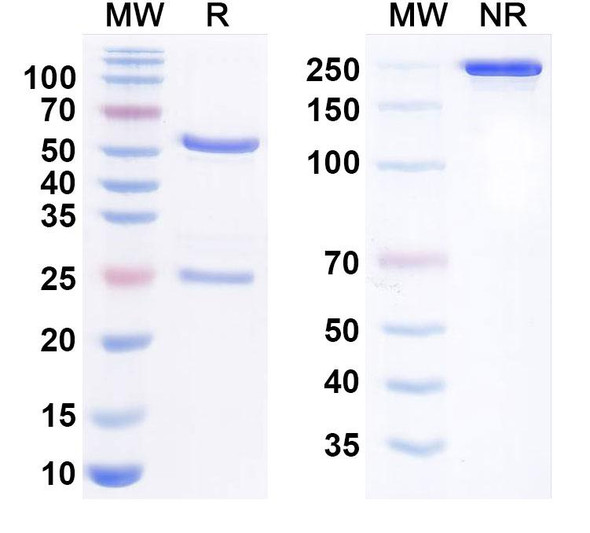
Anti-Human CD271/NGFR Monoclonal Antibody (1A633) is a mouse monoclonal antibody of isotype IgG. Immunogen: Mammalian cells - derived recombinant human CD271/NGFR (Met1-Asn250). Target: Tumor necrosis factor receptor superfamily member 16, Gp80-LNGFR, Low affinity neurotrophin receptor p75NTR, Low-affinity nerve growth factor receptor, NGF receptor, Low-affinity nerve growth factor receptor p75NGFR, Low-affinity nerve growth factor receptor p75NGR, p75 ICD, CD271, NGFR. Species reactivity: Human. Applications: ELISA, IHC, WB. Protein A/G purified from cell culture supernatant. Supplied as a liquid in 0.01M PBS, pH 7.4.
Tumor necrosis factor receptor superfamily member 16 (CD271/NGFR) is a ~45 kDa protein. Low affinity receptor which can bind to NGF, BDNF, NTF3, and NTF4. Forms a heterodimeric receptor with SORCS2 that binds the precursor forms of NGF, BDNF and NTF3 with high affinity, and has much lower affinity for mature NGF and BDNF. Plays an important role in differentiation and survival of specific neuronal populations during development. Can mediate cell survival as well as cell death of neural cells. Plays a role in the inactivation of RHOA.
Product Name:
Anti-Human CD271/NGFR Monoclonal Antibody (1A633)
Size:
50 µg, 100 µg
Product SKU:
GXMA00607
Target:
Tumor necrosis factor receptor superfamily member 16
Host Species:
Mouse
Antibody Type:
Monoclonal
Clone ID:
1A633
Reactivity:
Human
Buffer:
0.01M PBS pH 7.4.
Storage & Shipping:
Store at 2 to 8°C for frequent use. Store at -20 to -80°C for twelve months from the date of receipt.
Format:
Liquid
Applications:
ELISA, IHC, WB
Antibody Isotype:
IgG
Purity:
>95% as determined by SDS-PAGE.
Purification:
Protein A/G purified from cell culture supernatant.
Endotoxin Level:
< 10 EU/mg
Guarantee:
12 months
Immunogen:
Mammalian cells - derived recombinant human CD271/NGFR (Met1-Asn250).