Description
ATP6V1G3 Antibody (CAB14443)
The ATP6V1G3 Antibody (CAB14443) is a high-quality antibody developed for reliable detection and analysis of target proteins. This antibody, produced in rabbits, demonstrates high reactivity with human samples and has been validated for use in Western blot applications.ATP6V1G3 is essential for maintaining cellular functions by regulating the acidification of lysosomes and endosomes, which are critical for processes like autophagy and protein degradation. Dysregulation of ATP6V1G3 has been linked to various diseases, including cancer and neurodegenerative disorders, making it a promising target for therapeutic interventions.
This antibody is validated for use in WB, IHC-P, ELISA applications and has demonstrated reactivity against Mouse samples.
| Product Name: | ATP6V1G3 Antibody |
| SKU: | CAB14443 |
| Size: | 20μL, 100μL |
| Reactivity: | Mouse |
| Conjugate: | Unconjugated |
| Immunogen: | Recombinant protein (or fragment).This information is considered to be commercially sensitive. | ||||||
| Sequence: | MTSQ SQGI HQLL QAEK RAKD KLEE AKKR KGKR LKQA KEEA MVEI DQYR MQRD KEFR LKQS KIMG SQNN LSDE IEEQ TLGK IQEL NGHY NKYM ESVM NQLL SMVC DMKP EIHV NYRA TN | ||||||
| Tested Applications: | WB IHC-P ELISA | ||||||
| Recommended Dilution: |
| ||||||
| Synonyms: | Vma10, ATP6G3, ATP6V1G3 |
| Positive Sample: | Mouse kidney |
| Cellular Localization: | Cytosol, Plasma Membrane. |
| Calculated MW: | 14kDa |
| Observed MW: | 14kDa |
This gene encodes a component of vacuolar ATPase (V-ATPase), a multisubunit enzyme that mediates acidification of eukaryotic intracellular organelles. V-ATPase dependent organelle acidification is necessary for such intracellular processes as protein sorting, zymogen activation, receptor-mediated endocytosis, and synaptic vesicle proton gradient generation. V-ATPase is composed of a cytosolic V1 domain and a transmembrane V0 domain. The V1 domain consists of three A and three B subunits, two G subunits plus the C, D, E, F, and H subunits. The V1 domain contains the ATP catalytic site. The V0 domain consists of five different subunits: a, c, c', c'' and d. Additional isoforms of many of the V1 and V0 subunit proteins are encoded by multiple genes or alternatively spliced transcript variants. This gene encodes one of three G subunit proteins. Transcript variants encoding different isoforms have been found for this gene.
| Purification Method | Affinity purification |
| Gene ID | 127124 |
| RRID | AB_2761313 |
| Buffer Information | Store at -20℃. Avoid freeze / thaw cycles. Buffer: PBS with 0.01% thimerosal,50% glycerol,pH7.3. |
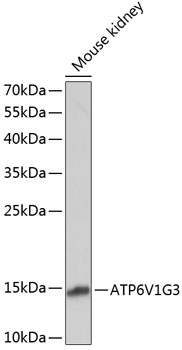 | Western blot analysis of lysates from mouse kidney, using ATP6V1G3 Rabbit pAb (CAB14443) at 1:1000 dilution. Secondary antibody: HRP-conjugated Goat anti-Rabbit IgG (H+L) (CABS014) at 1:10000 dilution. Lysates/proteins: 25μg per lane. Blocking buffer: 3% nonfat dry milk in TBST. Detection: ECL Basic Kit (AbGn00020). Exposure time: 90s. |
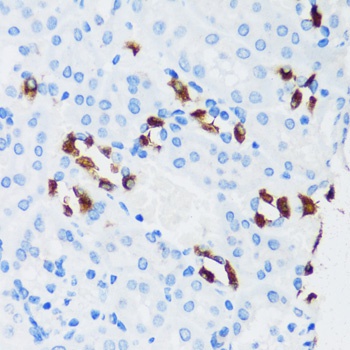 | Immunohistochemistry analysis of paraffin-embedded Mouse kidney using ATP6V1G3 Rabbit pAb (CAB14443) at dilution of 1:100 (40x lens). Microwave antigen retrieval performed with 0.01M PBS Buffer (pH 7.2) prior to IHC staining. |