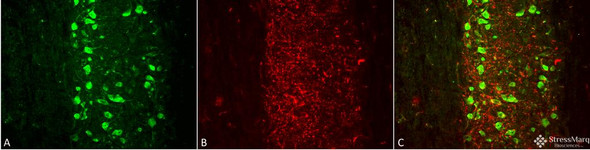
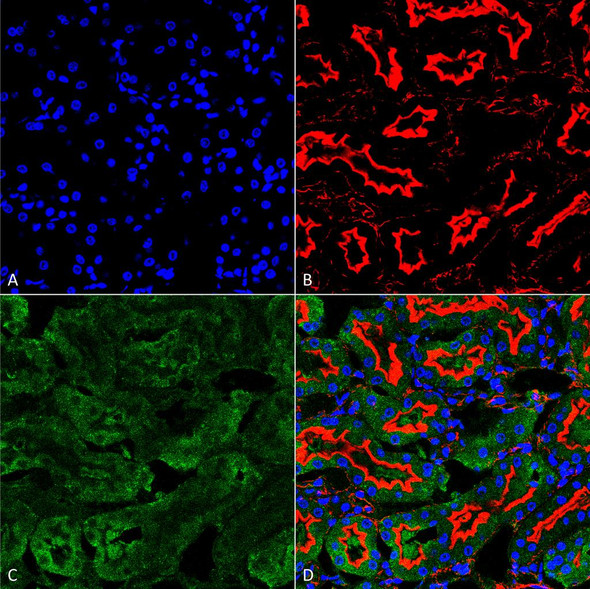
Immunocytochemistry/Immunofluorescence analysis using Mouse Anti-Cav3.1 Monoclonal Antibody, Clone N178A/9 (STMA00120). Tissue: Neuroblastoma cells (SH-SY5Y). Species: Human. Fixation: 4% PFA for 15 min. Primary Antibody: Mouse Anti-Cav3.1 Monoclonal Antibody (STMA00120) at 1:50 for overnight at 4°C with slow rocking. Secondary Antibody: AlexaFluor 488 at 1:1000 for 1 hour at RT.
Key Features
Anti-Cav3.1 Antibody [N178A/9 (Formerly sold as S178A-9)]
Cav3.1 Antibody [N178A/9 (Formerly sold as S178A-9)]
Cav3.1 Antibody [N178A/9 (Formerly sold as S178A-9)] is a mouse monoclonal antibody directed against Cav3.1, offered by Assay Genie for research applications. Reported applications include WB, IHC and ICC/IF. Reported reactivity: Human, Mouse and Rat. Supplied as IgG1, purified by Protein G.
Cav3.1, encoded by the CACNA1G gene, is a low-voltage-activated T-type calcium channel that plays a pivotal role in regulating neuronal excitability and rhythmic firing. Widely expressed across tissues, Cav3.1 is particularly important in the central nervous system, where it contributes to burst firing and oscillatory activity in thalamic and cortical neurons. In the heart, it may also participate in pacemaker currents, highlighting its physiological versatility. In the brain, Cav3.1 channels are considered secondary pacemakers, modulating sleep-wake cycles, sensory processing, and synaptic integration. Dysregulation of Cav3.1 activity has been implicated in a range of neurological and neurodegenerative disorders, including epilepsy, Parkinson’s disease, and essential tremor. Altered T-type calcium channel function may also contribute to cognitive decline and neuroinflammation, positioning Cav3.1 as a potential therapeutic target in age-related neurodegeneration. Pharmacological blockers of T-type calcium channels, including Cav3.1, are already used clinically as antihypertensives and antiepileptics. Emerging evidence suggests these channels may also mediate the effects of certain anesthetics and antipsychotics, further underscoring their relevance in neuropharmacology. Despite their clinical significance, many aspects of Cav3.1’s cellular localization, in vivo function, and disease-specific roles remain underexplored. Advancing our understanding of Cav3.1 could unlock new strategies for modulating calcium signaling in neurodegenerative disease. This antibody is also available conjugated to ATTO 390, ATTO 488, ATTO 594, APC, Biotin, FITC, HRP, PerCP and RPE. Supplied in 100 µg. For research use only; not for diagnostic or therapeutic procedures.
Product Name:
Cav3.1 Antibody [N178A/9 (Formerly sold as S178A-9)]
Product SKU:
STMA00120
Size:
100 µg
Target:
Cav3.1
Host Species:
Mouse
Antibody Type:
Monoclonal
Clone ID:
N178A/9 (Formerly sold as S178A-9)
Research Areas:
Neuroscience, Ion Channels, Calcium Channels, Voltage-Gated Calcium Channels
Buffer:
PBS pH7.4, 50% glycerol, 0.09% sodium azide
Storage & Shipping:
Store at -20°C. Shipped on Blue Ice or 4°C. Conjugated variants should be stored according to the product label.
Format:
Liquid
Applications:
WB, IHC, ICC/IF
Antibody Isotype:
IgG1
Purification:
Protein G Purified
Concentration:
1 mg/ml
Reactivity:
Human, Mouse, Rat
Recommended Dilution:
WB (1:1000), ICC/IF (1:100);optimal dilutions for assays should be determined by the user.
Specificity:
Detects ~<200kDa. Does not cross-react with Cav3.2.
Guarantee:
12 months from date of dispatch
Immunogen:
Fusion protein amino acids 2052-2172 (cytoplasmic C-terminus) of mouse Cav3.1
Immunogen Species:
Mouse
Accession Number:
NP_001106284.1
Gene ID:
1933-08-25 00:00:00
Swiss-Prot:
Q9WUT2
Cellular Localization:
Membrane
Alternative Names:
Voltage-dependent T-type calcium channel subunit alpha-1G, Cav3.1, CACNA1G, CAC1G_HUMAN, KIAA1123, CaV T1, Cav3 1, cav3 1c, MGC117234, NBR13, voltage gated calcium channel cav3.1, calcium channel voltage dependent alpha 1G subunit, calcium channel voltage dependent T type alpha 1G subunit, calcium channel voltage dependent T type alpha1G subunit, voltage dependent calcium channel alpha 1G subunit isoform 11, voltage dependent T type calcium channel subunit alpha 1G, Voltage gated calcium channel subunit alpha Cav3 1
References:
1. Perez-Reyes E. (2003). Physiol. Rev., 83: 117-161.