Description
SYBR Green qPCR master mix for challenging targets
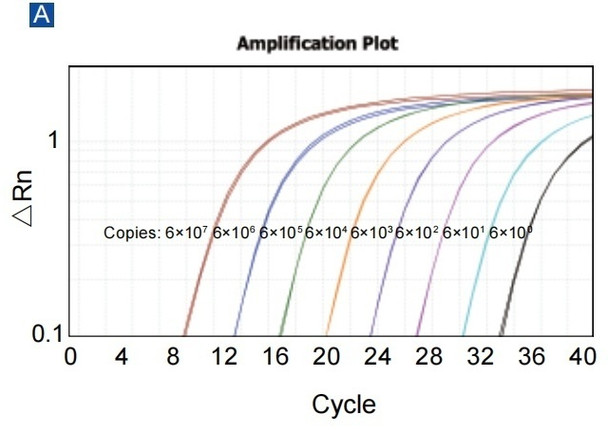
GenieQ Ultra SYBR qPCR Master Mix is a premium 2X SYBR Green master mix engineered for maximum sensitivity on low-abundance, degraded or high-GC templates, with strong inhibitor tolerance. It includes anti-contamination protection and universal ROX compatibility for demanding quantitative assays.
The mix is designed to capture signals from low-template, low-concentration and low-input samples with high stability. A built-in dUTP/heat-labile UDG system removes carry-over contamination at room temperature. The fully premixed formula keeps performance consistent even after reactions assembled with primers and template are stored for 72 hours. Just add primers, template and water to a 20 μl reaction and run a standard or fast two-step program with melting curve analysis. For research use only.
Key Features
| Low-abundance sensitivity | Captures low-template, low-concentration and low-input signals with high stability. | |
| Complex templates | Handles degraded samples and high-GC templates reliably in challenging experiments. | |
| Anti-contamination system | A dUTP/heat-labile UDG system eliminates carry-over contaminants at room temperature. | |
| Premixed stability | Performance stays consistent even after reactions mixed with primers and template are stored for 72 hours. |
Specifications
| Format | 2X SYBR Green qPCR master mix |
| Detection | SYBR Green dye with melting curve analysis |
| Contamination control | dUTP/heat-labile UDG system |
| Templates | DNA or cDNA, including low-abundance, degraded and high-GC templates |
| Reaction volume | 20 μl |
| Shelf life | 2 years |
Components
| Components | Amount |
| GenieQ Ultra SYBR qPCR Master Mix (2X) | 500 rxns / 2,500 rxns |
Storage
Store at -30 ~ -15°C.
- Prepare the reaction mixture
- Set up the following 20 μl reaction in a qPCR tube:
| Components | Volume |
| GenieQ Ultra SYBR qPCR Master Mix (2X) | 10.0 μl |
| Primer 1 (10 μM) | 0.4 μl |
| Primer 2 (10 μM) | 0.4 μl |
| Template DNA/cDNA | x μl |
| ddH2O | To 20.0 μl |
- A final primer concentration of 0.2 μM generally gives optimal amplification. If performance is suboptimal, adjust the primer concentration within 0.1–1.0 μM.
- Undiluted cDNA stock should not exceed 1/10 of the total qPCR reaction volume.
- Run the qPCR program
| Stage | Step | Reps | Temperature | Time |
| Stage 1 | Initial denaturationa | 1 | 95°C | 30 sec |
| Stage 2 | Cycles | 40 | 95°C | 3–10 secb |
| 60°C* | 10–30 secc | |||
| Stage 3 | Melting curved | Instrument default | Instrument default |
* Fluorescence signal acquisition.
a The standard initial denaturation suits most reactions. For templates with complex structures, extend it to 5 min.
b Use 10 sec for standard programs; in fast programs it can be as short as 3 sec.
c Standard programs typically use 30 sec. In fast programs, use as little as 10 sec for amplicons smaller than 200 bp; use 30 sec for amplicons over 200 bp.
d Melting curve programs vary between instruments; use the instrument's default program.
For more effective contamination removal, add a 37°C digestion step for 2 min (1 cycle) before initial denaturation.
- Optimise the reaction if needed
- An ideal reaction shows a single melting curve peak (specificity), amplification efficiency close to 100% (efficiency) and reasonable CT values (sensitivity). If the default conditions do not perform well, adjust as follows.
- To improve specificity, raise the annealing temperature in 3°C increments (e.g. two-step 95°C/10 sec, 60°C/30 sec → 95°C/10 sec, 63°C/30 sec).
- To improve efficiency, extend the extension time in the two-step program (95°C/10 sec, 60°C/30 sec → 95°C/10 sec, 60°C/60 sec) or use a three-step program (95°C/10 sec, 56°C/30 sec, 72°C/30 sec), extending the 72°C step to 60 sec if needed.
Q1: Why is my amplification curve abnormal?
- A curve that is not smooth usually reflects a weak signal that the system has corrected; increase the template concentration and repeat. A curve that breaks or declines occurs when the template concentration is too high and the baseline endpoint exceeds the CT value; reduce the baseline endpoint (CT value - 4) and reanalyse. A sudden drop in individual curves is caused by air bubbles; centrifuge samples properly and check for bubbles before the run.
Q2: What should I do if there is no amplification curve after the run?
- Check the number of cycles (typically 40; too many raises background and reduces reliability); confirm signal collection is set during the annealing-extension phase (two-step) or the 72°C extension phase (three-step); test old primers for degradation by PAGE; reduce template dilution, starting with the highest concentration for unknown samples; and re-prepare degraded template.
Q3: Why do CT values appear too late?
- Possible causes are very low amplification efficiency (optimise conditions, try the three-step program or redesign primers); template concentration too low (reduce dilution); template degradation (re-prepare template); PCR product too long (80–150 bp is recommended); or PCR inhibitors from the template (increase template dilution or re-prepare the template).
Q4: How can I improve a poor standard curve in absolute quantification?
- Reduce pipetting error by diluting the template further and increasing the pipetting volume; re-prepare degraded standard material; and increase the template dilution if the concentration is too high.
Q5: Why does the melting curve show multiple peaks?
- Poor primer design (redesign primers, optimising length, GC content and specificity); primer concentration too high (reduce it to prevent primer dimers and nonspecific binding); or genomic DNA in the cDNA template (re-prepare cDNA with thorough gDNA removal, e.g. a gDNA removal step or DNase treatment).
Q6: What causes poor reproducibility?
- Inaccurate pipetting (use a high-quality pipette and add more concentrated template for accurate volumes); uneven temperature control across the instrument block (calibrate the instrument regularly); and low template concentration (reduce template dilution or increase the volume added).