Description
Probe qPCR master mix
GenieQ Universal Probe qPCR Master Mix is a 2X master mix for probe-based (hydrolysis-probe) quantitative PCR. It gives specific, sensitive amplification across a wide dynamic range. Universal ROX compatibility suits most real-time platforms, and anti-contamination chemistry gives confident results.
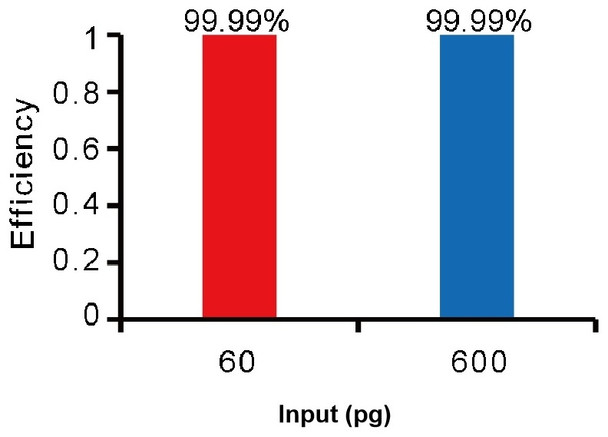
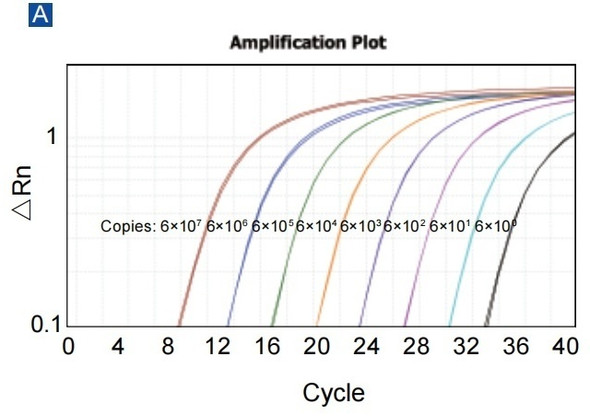
The core enzyme is a chemically modified hot-start Taq DNA polymerase. Combined with an optimised qPCR buffer, it suppresses non-specific amplification and improves amplification efficiency, which can reach 99%. Standard curves are linear over a wide quantitative range, with good repeatability. A specific ROX passive reference dye works on all qPCR instruments without adjusting its concentration. A dUTP/UDG system, active at room temperature, removes carryover amplicon contamination. The mix amplifies genomic DNA, cDNA, plasmid DNA and λDNA templates. For research use only.
Key Features
| High sensitivity | A hot-start Taq DNA polymerase gives superior amplification performance and sensitivity. | |
| Excellent linearity | Amplification efficiency can reach 99%. | |
| Reliable quantification | A dUTP/UDG anti-contamination system eliminates deviation caused by aerosol carryover. | |
| Universal ROX reference dye | A specific ROX dye suits almost all qPCR instruments with no adjustment. |
Specifications
| Format | 2X probe qPCR master mix |
| Detection chemistry | Hydrolysis (TaqMan) probe |
| Polymerase | Chemically modified hot-start Taq DNA polymerase |
| Reference dye | Universal ROX passive reference dye (no adjustment needed) |
| Anti-contamination | dUTP/heat-labile UDG system |
| Templates | Genomic DNA, cDNA, plasmid DNA, λDNA |
| Shelf life | 2 years |
Components
| Components | 500 rxns | 2,500 rxns |
| GenieQ Universal Probe qPCR Master Mix (2X)* | 4 × 1.25 ml | 5 × (4 × 1.25 ml) |
*Contains dNTP/dUTP mix, Mg2+, hot-start Taq DNA polymerase, heat-labile UDG and specific ROX reference dye. Reaction numbers are based on 20 μl reactions.
Storage
Store at -30 ~ -15°C.
- Prepare the reaction mixture in a qPCR tube
| Components | Volume |
| GenieQ Universal Probe qPCR Master Mix (2X) | 10 μl |
| Primer 1 (10 μM) | 0.4 μl |
| Primer 2 (10 μM) | 0.4 μl |
| TaqMan probe (10 μM) | 0.2 μl |
| Template DNA/cDNA | x μl |
| ddH2O | Up to 20 μl |
- A final primer concentration of 0.2 μM usually works well. If performance is poor, adjust within 0.1–1.0 μM.
- Adjust the final probe concentration within 50–250 nM. Do not use ROX-labelled probes.
- Template volume accuracy strongly affects results. Dilute the template before adding it to improve repeatability.
- Undiluted cDNA should be ≤1/10 of the total volume.
- Run the qPCR program (validated on an ABI StepOnePlus)
| Stage | Step | Temperature | Time | Cycles |
| 1 | Contamination digestion | 37°C | 2 min | 1 |
| 2 | Initial denaturationa | 95°C | 5 min | 1 |
| 3 | Denaturation | 95°C | 10 sec | 45 |
| 3 | Annealing/extensionb | 60°C | 30 sec | 45 |
a The hot-start polymerase needs heat activation: use at least 5 min at 95°C. For GC-rich templates, extend to 10 min.
b Set the extension time to the instrument's minimum data-acquisition time: ≥30 sec for ABI 7700 and 7900HT; ≥31 sec for ABI 7000 and 7300; ≥34 sec for ABI 7500; ≥10 sec for ABI StepOnePlus.
Primer design
- Length 17–25 bp; GC content 40%–60% (optimum 45%–55%); Tm >60°C.
- Keep base distribution even and avoid GC- or AT-rich regions, especially at the 3' end. Avoid runs of consecutive T/C or A/G.
- No more than two G or C in the last five bases at the 3' end.
- Place one primer as close as possible to the probe without overlapping it.
Probe design
- Place the probe as close as possible to the forward or reverse primer, without overlap.
- Length typically 18–40 bp; avoid runs of identical bases, especially four or more G; avoid G at the 5' end.
- Probe annealing temperature 65 ~ 67°C.
Q1: Why does my amplification plot have an abnormal shape?
- A rough plot means the signal is too weak, so increase template concentration. A broken or downward plot means the template is too concentrated and the baseline endpoint exceeds the Ct; set the baseline endpoint to Ct - 4 and re-analyse. A sudden drop usually means bubbles: centrifuge the tubes and check for bubbles before running.
Q2: What should I do if there is no amplification plot?
- Use 45 cycles (more raises background); make sure signal acquisition is set at the annealing/extension step (two-step) or the 72°C extension step (three-step); check old primers for degradation by PAGE; reduce the template dilution, starting unknown samples at the highest concentration; and prepare fresh template if it may be degraded.
Q3: Why do Ct values appear late?
- Possible causes are low amplification efficiency (optimise the reaction, try a three-step program or redesign primers); low or degraded template; products that are too long (80–150 bp is recommended); or PCR inhibitors carried over with the template (increase the dilution or re-prepare the template).
Q4: Why is there amplification in the negative control?
- The reaction is contaminated. Repeat with fresh master mix, ddH2O and primers.
Q5: How can I improve standard curve linearity in absolute quantification?
- Increase the template dilution factor and loading volume to reduce pipetting error, prepare fresh standards if they may be degraded, and dilute templates that are too concentrated.
Q6: How can I improve repeatability?
- Use a high-performance pipette, increase the template dilution factor and loading volume, calibrate the qPCR instrument regularly, and avoid very low template concentrations.