Description
SYBR Green qPCR master mix
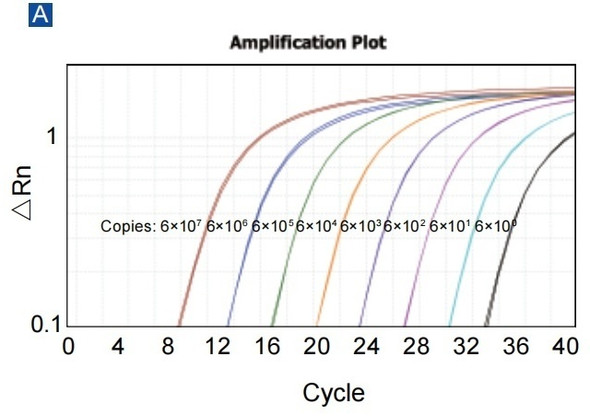
GenieQ Universal SYBR qPCR Master Mix is a 2X SYBR Green master mix for routine, sensitive real-time PCR, with high amplification efficiency and a broad linear dynamic range. A universal ROX reference dye supports all qPCR instruments, and hot-start chemistry reduces non-specific products, so even low-expression genes are detected reliably.
The core enzyme, GenieQ Hot-Start DNA Polymerase, is an antibody-modified hot-start polymerase with strong specificity, high sensitivity and high yield. Combined with a qPCR-optimised buffer and a specificity-enhancing factor, it gives bright fluorescence and smooth amplification curves. The mix contains dNTPs, Mg2+, polymerase, SYBR Green I and ROX reference dye: just add primers and template. It quantifies DNA from all species, including genomic DNA, cDNA, plasmid DNA and λDNA. For research use only.
Key Features
| Detects low-expression genes | Antibody-modified hot-start polymerase and a specificity-enhancing factor give strong amplification and high sensitivity. | |
| Universal ROX reference | Works on all qPCR instruments without adjusting the ROX concentration. | |
| High fluorescence intensity | Greatly improved signal gives clean, well-shaped amplification curves. | |
| Ready to use | 2X premix needs only primers and template. |
Specifications
| Method | SYBR Green I dye-based qPCR |
| Format | 2X master mix (dNTPs, Mg2+, hot-start DNA polymerase, SYBR Green I, ROX reference dye) |
| Reaction volume | 20 μl |
| Instrument compatibility | All qPCR instruments (universal ROX, no adjustment needed) |
| Templates | Genomic DNA, cDNA, plasmid DNA, λDNA and other DNA from all species |
| Shelf life | 2 years |
Components
| Components | 500 rxns | 2,500 rxns |
| GenieQ Universal SYBR qPCR Master Mix (2X)* | 4 × 1.25 ml | 20 × 1.25 ml |
*Contains dNTPs, Mg2+, GenieQ Hot-Start DNA Polymerase, SYBR Green I and ROX reference dye. Reaction numbers are based on 20 μl reactions.
Storage
Store at -30 ~ -15°C.
- Prepare the reaction mixture
- Set up the following 20 μl reaction in a qPCR tube:
| Components | Volume |
| GenieQ Universal SYBR qPCR Master Mix (2X) | 10.0 μl |
| Primer 1 (10 μM) | 0.4 μl |
| Primer 2 (10 μM) | 0.4 μl |
| Template DNA/cDNA | x μl |
| ddH2O | To 20.0 μl |
- A final primer concentration of 0.2 μM usually works well. If performance is poor, adjust within 0.1–1.0 μM.
- Template volume strongly affects qPCR results. Dilute the template before adding it to improve repeatability.
- Keep undiluted cDNA template ≤1/10 of the total volume.
- Run the qPCR program
| Stage | Step | Reps | Temperature | Time |
| Stage 1 | Initial denaturationa | 1 | 95°C | 30 sec |
| Stage 2 | Cycling reaction | 40 | 95°C 60°C | 3–10 secb 10–30 secc |
| Stage 3 | Melting curved | 1 | Instrument default | Instrument default |
a Suitable for most reactions. For templates with complex structure, extend to 3 min.
b Standard program: 10 sec; fast program: 3 sec.
c Standard program: 30 sec. Fast program: as short as 10 sec for amplicons ≤200 bp; 30 sec for amplicons >200 bp.
d Melting curve acquisition differs between instruments; use the instrument's default settings.
Q1: Why does my amplification plot have an abnormal shape?
- A rough plot means the signal is too weak: increase the template concentration. A broken or downward plot means the template concentration is too high and the baseline end point exceeds the Ct value: set the baseline end point to Ct - 4 and reanalyse. A plot that drops suddenly indicates bubbles: centrifuge and check tubes for bubbles before running.
Q2: What should I do if there is no amplification plot?
- Check that enough cycles are set (usually 40; too many raise background); confirm signal acquisition is set at the annealing/extension step (two-step) or at the 72°C extension (three-step); check old primers for degradation by PAGE; reduce the template dilution factor (start unknown samples at the highest concentration); and prepare fresh template if it may be degraded.
Q3: Why do Ct values appear too late?
- Possible causes are low amplification efficiency (optimise the system, try a three-step program or redesign primers), low template concentration (reduce the dilution factor), degraded template (prepare fresh template), long amplicons (80–150 bp is recommended) and PCR inhibitors carried over with the template (increase the dilution factor or prepare new template).
Q4: Why is there amplification in the negative control?
- The reaction may be contaminated: replace the mix, ddH2O and primers and prepare reactions in a clean bench. Primer dimers may also be the cause; check the melting curve.
Q5: Why is the standard curve not linear in absolute quantification?
- Pipetting deviations (increase the template dilution factor and pipetting volume), degraded standards (prepare new standards) or too high a template concentration (increase the dilution factor).
Q6: Why does the melting curve show multiple peaks?
- Primer design may be unsuitable (redesign primers), primer concentration may be too high (reduce it) or the cDNA may contain genomic DNA (prepare new cDNA).
Q7: How can I improve repeatability?
- Use a higher-performance pipette, increase the template dilution factor and loading volume; calibrate the instrument regularly to minimise well-to-well temperature differences; and avoid very low template concentrations by reducing the dilution factor or increasing the sample volume.