Description
GenieZol Total RNA Extraction Reagent
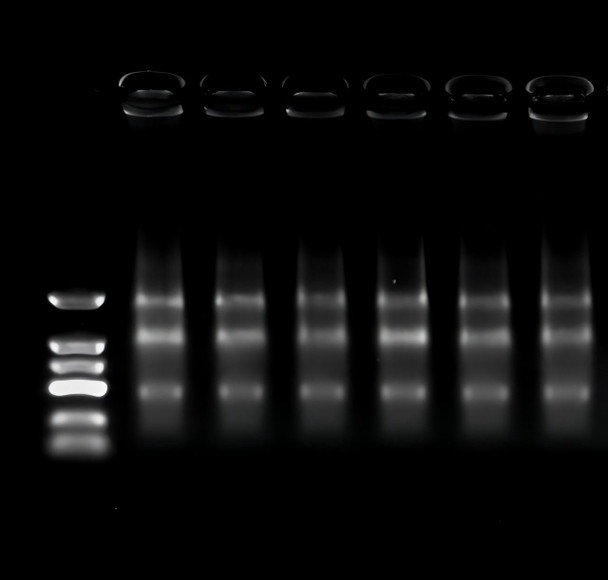
GenieZol Total RNA Extraction Reagent is a monophasic guanidinium-thiocyanate and phenol solution for single-step isolation of high-quality total RNA from animal and plant tissues, cultured cells and bacterial samples. It rapidly lyses samples while inhibiting endogenous RNases, preserving the integrity of the recovered RNA.
After the addition of chloroform and centrifugation, the sample separates into a lower organic phase, an interphase and an upper aqueous phase; total RNA partitions into the aqueous phase and is recovered by isopropanol precipitation. A built-in indicator turns the lower phase pink after separation, making the aqueous layer easy to collect cleanly. RNA prepared this way is high in purity and largely free of protein and genomic DNA.
| Product Name: | GenieZol Total RNA Extraction Reagent |
| Brand: | GenieZol |
| Product type: | Total RNA extraction reagent (guanidinium/phenol) |
| Sample types: | Animal & plant tissues, cultured cells, bacteria |
| Typical processing time: | about 1 hour |
| Hazard note: | Contains phenol and guanidine salts - corrosive/toxic. Handle in a fume hood with appropriate PPE. |
| Storage: | Store at 2-8 C, protected from light. |
| Shipping: | Ships at ambient temperature. |
| Available sizes: | 100 ml, 250 ml |
- High yield, high purity and good integrity - total RNA in as little as about 1 hour.
- Colour indicator makes phase separation and aqueous-phase collection easy.
- Sensitive enough for viral and other low-input samples.
- Flexible input: works with small (50-100 mg tissue / 5x10^6 cells) through to large (over 1 g / over 10^7 cells) samples.
- Total RNA isolation for RT-PCR and qPCR
- Northern blotting and dot hybridisation
- mRNA purification and poly(A)+ selection
- RNase protection assays, in-vitro translation and cDNA library construction
| Step | Procedure |
| 1 | Homogenise or lyse the sample directly in GenieZol reagent (approximately 1 ml per 50-100 mg tissue or 5-10 x10^6 cells). |
| 2 | Incubate briefly at room temperature to allow complete dissociation of nucleoprotein complexes. |
| 3 | Add chloroform, shake, and centrifuge to separate the phases; the lower phase turns pink. |
| 4 | Transfer the upper aqueous phase to a fresh tube and precipitate RNA with isopropanol. |
| 5 | Wash the RNA pellet with 75% ethanol, air-dry briefly, and dissolve in RNase-free water. |
Note: Always work in a fume hood with gloves and eye protection. Keep samples cold and use RNase-free consumables throughout to protect RNA integrity.
What sample types is GenieZol suitable for?
It works with a broad range of inputs - animal and plant tissues, cultured cells and bacteria - from small biopsies to gram-scale tissue.
How does the colour indicator help?
After chloroform addition and centrifugation the lower organic phase turns pink, so the RNA-containing upper aqueous phase is easy to identify and pipette without disturbing the interphase.
Is any special handling required?
Yes. The reagent contains phenol and guanidine salts, so it should be used in a fume hood with gloves and eye protection, and disposed of as hazardous waste.
Can I recover DNA and protein as well?
The organic phase and interphase retain DNA and protein, which can be recovered by sequential precipitation if needed.