Description
Human SUMO1 Recombinant Protein (N-His)
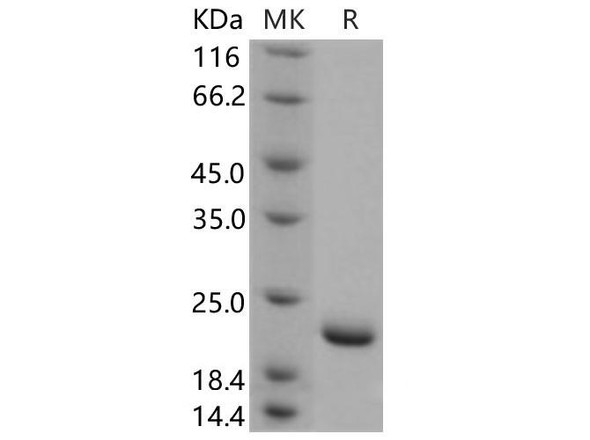
Human SUMO1 Recombinant Protein (N-His) is a recombinant protein expressed in E. coli, spanning Met1-Val101, with an N-terminal His tag. Predicted molecular weight: 13.72 kDa. Purity: >95% as determined by SDS-PAGE. Supplied lyophilized from a solution in PBS pH 7.4, 0.02% NLS, 1 mM EDTA, 4% Trehalose, 1% Mannitol. Applications: ELISA, immunogen, SDS-PAGE and Western blot. Small ubiquitin-related modifier 1 (SUMO1) is a ~11 kDa protein. Ubiquitin-like protein that can be covalently attached to proteins as a monomer or a lysine-linked polymer. For research use only.
Covalent attachment via an isopeptide bond to its substrates requires prior activation by the E1 complex SAE1-SAE2 and linkage to the E2 enzyme UBE2I, and can be promoted by E3 ligases such as PIAS1-4, RANBP2 or CBX4. This post-translational modification on lysine residues of proteins plays a crucial role in a number of cellular processes such as nuclear transport, DNA replication and repair, mitosis and signal transduction. Involved for instance in targeting RANGAP1 to the nuclear pore complex protein RANBP2. Covalently attached to the voltage-gated potassium channel KCNB1; this modulates the gating characteristics of KCNB1.
| Product Name: | Human SUMO1 Recombinant Protein (N-His) |
| SKU: | GXRP01920 |
| Size: | 50 µg, 100 µg, 1 mg |
| Species: | Human |
| Synonyms: | SUMO-1, SMT3C, SMT3H3, Sentrin, GMP1, Ubiquitin-like protein UBL1, UBL1, Small ubiquitin-related modifier 1, Ubiquitin-homology domain protein PIC1, SUMO1, Ubiquitin-like protein SMT3C, SMT3 homolog 3, Smt3C, GAP-modifying protein 1 |
| Tag: | N-His |
| Expression Host: | E. coli |
| Protein Length: | Met1-Val101 |
| Calculated MW: | 13.72 kDa |
| UniProt: | P63165 |
| Applications: | ELISA, Immunogen, SDS-PAGE, WB |
| Purity: | >95% as determined by SDS-PAGE. |
| Form: | Lyophilized |
| Formulation: | Lyophilized from a solution in PBS pH 7.4, 0.02% NLS, 1 mM EDTA, 4% Trehalose, 1% Mannitol. |
| Reconstitution: | Reconstitute in sterile water for a stock solution. Adjust the volume of sterile water so that, after reconstitution, the final stock concentration matches the value indicated on the product label or datasheet. |
| Storage: | Store at 2 to 8°C for frequent use. Store at -20 to -80°C for twelve months from the date of receipt. |
| Shipping: | In general, proteins are provided as lyophilized powder/frozen liquid. They are shipped out with dry ice/blue ice unless customers require otherwise. |
| Note: | For research use only. |