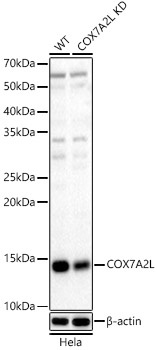
The [KD Validated] COX7A2L Polyclonal Antibody (CAB23681) is a high-quality antibody developed for reliable detection and analysis of target proteins. This antibody, produced in rabbits, specifically recognizes the human Cox7a2l protein and has been validated for use in Western blot applications. By binding to Cox7a2l, this antibody allows for accurate detection and analysis of the protein in various cell types, making it a valuable asset for studies in bioenergetics, metabolism, and mitochondrial dysfunction.Cox7a2l is a crucial component of the mitochondrial respiratory chain, playing a key role in electron transport and oxidative phosphorylation processes.
This antibody is validated for use in WB, ELISA applications and has demonstrated reactivity against Human samples.
Product Name:
[KD Validated] COX7A2L Polyclonal Antibody
SKU:
CAB23681
Size:
20μL, 100μL
Reactivity:
Human
Conjugate:
Unconjugated
Immunogen:
Recombinant protein (or fragment).This information is considered to be commercially sensitive.
Cytochrome c oxidase (COX), the terminal component of the mitochondrial respiratory chain, catalyzes the electron transfer from reduced cytochrome c to oxygen. This component is a heteromeric complex consisting of 3 catalytic subunits encoded by mitochondrial genes and multiple structural subunits encoded by nuclear genes. The mitochondrially-encoded subunits function in electron transfer, and the nuclear-encoded subunits may function in the regulation and assembly of the complex. This nuclear gene encodes a protein similar to polypeptides 1 and 2 of subunit VIIa in the C-terminal region, and also highly similar to the mouse Sig81 protein sequence. This gene is expressed in all tissues, and upregulated in a breast cancer cell line after estrogen treatment. It is possible that this gene represents a regulatory subunit of COX and mediates the higher level of energy production in target cells by estrogen. Several transcript variants, some protein-coding and others non-protein coding, have been found for this gene.
Purification Method
Affinity purification
Gene ID
9167
Buffer Information
Store at -20℃. Avoid freeze / thaw cycles. Buffer: PBS containing 50% glycerol, preserved with proclin300 or sodium azide, pH 7.3.
Western blot analysis of lysates from wild type(WT) and COX7A2L knockdown (KD) HeLa cells, using [KD Validated] COX7A2L Rabbit pAb (CAB23681) at 1:2000 dilution. Secondary antibody: HRP-conjugated Goat anti-Rabbit IgG (H+L) (CABS014) at 1:10000 dilution. Lysates/proteins: 25μg per lane. Blocking buffer: 3% nonfat dry milk in TBST. Detection: ECL Basic Kit (AbGn00020). Exposure time: 60s.