Description
Lysyl Oxidase Activity Assay Kit (Fluorometric)
Lysyl oxidase (LOX) is an enzyme that has a role in the formation and maintenance of the extracellular matrix with significant implications for metabolic health. A copper-dependent amine oxidase, LOX is primarily secreted by smooth muscle cells and fibroblasts, catalyzing the crosslinking of collagen and elastin fibers. Initially recognized for its structural functions, recent research has unveiled correlations between LOX activity and various physiological and pathological processes, including adipose tissue function, glucose metabolism and type 2 diabetes, fibrosis in several tissues and cardiovascular health.
Inhibition of LOX has shown promise in animal models for reducing metastasis and improving metabolic outcomes but, given the essential nature of LOX in normal tissue development and function, consideration must be given to potential side effects of LOX modulation. Assay Genie's Lysyl Oxidase Activity Assay Kit is a simple, sensitive means of measuring LOX activity with a sensitivity below 5 µUnits per well.
| Product Name: | Lysyl Oxidase Activity Assay Kit (Fluorometric) |
| SKU: | ARMA00229 |
| Size: | 100 Wells |
| Product Type: | Assay Kit |
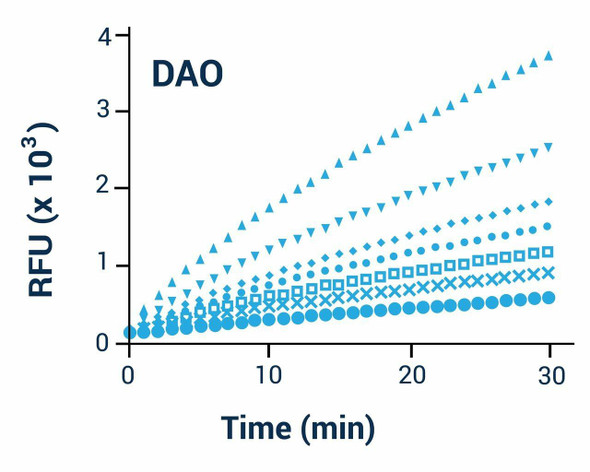
| Detection Method: | Fluorometric (Ex/Em = 535/587 nm), measured kinetically |
| Sensitivity: | Below 5 µUnits per well |
| Sample Type: | Cell extracts and cell culture media |
| Storage: | Store unopened kit at -20°C. Bring all components to room temperature before using. |
- Measures lysyl oxidase (LOX) activity with a sensitivity below 5 µUnits per well.
- Fluorometric detection (Ex/Em = 535/587 nm), measured kinetically.
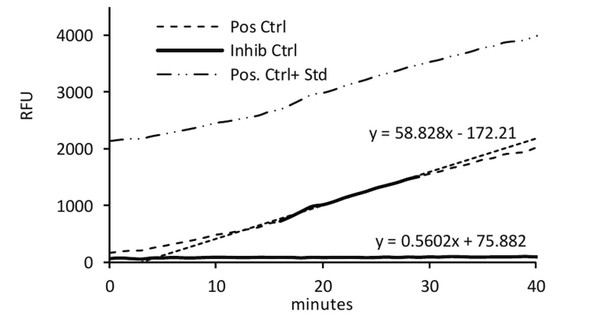
- Internal standard protocol to account for sample matrix effects – no separate standard curve required.
- Includes Active LOX positive control and LOX Inhibitor for background control.
- Suitable for cell extracts and cell culture media.
- 100 wells.
In the presence of lysyl oxidase activity, hydrogen peroxide is formed during substrate oxidation. The hydrogen peroxide produced is utilized by peroxidase to convert ADHP, an almost colorless, non-fluorescent compound, into resorufin with a dramatic increase in color and fluorescence.
| Component | Size | Cap Colour |
| Assay Buffer | 45 ml | NM |
| Diaminopentane | 100 µl | Clear |
| Peroxidase | Lyophilized | Green |
| ADHP Solution | 100 µl | Red |
| Active LOX | Lyophilized | Blue |
| LOX Inhibitor | Lyophilized | Purple |
| H2O2 | 100 µl | Yellow |
*Note:The below protocol is a sample protocol. Protocols are specific to each batch/lot. For the correct instructions please follow the protocol included in your kit.
| Step | Protocol |
| 1. | Plate Reader Setup: Set the reader to 37°C and configure it to measure fluorescence at Ex/Em = 535/587 nm every 30-60 seconds for 60 minutes. Warm Assay Buffer to 37°C. |
| 2. | Samples: Apply up to 48 µl of each sample (up to 10 µl cell culture media, maximum) to a preferably black 96-well plate in triplicate and adjust the volume to 48 µl with Assay Buffer. Do not use media containing serum or phenol red as each interferes with the assay. |
| 3. | Positive Control: Add 3 µl of Active LOX to a well and adjust the volume to 50 µl with Assay Buffer. |
| 4. | Internal Standard and Background Control: Transfer 2 µl of diluted 75 µM H2O2 to one well of each sample triad and 2 µl of LOX Inhibitor to another, so each sample is present as sample only, sample + internal standard and sample + LOX Inhibitor. |
| 5. | Initiate Reaction: Add 50 µl of Reaction Mix (46.5 µl Assay Buffer, 1.0 µl Diaminopentane, 2.0 µl Peroxidase, 0.5 µl ADHP Solution per well) to every sample, control and positive control well. |
| 6. | Measurement: Place the plate in the plate reader and begin measuring fluorescence as set up in step 1. |