The NDUFA5 Antibody (CAB3976) is a high-quality antibody developed for reliable detection and analysis of target proteins. This antibody, produced in rabbits, is highly specific for human samples and is ideal for use in Western blot applications. By targeting the NDUFA5 protein, this antibody enables accurate detection and analysis in various cell types, making it essential for investigations in areas such as mitochondrial function, energy metabolism, and cellular respiration.The NDUFA5 protein is critical for electron transport and ATP production in the mitochondria, making it a key player in cellular energy metabolism. Dysregulation of NDUFA5 has been linked to various diseases, including mitochondrial disorders and neurodegenerative conditions.
This antibody is validated for use in WB, ELISA applications and has demonstrated reactivity against Human, Mouse, Rat samples.
Product Name:
NDUFA5 Antibody
SKU:
CAB3976
Size:
20μL, 100μL
Reactivity:
Human, Mouse, Rat
Conjugate:
Unconjugated
Immunogen:
Recombinant protein (or fragment).This information is considered to be commercially sensitive.
This nuclear gene encodes a conserved protein that comprises the B13 subunit of complex I of the mitochondrial respiratory chain. The encoded protein localizes to the inner mitochondrial membrane, where it is thought to aid in the transfer of electrons from NADH to ubiquinone. Alternative splicing results in multiple transcript variants. There are numerous pseudogenes of this gene on chromosomes 1, 3, 6, 8, 9, 11, 12, and 16.
Purification Method
Affinity purification
Gene ID
4698
RRID
AB_2765424
Buffer Information
Store at -20℃. Avoid freeze / thaw cycles. Buffer: PBS containing 50% glycerol, preserved with proclin300 or sodium azide, pH 7.3.
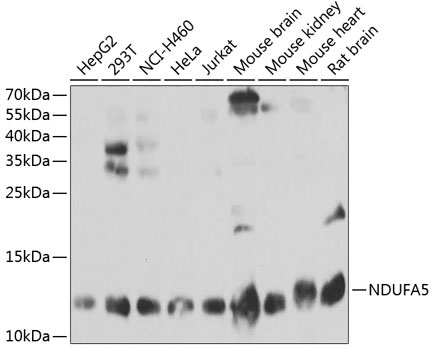
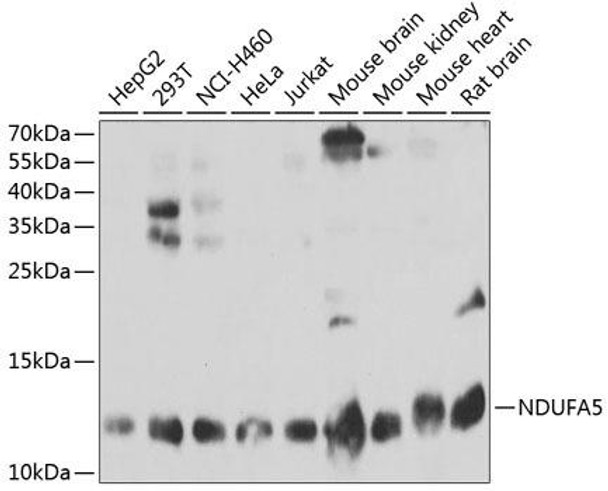
Western blot analysis of various lysates using NDUFA5 Rabbit pAb (CAB3976) at 1:1000 dilution. Secondary antibody: HRP-conjugated Goat anti-Rabbit IgG (H+L) (CABS014) at 1:10000 dilution. Lysates/proteins: 25μg per lane. Blocking buffer: 3% nonfat dry milk in TBST. Detection: ECL Basic Kit (AbGn00020). Exposure time: 60s.