The PE-Cyanine7 Anti-Mouse CD3 Antibody (17A2) from Assay Genie is a potent tool for studying immune responses in mouse models. This antibody specifically targets the CD3 protein, a crucial component of the T-cell receptor complex. By binding to CD3, this antibody allows for the detection and analysis of T-cell populations in various tissues and experimental conditions.The PE-Cyanine7 conjugate provides bright and stable fluorescence for flow cytometry applications, enabling precise identification and characterization of CD3-positive T cells.
With high specificity and sensitivity, this antibody is ideal for investigating T-cell activation, differentiation, and function in immunology research.Researchers studying immune responses, autoimmune diseases, transplantation, and infectious diseases will benefit from the reliable performance of the PE-Cyanine7 Anti-Mouse CD3 Antibody (17A2). Its versatility and compatibility with multiple research techniques make it a valuable tool for advancing our understanding of T-cell biology and immunological processes in mice.
Product Title:
PE/Cyanine7 Anti-Mouse CD3 Antibody [17A2]
SKU:
AGEL2148
Size:
50 Tests, 100 Tests, 200 Tests
Clone No:
17A2
Synonyms:
T-cell surface glycoprotein CD 3epsilon/delta/gamma/zeta chain;CD3E/D/G/Z;CD3e/d/g/z;CD3E/D/G/Z;CD3;
Host Species:
Rat
Reactivity:
Mouse
Application:
FCM
Isotype:
Rat IgG2b, κ
Isotype Control:
PE/Cyanine7 Rat IgG2b, κ Isotype Control[LTF-2]
Form:
Liquid
Conjugation:
PE/Cyanine 7
Recommended Use:
Each lot of this antibody is quality control tested by flow cytometric analysis. The amount of the reagent is suggested to be used 5 µL of antibody per test (million cells in 100 µL staining volume or per 100 µL of whole blood). Please check your vial before the experiment. Since applications vary, the appropriate dilutions must be determined for individual use.
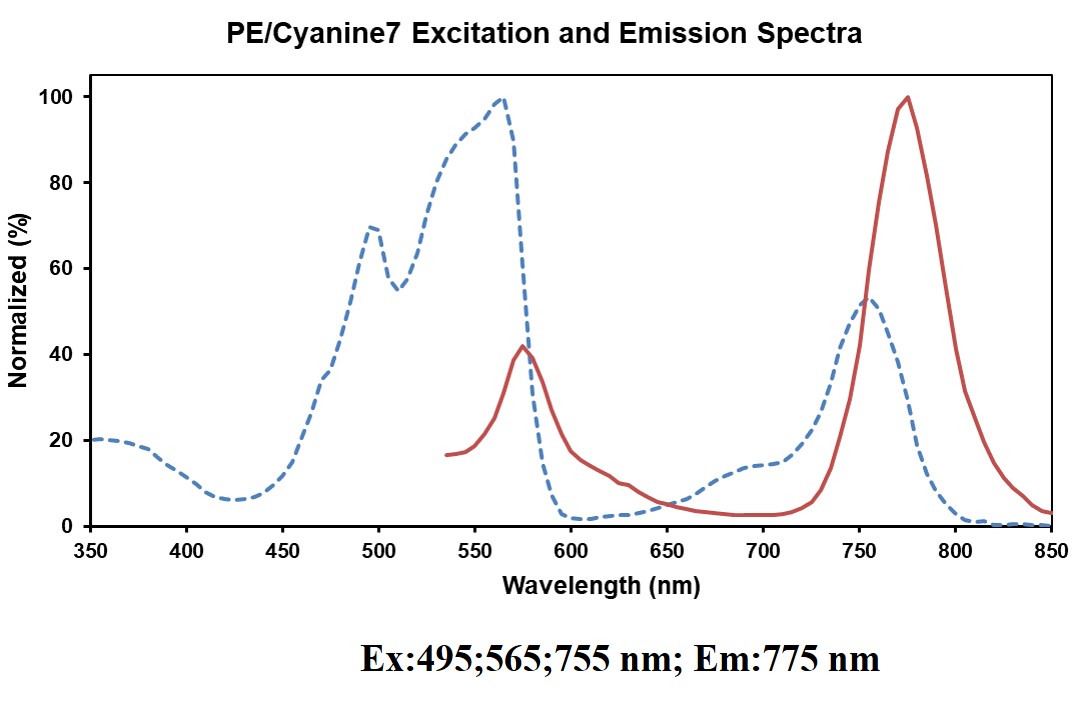
Spectrum:
Swissprot:
P04235 P11942 P22646 P24161
Gene ID:
12502
Storage Buffer:
Phosphate buffered solution, pH 7.2, containing 0.09% stabilizer and 1% protein protectant.
Stability & Storage:
Keep as concentrated solution. Store at 2~8°C and protected from prolonged exposure to light. Do not freeze. Centrifuge before opening to ensure complete recovery of vial contents. This product is guaranteed up to one year from purchase.
Background:
CD3, also known as T3, is a member of the Ig superfamily and primarily expressed on T cells, NK-T cells, and at different levels on thymocytes during T cell differentiation. CD3 is composed of CD3ε, δ, γ and ζ chains. It forms a TCR complex by associating with TCR α/β or γ/δ chains. CD3 plays a critical role in TCR signal transduction, T cell activation, and antigen recognition by binding the peptide/MHC antigen complex.

![PE/Cyanine7 Anti-Mouse CD3 Antibody [17A2] (AGEL2148)](https://cdn11.bigcommerce.com/s-h68l9z2lnx/images/stencil/1280x1280/products/229608/605051/pecyanine7-anti-mouse-cd3-antibody-17a2-agel2148__51020.1706889176.jpg?c=2?imbypass=on "PE/Cyanine7 Anti-Mouse CD3 Antibody [17A2] (AGEL2148)")
![PE/Cyanine7 Anti-Mouse CD3 Antibody [17A2] (AGEL2148)](https://cdn11.bigcommerce.com/s-h68l9z2lnx/images/stencil/608x608/products/229608/605051/pecyanine7-anti-mouse-cd3-antibody-17a2-agel2148__51020.1706889176.jpg?c=2 "PE/Cyanine7 Anti-Mouse CD3 Antibody [17A2] (AGEL2148)")
![PE/Cyanine7 Anti-Mouse CD3 Antibody [17A2] (AGEL0660)](https://cdn11.bigcommerce.com/s-h68l9z2lnx/images/stencil/590x590/products/237390/618651/pecyanine7-anti-mouse-cd3-antibody-17a2-agel0660__03773.1733541885.jpg?c=2 "PE/Cyanine7 Anti-Mouse CD3 Antibody [17A2] (AGEL0660)")
![PE/Cyanine7 Anti-Mouse CD3 Antibody [17A2] (AGEL0660)](https://cdn11.bigcommerce.com/s-h68l9z2lnx/images/stencil/590x590/products/237390/753323/pecyanine7-anti-mouse-cd3-antibody-17a2-agel0660__89004.1785060204.jpg?c=2 "PE/Cyanine7 Anti-Mouse CD3 Antibody [17A2] (AGEL0660)")
![PE Anti-Mouse CD3 Antibody [17A2] (AGEL0099)](https://cdn11.bigcommerce.com/s-h68l9z2lnx/images/stencil/590x590/products/237205/618646/pe-anti-mouse-cd3-antibody-17a2-agel0099__64208.1733541881.jpg?c=2 "PE Anti-Mouse CD3 Antibody [17A2] (AGEL0099)")
![PE Anti-Mouse CD3 Antibody [17A2] (AGEL0099)](https://cdn11.bigcommerce.com/s-h68l9z2lnx/images/stencil/590x590/products/237205/753838/pe-anti-mouse-cd3-antibody-17a2-agel0099__10847.1785061781.jpg?c=2 "PE Anti-Mouse CD3 Antibody [17A2] (AGEL0099)")
![PE Anti-Mouse CD3 Antibody [17A2] (AGEL0656)](https://cdn11.bigcommerce.com/s-h68l9z2lnx/images/stencil/590x590/products/21187/606295/pe-anti-mouse-cd3-antibody-17a2-agel0656__10023.1707497580.jpg?c=2 "PE Anti-Mouse CD3 Antibody [17A2] (AGEL0656)")
![PE Anti-Mouse CD3 Antibody [17A2] (AGEL0656)](https://cdn11.bigcommerce.com/s-h68l9z2lnx/images/stencil/590x590/products/21187/767271/pe-anti-mouse-cd3-antibody-17a2-agel0656__04536.1785530734.jpg?c=2 "PE Anti-Mouse CD3 Antibody [17A2] (AGEL0656)")
![PE/Cyanine5.5 Anti-Mouse CD3 Antibody [17A2] (AGEL0661)](https://cdn11.bigcommerce.com/s-h68l9z2lnx/images/stencil/590x590/products/21192/606273/pecyanine5.5-anti-mouse-cd3-antibody-17a2-agel0661__86804.1707497479.jpg?c=2 "PE/Cyanine5.5 Anti-Mouse CD3 Antibody [17A2] (AGEL0661)")
![PE/Cyanine5.5 Anti-Mouse CD3 Antibody [17A2] (AGEL0661)](https://cdn11.bigcommerce.com/s-h68l9z2lnx/images/stencil/590x590/products/21192/761303/pecyanine5.5-anti-mouse-cd3-antibody-17a2-agel0661__11510.1785511898.jpg?c=2 "PE/Cyanine5.5 Anti-Mouse CD3 Antibody [17A2] (AGEL0661)")
![PE/Cyanine5.5 Anti-Mouse CD3 Antibody [17A2] (AGEL2149)](https://cdn11.bigcommerce.com/s-h68l9z2lnx/images/stencil/590x590/products/229609/605026/pecyanine5.5-anti-mouse-cd3-antibody-17a2-agel2149__56231.1706889073.jpg?c=2 "PE/Cyanine5.5 Anti-Mouse CD3 Antibody [17A2] (AGEL2149)")