The Phospho-beta-Catenin-S675 Antibody (CABP0795) is a high-quality antibody developed for reliable detection and analysis of target proteins. This antibody, generated in rabbits, is ideal for Western blotting applications with human samples, providing reliable and reproducible results.CTNNB1, also known as beta-catenin, is a key player in the Wnt signaling pathway, regulating cell proliferation, differentiation, and stem cell maintenance. Phosphorylation of CTNNB1 at serine 675 is a critical post-translational modification that influences its stability and activity, impacting various cellular processes.The Phospho-CTNNB1 (S675) Polyclonal Antibody enables researchers to investigate the role of CTNNB1 phosphorylation in signal transduction pathways, gene expression, and tumorigenesis.
This antibody is validated for use in WB, ELISA, IF-P applications and has demonstrated reactivity against Human, Mouse, Rat samples.
Product Name:
Phospho-beta-Catenin-S675 Antibody
SKU:
CABP0795
Size:
20μL, 100μL
Reactivity:
Human, Mouse, Rat
Conjugate:
Unconjugated
Immunogen:
Synthetic peptide. This information is considered to be commercially sensitive.
Sequence:
RLSV E
Tested Applications:
WBELISAIF-P
Recommended Dilution:
WB
1:500 - 1:2000
IF-P
1:50 - 1:200
ELISA
Recommended starting concentration is 1 μg/mL. Please optimize the concentration based on your specific assay requirements.
Cell Junction, Cell Membrane, Cytoplasm, Nucleus, Adherens Junction, Centrosome, Cytoskeleton, Microtubule Organizing Center, Spindle Pole.
Calculated MW:
85kDa
Observed MW:
100kDa
The protein encoded by this gene is part of a complex of proteins that constitute adherens junctions (AJs). AJs are necessary for the creation and maintenance of epithelial cell layers by regulating cell growth and adhesion between cells. The encoded protein also anchors the actin cytoskeleton and may be responsible for transmitting the contact inhibition signal that causes cells to stop dividing once the epithelial sheet is complete. Finally, this protein binds to the product of the APC gene, which is mutated in adenomatous polyposis of the colon. Mutations in this gene are a cause of colorectal cancer (CRC), pilomatrixoma (PTR), medulloblastoma (MDB), and ovarian cancer. Alternative splicing results in multiple transcript variants.
Purification Method
Affinity purification
Gene ID
1499
RRID
AB_2771023
Buffer Information
Store at -20℃. Avoid freeze / thaw cycles. Buffer: PBS containing 50% glycerol, preserved with proclin300 or sodium azide, pH 7.3.
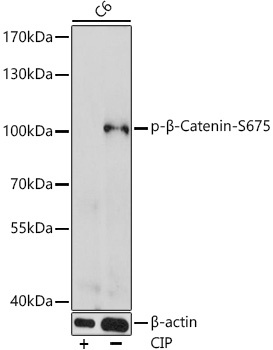
Western blot analysis of lysates from C6 cells, using Phospho-β-Catenin-S675 Rabbit pAb (CABP0795) at 1:1000 dilution. C6 cell lysates were treated by CIP at 37°C for 1 hour. Secondary antibody: HRP-conjugated Goat anti-Rabbit IgG (H+L) (CABS014) at 1:10000 dilution. Lysates/proteins: 25μg per lane. Blocking buffer: 3% BSA. Detection: ECL Enhanced Kit (AbGn00021). Exposure time: 180s.
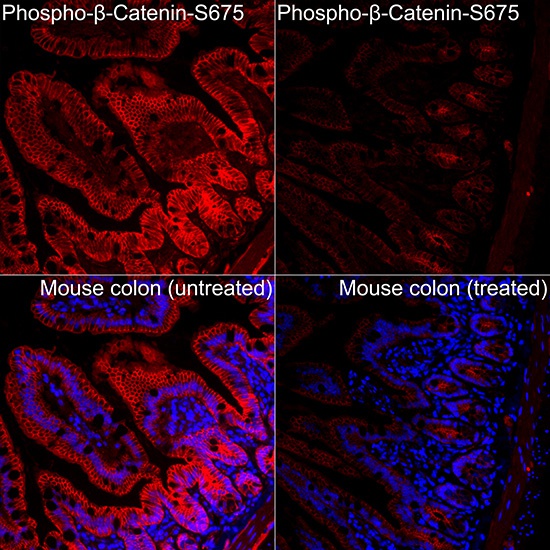
Immunofluorescence analysis of Mouse colon(treated with λPP) and Mouse colon(untreated) tissue using Phospho-β-Catenin-S675 Rabbit pAb (CABP0795) at a dilution of 1:100 (40x lens). Secondary antibody: Cy3-conjugated Goat anti-Rabbit IgG (H+L)(CABS007) at 1:500 dilution. Blue: DAPI for nuclear staining. High pressure antigen retrieval performed with 0.01M Citrate Buffer (pH 6.0) prior to IF staining.