The Phospho-EGFR-Y1173 Monoclonal Antibody (CABP0992) is a high-quality antibody developed for reliable detection and analysis of target proteins. EGFR, a key signaling molecule involved in cell growth and proliferation, is known to be activated through phosphorylation at different tyrosine residues, including Y1173. This antibody, raised in rabbits, exhibits high specificity and sensitivity for detecting phosphorylated EGFR at Y1173 in human samples.Validated for use in Western blot applications, the Phospho-EGFR (Y1173) Rabbit Monoclonal Antibody (CABP0992) allows for precise detection and quantification of phosphorylated EGFR, providing researchers with valuable insights into signaling pathways involved in cancer development, progression, and resistance to therapy.
This antibody is validated for use in WB, ELISA applications and has demonstrated reactivity against Human samples.
Product Name:
Phospho-EGFR-Y1173 Monoclonal Antibody
SKU:
CABP0992
Size:
20μL, 100μL
Reactivity:
Human
Clone Number:
ARC1536
Conjugate:
Unconjugated
Immunogen:
Synthetic peptide. This information is considered to be commercially sensitive.
Tested Applications:
WBELISA
Recommended Dilution:
WB
1:1000 - 1:3000
ELISA
Recommended starting concentration is 1 μg/mL. Please optimize the concentration based on your specific assay requirements.
Cell Membrane, Endoplasmic Reticulum Membrane, Endosome, Endosome Membrane, Golgi Apparatus Membrane, Nucleus Membrane, Nucleus, Secreted, Single-Pass Type I Membrane Protein.
Calculated MW:
134kDa
Observed MW:
175kDa
The protein encoded by this gene is a transmembrane glycoprotein that is a member of the protein kinase superfamily. This protein is a receptor for members of the epidermal growth factor family. EGFR is a cell surface protein that binds to epidermal growth factor, thus inducing receptor dimerization and tyrosine autophosphorylation leading to cell proliferation. Mutations in this gene are associated with lung cancer. EGFR is a component of the cytokine storm which contributes to a severe form of Coronavirus Disease 2019 (COVID-19) resulting from infection with severe acute respiratory syndrome coronavirus-2 (SARS-CoV-2).
Purification Method
Affinity purification
Gene ID
1956
RRID
AB_2863885
Buffer Information
Store at -20℃. Avoid freeze / thaw cycles. Buffer: PBS containing 50% glycerol and 0.05% BSA, preserved with proclin300 or sodium azide, pH 7.3.
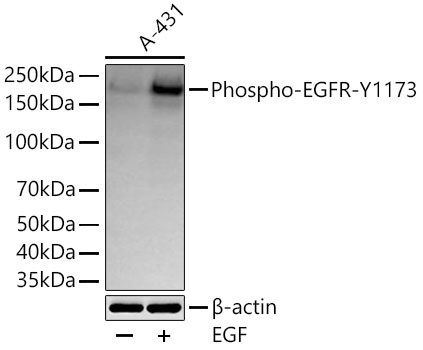
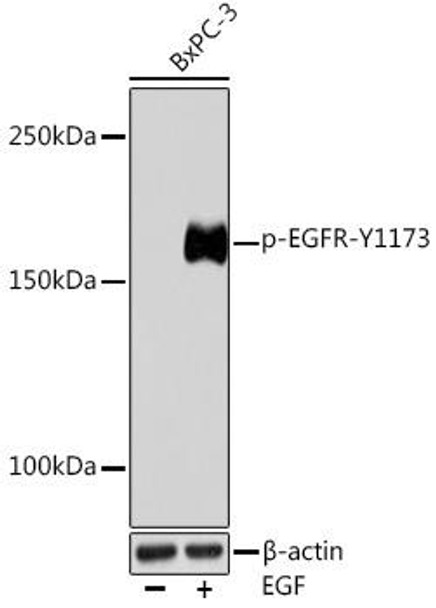
Western blot analysis of lysates from A-431 cells using Phospho-EGFR-Y1173 Rabbit mAb (CABP0992) at 1:1000 dilution incubated at room temperature for 1.5 hours. A-431 cells were treated with EGF (100 ng/mL) at 37℃ for 30 minutes after serum-starvation overnight. Secondary antibody: HRP-conjugated Goat anti-Rabbit IgG (H+L) (CABS014) at 1:10000 dilution. Lysates/proteins: 30 μg per lane. Blocking buffer: 3% nonfat dry milk in TBST. Detection: ECL Basic Kit (AbGn00020). Exposure time: 45s.