Description
Propidium Iodide (PI) Staining Solution (50µg/mL)
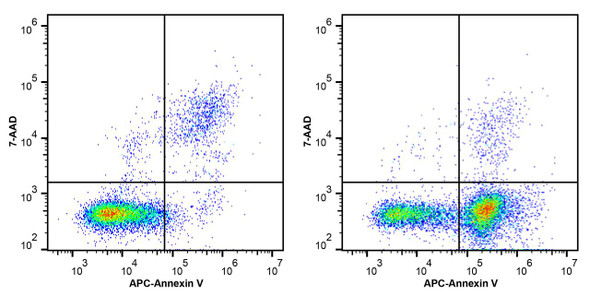
Propidium Iodide (PI) Staining Solution (50µg/mL) is a 50µg/mL PI reagent for identifying late apoptotic and necrotic cells. PI is a membrane-impermeant nucleic acid dye that intercalates into double-stranded DNA and emits red fluorescence once bound. Researchers use it with flow cytometry, often together with Annexin V, to distinguish cells at different stages of apoptosis.
Propidium iodide (PI) is a nuclear staining reagent that binds DNA and localizes to the nucleus. The reagent is an analog of ethidium bromide and is supplied as a liquid at a concentration of 50 µg/mL. Its molecular formula is C27H34I2N4 and its CAS number is 25535-16-4. In this product, PI serves as a fluorescent marker of nuclear DNA.
Researchers use PI to detect apoptosis or necrosis, two forms of cell death. The reagent is also frequently applied in flow cytometry analysis, where stained cells can be measured individually. Because the number of apoptotic or necrotic cells may increase over time after staining, the manual advises detecting apoptosis as soon as possible after staining to keep the results representative of the sample at the time of staining.
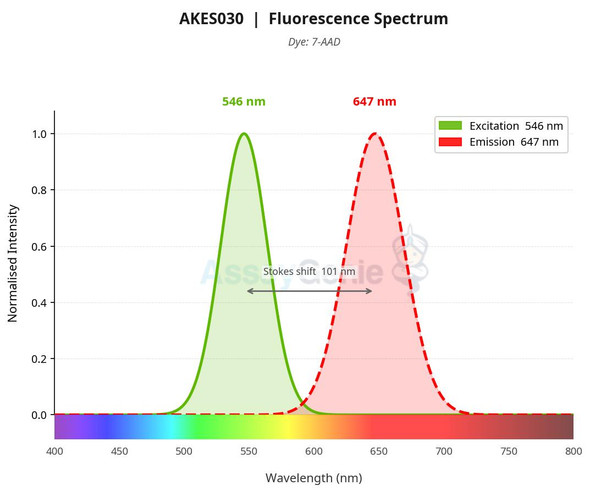
PI works by intercalating into double-stranded DNA. After it binds, the dye releases red fluorescence, so the signal reflects the dye's association with DNA in the sample. Because PI is an intercalator, staining depends on the dye reaching DNA within the sample, and the fluorescence readout is generated only after that binding occurs.
PI solution is sensitive to light and readily absorbs moisture, so it should be stored at 2-8°C, protected from light, and kept away from freeze/thaw cycles. Extended exposure of samples to direct light can quench the fluorophore. The reagent is irritating, so lab coats and disposable gloves should be worn, and direct contact with the body and inhalation should be avoided. Phosphate-buffered saline (PBS) is listed as the additional reagent required for use, and the product ships on ice bags.
| Product name: | Propidium Iodide (PI) Staining Solution (50µg/mL) |
| SKU: | AKES029 |
| Target: | Nuclear DNA (dead or late apoptotic/necrotic cells) |
| Detection method: | Fluorescence, flow cytometry |
| Validated sample type: | Suspension cells |
| Storage: | 2-8°C, protect from light |
| Intended use: | Research use only |
- PI at 50µg/mL, supplied as a liquid
- Membrane-impermeant; enters cells only when membrane integrity is lost
- Stains DNA in the nucleus by intercalation with double-stranded DNA
- Red fluorescence on DNA binding; validated for suspension cells
- Compatible with Annexin V co-staining to separate apoptotic stages
- Store at 2-8°C, protected from light
PI does not cross intact plasma membranes. When membrane integrity is lost, as in late apoptotic or necrotic cells, PI enters the cell and intercalates into double-stranded DNA, where its red fluorescence increases by nearly 20-fold relative to unbound dye (per the Assay Genie product page). Signal is read on a flow cytometer or fluorescence instrument with appropriate settings.
- Detection of late apoptotic and necrotic cells in suspension cultures by flow cytometry
- Dual staining with Annexin V-FITC to distinguish stages of apoptosis
- Assessment of membrane integrity and cell viability prior to downstream analysis
- Nuclear DNA staining of cells that have lost membrane integrity
| Component | Storage |
| PI Staining Solution (50µg/mL) | 2-8°C, protect from light |
- 1x Annexin V Binding Buffer
- Annexin V-FITC (for dual staining)
- Phosphate-buffered saline (PBS)
- Centrifuge capable of 300 g
- Flow cytometer with appropriate settings
- Microcentrifuge tubes
- Vortex mixer
- Ice and a light-protected container
- Lab coat and disposable gloves
Staining of suspension cells
- Induce apoptosis in suspension cells with the reagents of interest.
- Collect cells, centrifuge at 300 g for 5 min, and discard the supernatant.
- Wash cells with PBS, resuspend gently, and count cells.
- Aliquot 1-5 x 10⁵ cells per tube, centrifuge at 300 g for 5 min, and discard the supernatant.
- Wash cells with PBS, centrifuge, and discard the supernatant.
- Resuspend cells in 500 µL of 1x Annexin V Binding Buffer.
- Add 5 µL of Annexin V-FITC and 5 µL of PI Staining Solution (50µg/mL) to each tube.
- Gently vortex and incubate at room temperature for 15-20 min in the dark.
- Analyze immediately on the flow cytometer. Alternatively, place cells on ice in the dark and analyze within 1 hour.
How should the PI staining solution be stored?
Store the reagent at 2-8°C, protected from light, and avoid freeze/thaw cycles. The expiration date is 12 months.
Which additional reagent is required?
Phosphate-buffered saline (PBS) is listed as the other reagent required for use with this product.
When should apoptosis be detected after staining?
Detect apoptosis as soon as possible after staining, because the number of apoptotic or necrotic cells may increase with time.
How can I protect stained samples from signal loss?
Avoid extended exposure of samples to direct light, which can quench the fluorophore.
What safety precautions apply when handling this reagent?
The reagent is irritating. Wear lab coats and disposable gloves, and avoid direct contact with the body and inhalation.
What shipping condition applies to this product?
The product ships on an ice bag.
| Storage: | 2-8°C, protect from light |
| Shelf life: | 12 months |
| Expiration: | 12 months |
| Freeze/thaw: | Avoid freeze/thaw cycles |
| Shipping: | Ice bag |
| Light sensitivity: | Protect from direct light to prevent fluorophore quenching |
Cautions
- For research use only. Not for diagnostic or therapeutic use.
- This reagent is irritating. Avoid direct contact with skin and inhalation. Wear a lab coat and disposable gloves.
- Validated only in suspension cells. Adherent cells that require enzymatic digestion may alter apoptotic or necrotic ratios.
- Good cell viability is essential for reliable results.
- Analyze samples as soon as possible after staining to avoid an increase in apoptosis or necrosis.
- Avoid extended exposure to direct light to protect the fluorophore from quenching.
- Avoid freeze/thaw cycles.
- For maximal performance, use within 12 months.