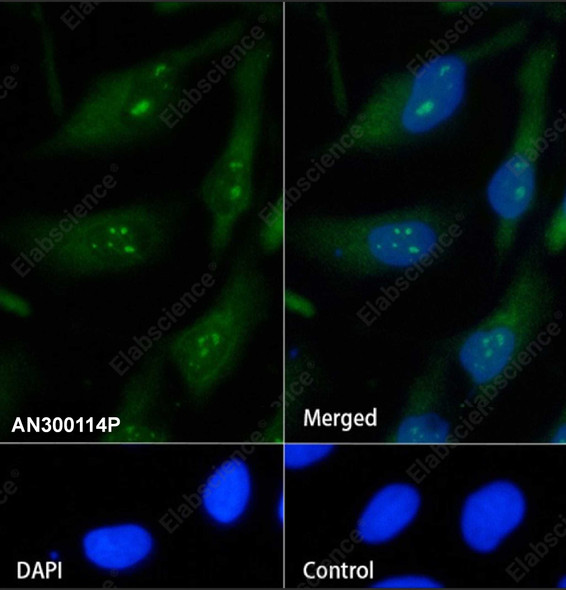
The Recombinant 53BP2/ASPP2 Monoclonal Antibody is a recombinant rabbit monoclonal antibody (clone C310388) against 53BP2. This gene encodes a member of the ASPP (apoptosis-stimulating protein of p53) family of p53 interacting proteins. The protein contains four ankyrin repeats and an SH3 domain involved in protein-protein interactions. It is localized to the perinuclear region of the cytoplasm, and regulates apoptosis and cell growth through interactions with other regulatory molecules including members of the p53 family. Produced by recombinant technology in Rabbit hosts and purified by Protein A affinity chromatography, this Rabbit IgG antibody is reactive against Human samples.
This antibody is suitable for WB, IHC, IF and ICC applications. It has been validated by WB analysis of HEK-293T. The target is localized to the cytoplasm, perinuclear region. Nucleus. Note: Predominantly found in the perinuclear region. Some small fraction is nuclear. Sequester in the cytoplasm on overexpression of DDX42.
Product Name:
Recombinant 53BP2/ASPP2 Monoclonal Antibody
SKU:
AGEL5706
Size:
50 µL, 100 µL
Antibody Type:
Recombinant Monoclonal Antibody
Synonyms:
53BP, 53BP2, Apoptosis stimulating of p53 protein 2, Apoptosis stimulating protein of p53 2, Apoptosis-stimulating of p53 protein 2, ASPP, ASPP2, BBP, Bcl2 binding protein, Bcl2-binding protein, NY REN 51 antigen, p53 binding protein 2, p53-binding protein 2, P53BP, P53BP2, PPP1R13A, Renal carcinoma antigen NY-REN-51, TP53BP, TP53BP2, tumor protein p53 binding protein, tumor protein p53 binding protein 2, Tumor suppressor p53 binding protein 2, Tumor suppressor p53-binding protein 2
Reactivity:
Human
Immunogen:
Recombinant Human 53BP2/ASPP2 protein
Applications:
WBIHCIFICC
Clonality:
Recombinant Monoclonal
Clone No:
C310388
Host:
Rabbit
Isotype:
Rabbit IgG
Target:
53BP2
Conjugation:
Unconjugated
Observed MW:
124 kDa
Recommended Dilution:
WB 1:1000-5000; IHC 1:100-300; ICC/IF 1:100-300
UniProt:
Q13625
Purification:
Protein A
Concentration:
0.2 mg/mL
Buffer:
PBS, 50% glycerol, 0.05% Proclin 300, 0.05% protein protectant.
Storage:
Store at -20°C valid for 12 months. Avoid freeze / thaw cycles.