The Recombinant BRAT1 Monoclonal Antibody is a recombinant rabbit monoclonal antibody (clone C330848) against BRAT1. The protein encoded by this ubiquitously expressed gene interacts with the tumor suppressing BRCA1 (breast cancer 1) protein and and the ATM (ataxia telangiectasia mutated) protein. ATM is thought to be a master controller of cell cycle checkpoint signalling pathways that are required for cellular responses to DNA damage such as double-strand breaks that are induced by ionizing radiation and complexes with BRCA1 in the multi-protein complex BASC (BRAC1-associated genome surveillance complex). The protein encoded by this gene is thought to play a role in the DNA damage pathway regulated by BRCA1 and ATM. Produced by recombinant technology in Rabbit hosts and purified by Protein A affinity chromatography, this Rabbit IgG antibody is reactive against Human samples.
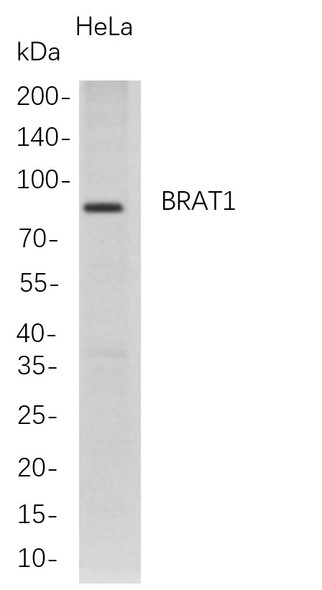
This antibody is suitable for WB and FC applications. It has been validated by WB analysis of HeLa. The target is localized to the Nucleus. Cytoplasm, Note: Present at double strand breaks (DSBs)following ionizing radiation treatment. The ubiquitinated form localizes in the nucleus in a NDFIP1-dependent manner.
Product Name:
Recombinant BRAT1 Monoclonal Antibody
SKU:
AGEL6154
Size:
50 µL, 100 µL
Antibody Type:
Recombinant Monoclonal Antibody
Synonyms:
BAAT, BAAT1, BRAT, BRAT1, C7orf, C7orf27, RMFSL
Reactivity:
Human
Immunogen:
Recombinant Human BRAT1 protein
Applications:
WBFC
Clonality:
Recombinant Monoclonal
Clone No:
C330848
Host:
Rabbit
Isotype:
Rabbit IgG
Target:
BRAT1
Conjugation:
Unconjugated
Observed MW:
90 kDa
Calculated MW:
90 kDa
Recommended Dilution:
WB 1:1000-5000; FC 1:100-500
UniProt:
Q6PJG6
Purification:
Protein A
Concentration:
0.2 mg/mL
Buffer:
PBS, 50% glycerol, 0.05% Proclin 300, 0.05% protein protectant.
Storage:
Store at -20°C valid for 12 months. Avoid freeze / thaw cycles.
Western Blot with Recombinant BRAT1 Monoclonal Antibody at dilution of 1:1000 dilution. Lane A: HeLa lysate. Observed-MW:90 kDa Calculated-MW:90 kDa