Cathepsin D (CTSD); a well known lysosomal aspartyl protease and belongs to the peptidase C1 family; which is a normal and major component of lysosomes; and is found in almost all cells and tissues of mammals. Its mostly described function is intracellular catabolism in lysosomal compartments; other physiological effect include hormone and antigen processing. Cathepsin D has a specificity similar to but narrower than that of pepsin A. Cathepsin D plays an important role in the degradation of proteins; the generation of bioactive proteins; antigen processing; etc. Among different role in cell physiology; a new function of this enzyme is examined. Cathepsin D is an important regulator of apoptotic pathways in cells. It acts at different stage of intrinsic and extrinsic pathway of apoptosis. In addition; CTSD secreted from human prostate carcinoma cells are responsible for the generation of angiostatin; a potent endogenous inhibitor of angiogenesis; suggesting its contribution to the prevention of tumor growth and angiogenesis-dependent growth of metastases.
Product Name:
Human Cathepsin D/CTSD Recombinant Protein (RPES2594)
Product Code:
RPES2594
Size:
10µg
Species:
Human
Expressed Host:
HEK293 Cells
Synonyms:
Cathepsin D, CTSD,CLN10,CPSD,HEL-S-130P
Accession:
P07339
Sequence:
Met 1-Leu 412
Fusion tag:
C-His
Activity:
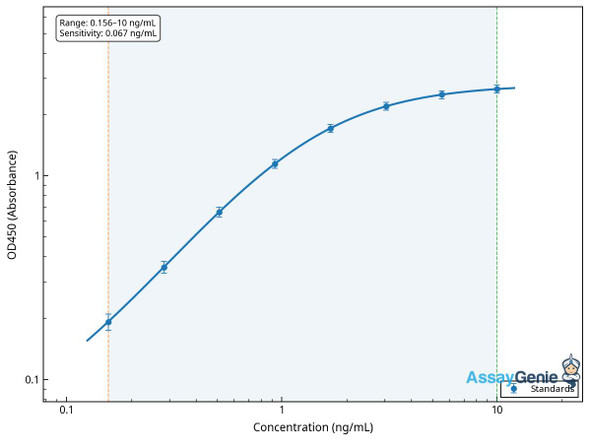
Measured by its ability to bind biotinylated human CTSS-His in a functional ELISA.
Endotoxin:
<1.0 EU per µg as determined by the LAL method.
Protein Construction:
A DNA sequence encoding the pro form of human CTSD (P07339) (Met 1-Leu 412) was fused with a polyhistidine tag at the C-terminus.
Purity:
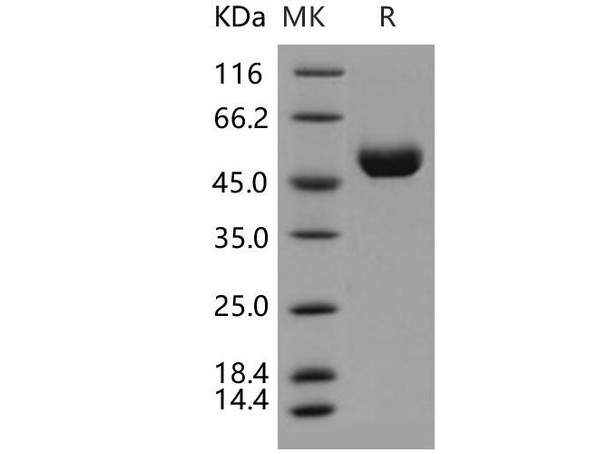
> 97 % as determined by reducing SDS-PAGE.
Mol Mass:
44 kDa
AP Mol Mass:
40-110 kDa
Formulation:
Lyophilized from sterile 25mM MES; 150mM NaCl; pH 6.5
Shipping:
This product is provided as lyophilized powder which is shipped with ice packs.
Stability and Storage:
Lyophilized proteins are stable for up to 12 months when stored at -20 to -80°C. Reconstituted protein solution can be stored at 4-8°C for 2-7 days. Aliquots of reconstituted samples are stable at < -20°C for 3 months.