The protein ICAM-3, also known as CD50, is a member of the intercellular adhesion molecule (ICAM) family consisting three members. It is a DC-SIGN ligand that is constitutively expressed on resting leukocytes, and is thus an important molecule for the first immune response. ICAM-3 comprises of five immunoglobulin-like domains, and binds LFA-1 through its two N-terminal domains. It functions not only as an adhesion molecule, but also as a potent signalling molecule. ICAM-3 binds to LFA-1 on antigen-presenting cells (APC) stabilizing the T cell-APC interaction, facilitating signaling through the CD3/TCR complex. However, recent evidence using cultured and transformed T cells suggests ICAM-3 may also function in signaling. It has been reported that CD50 molecule can play a role in developing functionally mature T lymphocytes and its expression increases during the maturation process of T lymphocytes. In addition, the interactions of ICAM-3 and LFA-1 facilitate HIV-1- induced virological synapse formation between T cells. ICAM-3 is associated with an increase of cellular radio-resistance and cancer cell proliferation. It could be considered as a candidate for anti-cancer drug development and as a cancer diagnostic marker.
Product Name:
Human CD50/ICAM-3 Recombinant Protein (RPES4223)
Product Code:
RPES4223
Size:
20µg
Species:
Human
Expressed Host:
HEK293 Cells
Synonyms:
CD50,CDW50,ICAM-3,ICAM-R
Accession:
NP_002153.2
Sequence:
Met 1-His 485
Fusion tag:
C-His
Activity:
Measured by the ability of the immobilized protein to support the adhesion of PMA-stimulated HSB2 human peripheral blood acute lymphoblastic leukemia cells.When cells are added to ICAM3-coated plates (12.5 µg/mL , 100 ?L/well), approximately >25% cells will adhere specifically.
Endotoxin:
<1.0 EU per µg as determined by the LAL method.
Protein Construction:
A DNA sequence encoding the extracellular domain of human ICAM3 (NP_002153.2) (Met 1-His 485) was expressed, with the C-terminal fused polyhistidine tag.
Purity:
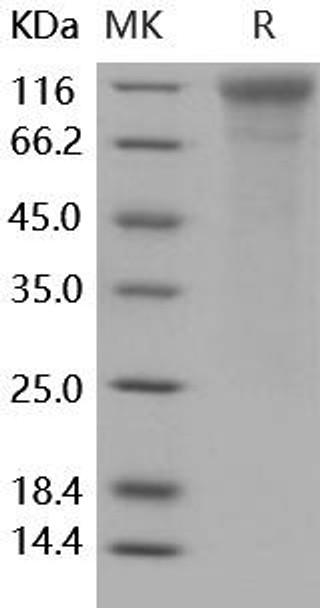
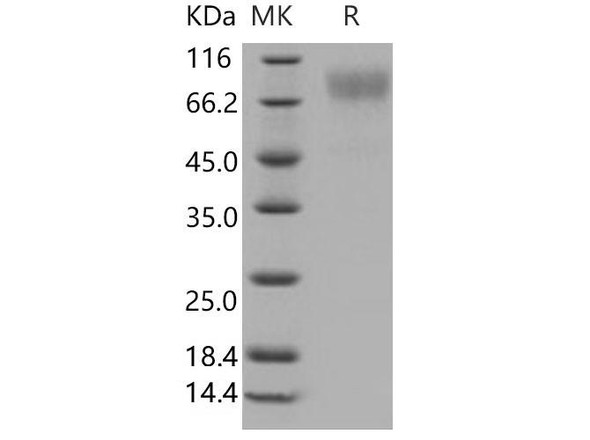
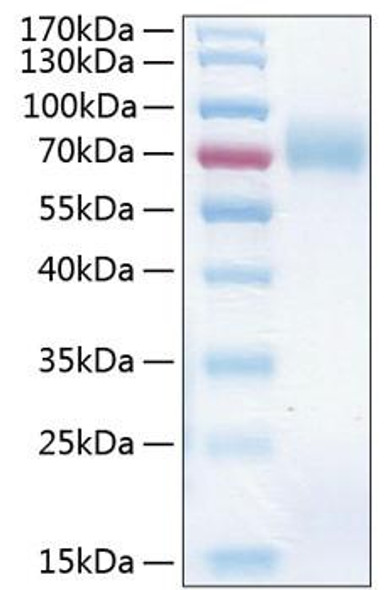
> 92 % as determined by reducing SDS-PAGE.
Mol Mass:
50.8 kDa
AP Mol Mass:
100-120 kDa
Formulation:
Lyophilized from sterile PBS, pH 7.5
Shipping:
This product is provided as lyophilized powder which is shipped with ice packs.
Stability and Storage:
Lyophilized proteins are stable for up to 12 months when stored at -20 to -80°C. Reconstituted protein solution can be stored at 4-8°C for 2-7 days. Aliquots of reconstituted samples are stable at < -20°C for 3 months.