Integrin-linked kinase-associated serine/threonine phosphatase 2C, also known as ILKAP, is cytoplasm protein which belongs to the PP2C family. ILKAP contains one PP2C-like domain. ILKAP is widely expressed. Highest levels expressed in striated muscle. Much lower levels evident in various smooth muscle tissues. ILKAP may play a role in regulation of cell cycle progression via dephosphorylation of its substrates whose appropriate phosphorylation states might be crucial for cell proliferation. ILKAP selectively associates with integrin linked kinase (ILK), to modulate cell adhesion and growth factor signaling. ILKAP inhibits the ILK-GSK3B signaling axis and may play an important role in inhibiting oncogenic transformation. Integrin-linked kinase ( ILK ) plays key roles in a variety of cell functions, including cell proliferation, adhesion and migration. Within the cell, ILK localizes to multiple sites, including the cytoplasm, focal adhesion complexes that mediate cell adhesion to extracellular substrates, as well as cell-cell junctions in epidermal keratinocytes. Nuclear ILK can be rapidly exported into the cytoplasm through a CRM1-dependent pathway, and its export is enhanced by the type 2C protein phosphatase ILKAP. Nuclear localization of ILK in epidermal keratinocytes is associated with increased DNA synthesis, which is sensitive to inhibition by ILKAP.
Product Name:
Human ILKAP Recombinant Protein (RPES2073)
Product Code:
RPES2073
Size:
100 µg
Species:
Human
Expressed Host:
HEK293 Cells
Synonyms:
ILKAP2,ILKAP3,PP2C-DELTA
Accession:
Q9H0C8
Sequence:
Met 1-His 392
Fusion tag:
C-His
Endotoxin:
<1.0 EU per µg as determined by the LAL method.
Protein Construction:
A DNA sequence encoding the human ILKAP (Q9H0C8) (Met 1-His 392) was expressed, with a C-terminal polyhistidine tag.
Purity:
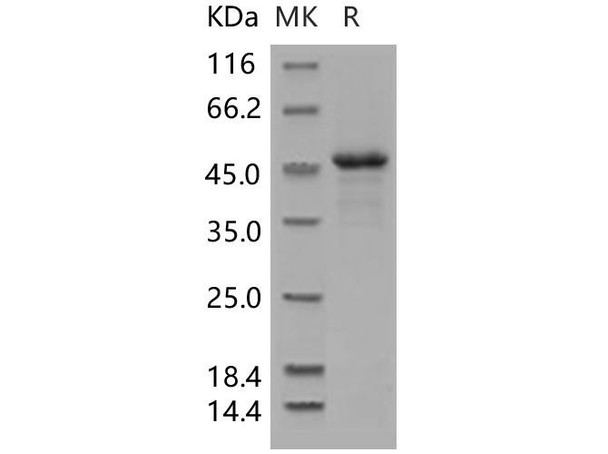
> 92 % as determined by reducing SDS-PAGE.
Mol Mass:
44.3 kDa
AP Mol Mass:
46 kDa
Formulation:
Lyophilized from sterile PBS, pH 7.4
Shipping:
This product is provided as lyophilized powder which is shipped with ice packs.
Stability and Storage:
Lyophilized proteins are stable for up to 12 months when stored at -20 to -80°C. Reconstituted protein solution can be stored at 4-8°C for 2-7 days. Aliquots of reconstituted samples are stable at < -20°C for 3 months.