Prostatic acid phosphatase (PAP, or ACPP), also known as prostatic specific acid phosphatase (PSAP), is an enzyme produced by the prostate. As a non-specific phosphomonoesterase, Prostatic acid phosphatase synthetized and secreted into seminal plasma under androgenic control. The enzyme is a dimer of molecular weight around 100 kDa. Prostatic acid phosphatase is a clinically important protein for its relevance as a biomarker of prostate carcinoma. Furthermore, it has a potential role in fertilization. The major action of PAP is to dephosphorylate macromolecules with the help of catalytic residues (His(12) and Asp(258)) that are located in the cleft between two domains. Cellular prostatic acid phosphatase (cPAcP), an authentic tyrosine phosphatase, is proposed to function as a negative growth regulator of prostate cancer (PCa) cells in part through its dephosphorylation of ErbB-2. cPAcP functions as a neutral protein tyrosine phosphatase (PTP) in prostate cancer cells and dephosphorylates HER-2/ErbB-2/Neu (HER-2: human epidermal growth factor receptor-2) at the phosphotyrosine (p-Tyr) residues. Injection of the secretory isoform of PAP has potent antinociceptive effects in mouse models of chronic pain. This enzyme exhibits ecto-5'-nucleotidase activity, is widely distributed, and implicated in the formation of chronic pain. Additionally, PAP could be a target molecule in specific immunotherapy for patients with nonprostate adenocarcinomas including colon and gastric cancers.
Measured by its ability to cleave a substrate, pNitrophenyl phosphate (pNPP). The specific activity is >100,000 pmol/min/µg.
Endotoxin:
<1.0 EU per µg as determined by the LAL method.
Protein Construction:
A DNA sequence encoding the human ACPP (NP_001127666.1) (Met 1-Lys 382) was fused with a polyhistidine tag at the C-terminus.
Purity:
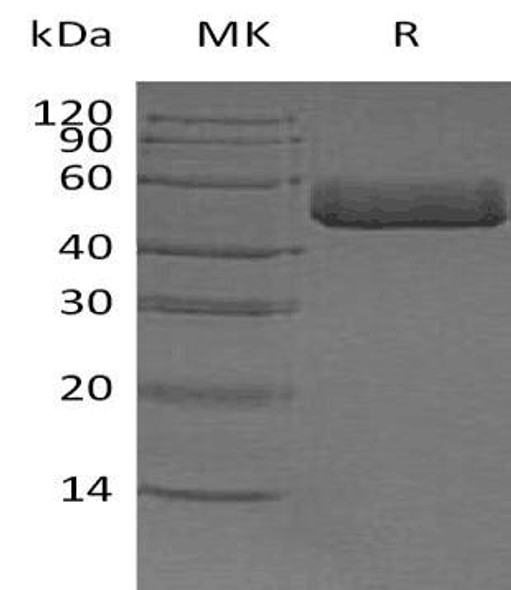
> 97 % as determined by reducing SDS-PAGE.
Mol Mass:
42 kDa
AP Mol Mass:
45-55 kDa
Formulation:
Lyophilized from sterile PBS, pH 7.4
Shipping:
This product is provided as lyophilized powder which is shipped with ice packs.
Stability and Storage:
Lyophilized proteins are stable for up to 12 months when stored at -20 to -80°C. Reconstituted protein solution can be stored at 4-8°C for 2-7 days. Aliquots of reconstituted samples are stable at < -20°C for 3 months.