Lysosomal carboxypeptidase, cathepsin A (protective protein, CathA), is a component of the lysosomal multienzyme complex along with beta-galactosidase (GAL) and sialidase Neu1, where it activates Neu1 and protects GAL and Neu1 against the rapid proteolytic degradation. Cathepsin A is a multicatalytic enzyme with deamidase and esterase in addition to carboxypeptidase activities. It was recently identified in human platelets as deamidase. In vitro, it hydrolyzes a variety of bioactive peptide hormones including tachykinins, suggesting that extralysosomal cathepsin A plays a role in regulation of bioactive peptide functions. It is a member of the alpha/beta hydrolase fold family and has been suggested to share a common ancestral relationship with other alpha/beta hydrolase fold enzymes, such as cholinesterases. Cathepsin A defects are linked to multiple forms of Galactosialidosis with a combined secondary deficiency of beta-galactosidase and neuraminidase. Cathepsin A is a key molecule in the onset of galactosialidosis and also highlight the therapeutic acts in vivo as an endothelin-1-inactivating enzyme and strongly confirm a crucial role of this enzyme in effective elastic fiber formation.
Product Name:
Mouse Cathepsin A/CTSA Recombinant Protein (RPES2703)
Product Code:
RPES2703
Size:
50 µg
Species:
Mouse
Expressed Host:
HEK293 Cells
Synonyms:
AU019505,PPCA,Ppgb
Accession:
P16675-1
Sequence:
Met 1-Tyr 474
Fusion tag:
C-His
Endotoxin:
<1.0 EU per µg of the protein as determined by the LAL method.
Protein Construction:
A DNA sequence encoding the mouse CTSA (P16675-1) (Met 1-Tyr 474) was expressed, with a C-terminal polyhistidine tag.
Purity:
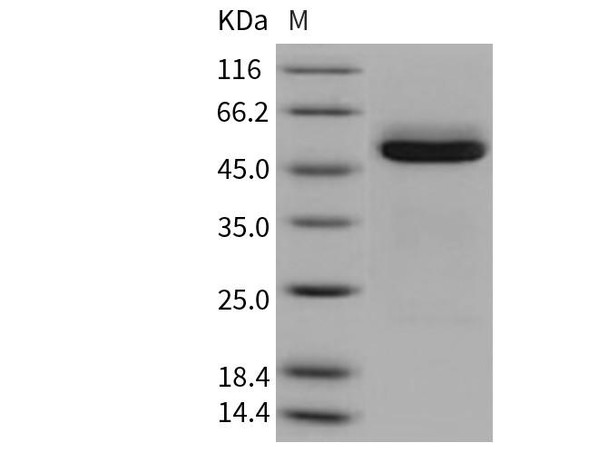
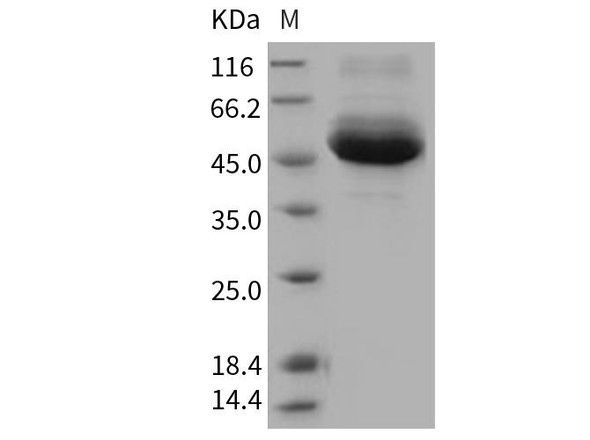
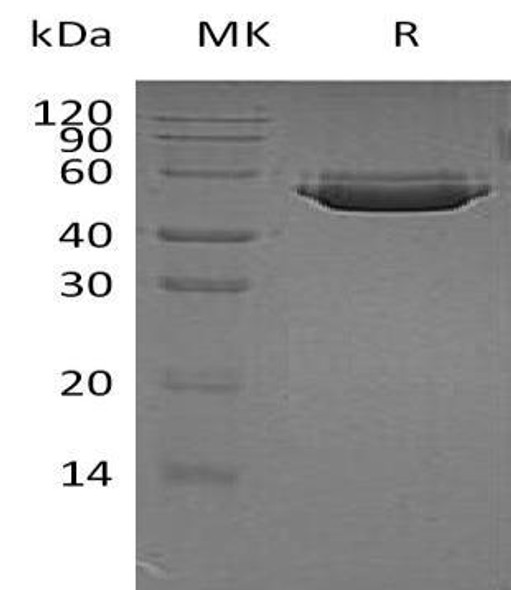
> 96 % as determined by SDS-PAGE
Mol Mass:
52.8 kDa
AP Mol Mass:
52.8 kDa
Formulation:
Lyophilized from sterile 25mM Tris, 0.3M NaCl, pH 8.0
Shipping:
This product is provided as lyophilized powder which is shipped with ice packs.
Stability and Storage:
Lyophilized proteins are stable for up to 12 months when stored at -20 to -80°C. Reconstituted protein solution can be stored at 4-8°C for 2-7 days. Aliquots of reconstituted samples are stable at < -20°C for 3 months.