Uteroglobin (UG), also known as Secretoglobin 1A member 1 (SCGB1A1), Blastokinin, Clara cell secretor protein (CCSP) or Clara cell-specific 10-kDa protein (CC10), is the founding member of the secretoglobin family of small, secreted, disulfide-bridged dimeric proteins found only in mammals. This protein is mainly expressed in lung, with anti-inflammatory/immunomodulatory properties. Previous in vitro studies demonstrated that CCAAT/enhancer-binding proteins (C/EBPs) are the major transcription factors for the regulation of SCGB1A1 gene expression, whereas FOXA1 had a minimum effect on the transcription. Uteroglobin is a multifunctional protein with antiinflammatory/immunomodulatory properties. Uteroglobin inhibits soluble phospholipase A(2) activity and binds and perhaps sequesters hydrophobic ligands such as progesterone, retinols, polychlorinated biphenyls, phospholipids, and prostaglandins. In addition to its antiinflammatory activities, Uteroglobin manifests antichemotactic, antiallergic, antitumorigenic, and embryonic growth-stimulatory activities. The tissue-specific expression of the Uteroglobin gene is regulated by several steroid hormones, although a nonsteroid hormone, prolactin, further augments its expression in the uterus. Based on its anti-inflammatory and antiallergic properties, Uteroglobin is a potential drug target. The mechanism of Uteroglobin action is likely to be even more complex as it also functions via a putative receptor-mediated pathway.
Product Name:
Mouse Uteroglobin/SCGB1A1 Recombinant Protein (RPES3100)
Product Code:
RPES3100
Size:
5µg
Species:
Mouse
Expressed Host:
HEK293 Cells
Synonyms:
Uteroglobin, Clara cell 17 kDa protein, Clara cell phospholipid-binding protein, CCPBP, Clara cells 10 kDa secretory protein, CC10, PCB-binding protein, Secretoglobin family 1A member 1, Scgb1a1, Cc10, Ugb,CC16,CCSP,PCB-BP,UG,UGB,Utg
Accession:
Q06318
Sequence:
Met 1-Phe 96
Fusion tag:
C-His
Activity:
Measured by the ability of the immobilized protein to support the adhesion of the A549 human lung carcinoma cell line. When 5 x 10E4 cells/well are added to SCGB1A1 coated plates (5 µg/ml with 100 ?l/well), approximately >40% will adhere after 1 hour at 37?.
Endotoxin:
<1.0 EU per µg of the protein as determined by the LAL method.
Protein Construction:
A DNA sequence encoding the mouse SCGB1A1 (Q06318) (Met 1-Phe 96) was expressed, with a polyhistidine tag at the C-terminus.
Purity:
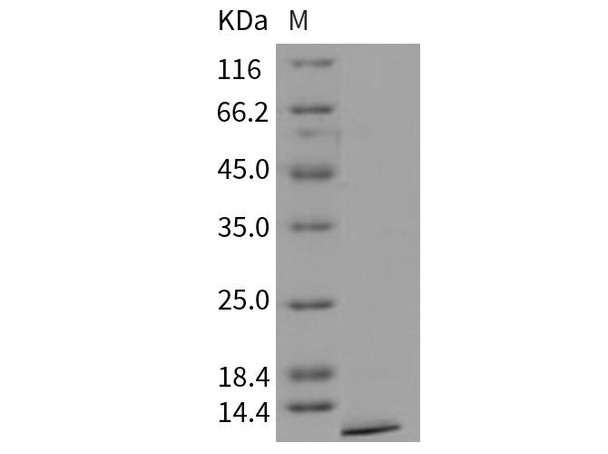
> 88 % as determined by SDS-PAGE
Mol Mass:
9.8 kDa
AP Mol Mass:
12 kDa
Formulation:
Lyophilized from sterile PBS, pH 7.4
Shipping:
This product is provided as lyophilized powder which is shipped with ice packs.
Stability and Storage:
Lyophilized proteins are stable for up to 12 months when stored at -20 to -80°C. Reconstituted protein solution can be stored at 4-8°C for 2-7 days. Aliquots of reconstituted samples are stable at < -20°C for 3 months.