Intercellular adhesion molecule-1 (ICAM-1, or CD54) is a 90 kDa member of the immunoglobulin (Ig) superfamily and is critical for the firm arrest and transmigration of leukocytes out of blood vessels and into tissues. ICAM-1 is constitutively present on endothelial cells, but its expression is increased by proinflammatory cytokines. The endothelial expression of ICAM-1 is increased in atherosclerotic and transplant-associated atherosclerotic tissue and in animal models of atherosclerosis. Additionally, ICAM-1 has been implicated in the progression of autoimmune diseases. ICAM-1 is a ligand for LFA-1(integrin). When activated, leukocytes bind to endothelial cells via ICAM-1/LFA-1 interaction and then transmigrate into tissues. Presence with heavy glycosylation and other structural characteristics, ICAM-1 possesses binding sites for a number of immune-associated ligands and serves as the binding site for entry of the major group of human Rhinovirus (HRV) into various cell types. ICAM-1 also becomes known for its affinity for Plasmodium falciparum-infected erythrocytes (PFIE), providing more of a role in infectious disease. Previous studies have shown that ICAM-1 is involved in inflammatory reactions and that a defect in ICAM-1 gene inhibits allergic contact hypersensitivity.
Product Name:
Rat ICAM/CD54 Recombinant Protein (RPES0223)
Product Code:
RPES0223
Size:
50µg
Species:
Rat
Expressed Host:
HEK293 Cells
Synonyms:
CD54,ICAM
Accession:
Q00238-1
Sequence:
Met 1-Thr 493
Fusion tag:
C-His
Activity:
Measured by the ability of the immobilized protein to support the adhesion of PMA-stimulated HSB2 human peripheral blood acute lymphoblastic leukemia cells.When cells are added to rat ICAM1 coated plates (12.5 ¦Ìg/mL, 100 ¦ÌL/well), approximately > 30% cells will adhere specificall
Endotoxin:
<1.0 EU per µg of the protein as determined by the LAL method
Protein Construction:
A DNA sequence encoding the rat ICAM1 (Q00238-1) extracellular domain (Met 1-Thr 493) was expressed, fused with a polyhistidine tag at the C-terminus.
Purity:
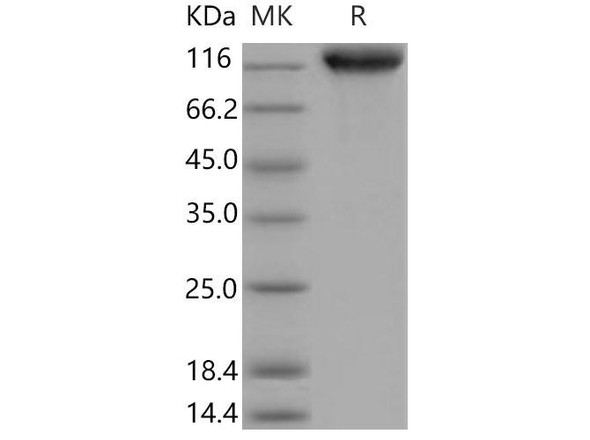
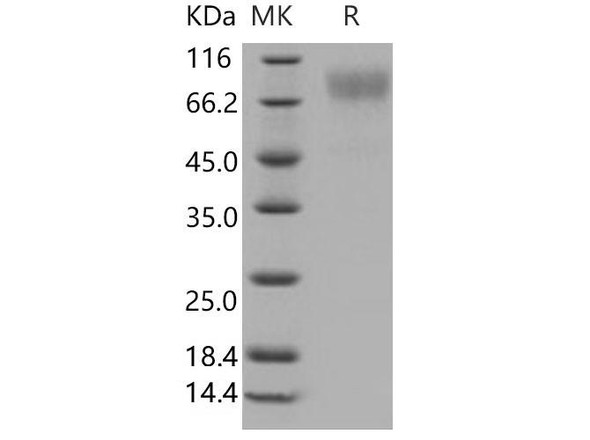
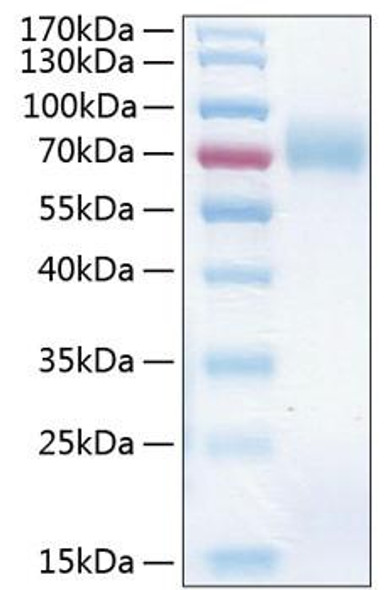
> 97 % as determined by SDS-PAGE
Mol Mass:
52.7 kDa
AP Mol Mass:
70-75 kDa
Formulation:
Lyophilized from sterile PBS, pH 7.4
Shipping:
This product is provided as lyophilized powder which is shipped with ice packs.
Stability and Storage:
Lyophilized proteins are stable for up to 12 months when stored at -20 to -80°C. Reconstituted protein solution can be stored at 4-8°C for 2-7 days. Aliquots of reconstituted samples are stable at < -20°C for 3 months.