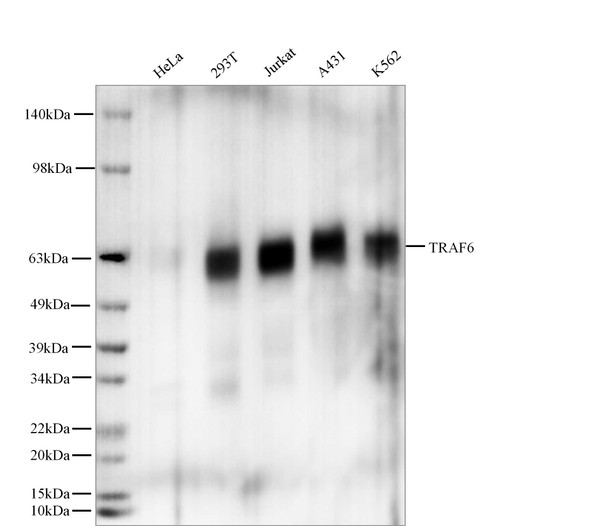
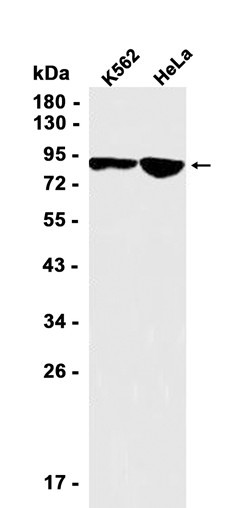
The Recombinant TRAF6 Monoclonal Antibody is a recombinant rabbit monoclonal antibody (clone C733400) against TRAF6. The protein encoded by this gene is a member of the TNF receptor associated factor (TRAF) protein family. TRAF proteins are associated with, and mediate signal transduction from, members of the TNF receptor superfamily. This protein mediates signaling from members of the TNF receptor superfamily as well as the Toll/IL-1 family. Produced by recombinant technology in Rabbit hosts and purified by affinity chromatography, this Rabbit IgG antibody is reactive against Human and Rat samples.
This antibody is suitable for WB applications. It has been validated by WB analysis of K562, Rat Rat Brain, C6, Hela. The target is localized to the Cytoplasm. Cytoplasm>cell cortex. Nucleus. Found in the nuclei of some agressive B-cell lymphoma cell lines as well as in the nuclei of both resting and activated T-and B-lymphocytes. Found in punctate nuclear body protein complexes. Ubiquitination may occur in the cytoplasm and sumoylation in the nucleus.
Product Name:
Recombinant TRAF6 Monoclonal Antibody
SKU:
AGEL8705
Size:
50 µL, 100 µL
Antibody Type:
Recombinant Monoclonal Antibody
Synonyms:
E3 ubiquitin protein ligase, E3 ubiquitin-protein ligase TRAF6, Interleukin 1 signal transducer, Interleukin-1 signal transducer, MGC 3310, MGC3310, MGC:3310, OTTHUMP00000232772, OTTHUMP00000232773, RING finger protein 85, RNF 85, RNF85, TNF receptor associated factor 6, TNF receptor-associated, TNF receptor-associated factor 6, TRAF 6, Traf6