Description
Zinc (Zn) Colorimetric Assay Kit
The Assay Genie Zinc (Zn) Colorimetric Assay Kit (MAES0111) measures zinc ion content in serum, plasma, urine, and milk samples. Zinc ions react with 5-Br-PADAP to form a colored complex, and absorbance is read at 560 nm on a microplate reader. The kit is intended for Research Use Only and supports routine quantification of zinc across the 0.748–46.2 µmol/L range.
The Zinc (Zn) Colorimetric Assay Kit quantifies zinc ion (Zn2+), an inorganic ion, in biological samples. The product page classifies the kit under the Inorganic Ions and Plant Physiology research areas. The manual notes that Zn2+ is present at very low concentrations in serum, so contamination of vessels and reagents with zinc must be avoided. Calibration relies on a 1.54 mmol/L zinc standard diluted with deionized water into a freshly prepared series spanning 0 to 46.2 µmol/L.
The kit is intended for measuring zinc content in four sample types: serum, plasma, urine, and milk. Its listed research areas, Inorganic Ions and Plant Physiology, indicate use in studies of inorganic ion content across these matrices. The kit is labeled for research use only and is not intended for clinical diagnosis. The manual also states that results depend on reagent handling, operating technique, and environment, so consistent conditions across a study help make comparisons meaningful.
The zinc ion in the sample reacts with 5-Br-PADAP to form a colored complex, and the depth of color is directly proportional to zinc concentration. The chromogenic working solution is prepared on the day of use by mixing 2 µL of Chromogenic Agent with 198 µL of buffer solution per well. After 0.05 mL of standard or pretreated sample is combined with 0.2 mL of working solution, the plate is mixed on a microplate reader for 30 seconds and held for 5 minutes at room temperature. Absorbance is read at 560 nm, within the 545 to 575 nm instrument range.
Serum and plasma are measured directly, while urine and milk require centrifugation at 10000×g at 4°C before use. Anticoagulants such as EDTA and citrate, and other metal chelators, must not be used, and hemolyzed samples should be avoided. Samples not tested on the day of collection can be stored at -80°C for one month. Kit reagents are stored at 2-8°C for 12 months, and the Chromogenic Agent and Buffer Solution must be protected from light.
Performance data from the manual show an analytical sensitivity of 0.418 µmol/L and a detection range of 0.748 to 46.2 µmol/L. Intra-assay precision across three human serum samples ranged from 2.5% to 2.9% CV, and inter-assay precision ranged from 3.5% to 4.3% CV. Spike recovery averaged 104% across three concentrations, with individual recoveries between 102% and 105%.
| Product Name: | Zinc (Zn) Colorimetric Assay Kit |
| SKU: | MAES0111 |
| Size: | 96 Assays |
| Sample Types: | Serum, plasma, urine, milk |
| Detection Method: | Colorimetric |
| Instrument: | Microplate reader (545–575 nm; 560 nm optimum) |
| Assay Time: | 20 min |
| Research Area: | Inorganic ions |
| Detection Principle: | Zinc ion reaction with 5-Br-PADAP |
| Wavelength: | 560 nm |
| Sensitivity: | 0.418 µmol/L |
| Detection Range: | 0.748–46.2 µmol/L |
| Sample Volume: | 50 µL |
| Recovery: | 104% |
| Intra-assay CV: | 2.5–2.9% |
| Inter-assay CV: | 3.5–4.3% |
- Colorimetric detection of zinc with 5-Br-PADAP chromogen, read at 560 nm
- Sensitivity of 0.418 µmol/L; detection range 0.748–46.2 µmol/L
- Validated sample types: serum, plasma, urine, and milk
- Sample volume of 50 µL; assay time of 20 min
- Recovery of 104% and intra-assay CV of 2.5–2.9%
- 96-assay format with microplate-compatible workflow
Zinc ions in the sample react with 5-Br-PADAP to produce a colored complex. The color depth is directly proportional to zinc ion concentration. Zinc content is calculated from the absorbance at 560 nm against a standard curve, with sample values corrected for the pretreatment and pre-assay dilution factors.
- Quantification of zinc content in serum, plasma, urine, and milk samples
- Studies of zinc homeostasis and trace element status in research models, including rat serum
- Investigation of zinc-related physiological processes such as growth, lipid metabolism, and immune function
- Comparative zinc measurements across sample types and experimental conditions
| Component | Quantity | Storage |
| Zinc Standard (1.54 mmol/L) | 0.5 mL × 1 vial (96 Assays) | 2–8°C |
| Protein Precipitator | 15 mL × 1 vial (96 Assays) | 2–8°C |
| Chromogenic Agent | 0.26 mL × 1 vial (96 Assays) | 2–8°C, protect from light |
| Buffer Solution | 26 mL × 1 vial (96 Assays) | 2–8°C, protect from light |
| Microplate | 96 wells (96 Assays) | No requirement |
- Microplate reader capable of 545–575 nm reading (560 nm optimum)
- Micropipettor
- Vortex mixer
- Centrifuge capable of 13,780 × g and 10,000 × g at 4°C
- Deionized water
Serum and plasma
- Do not use EDTA, citrate, or other metal chelators as anticoagulants.
- Do not use hemolytic samples.
- Detect serum or plasma directly.
- If not detected on the same day, store serum or plasma at -80°C for up to one month.
Urine
- Collect fresh urine.
- Centrifuge at 10000×g for 15 min at 4°C.
- Take the supernatant and keep it on ice for detection.
- If not detected on the same day, store at -80°C for up to one month.
Milk
- Collect fresh milk.
- Centrifuge at 10000×g for 10 min at 4°C.
- Take the middle layer clear liquid and keep it on ice for detection.
- If not detected on the same day, store at -80°C for up to one month.
Protein precipitation pretreatment (all sample types)
- Mix 50 µL of sample with 50 µL of protein precipitator.
- Centrifuge at 13780×g for 10 min at 4°C.
- Take the supernatant for detection.
- If the supernatant is turbid, transfer it to another centrifuge tube and centrifuge again.
- Dilution: the recommended dilution factor is 1 for human urine, human serum, human milk, and rat serum. The diluent is deionized water. For other sample types, perform a pretest to confirm the dilution factor.
Sample preparation
- Serum and plasma: assay directly. If not assayed the same day, store at −80°C for up to one month.
- Urine: collect fresh urine, centrifuge at 10,000 × g for 15 min at 4°C, and keep the supernatant on ice.
- Milk: collect fresh milk, centrifuge at 10,000 × g for 10 min at 4°C, and collect the middle clear layer on ice.
- Do not use EDTA, citrate, or other metal chelators as anticoagulants. Do not use hemolyzed samples.
Reagent preparation
- Equilibrate all reagents to room temperature before use.
- Prepare chromogenic working solution fresh for each assay: mix 2 µL Chromogenic Agent with 198 µL Buffer Solution per well (200 µL per well).
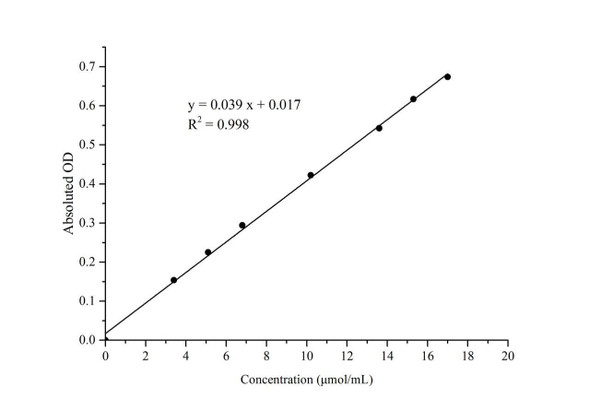
- Prepare standards fresh by diluting the 1.54 mmol/L Zinc Standard with deionized water to 0, 3.85, 7.7, 11.55, 15.4, 23.1, 30.8, and 46.2 µmol/L. Discard working dilutions after use.
Assay
- Pretreat samples: mix 50 µL sample with 50 µL Protein Precipitator, centrifuge at 13,780 × g for 10 min at 4°C, and use the supernatant.
- Add 0.05 mL of each standard to standard wells and 0.05 mL of pretreated supernatant to sample wells.
- Add 0.2 mL chromogenic working solution to each well.
- Mix on the microplate reader for 30 s, then stand for 5 min at room temperature.
- Read OD at 560 nm.
Calculation
- Average duplicate readings. Subtract the mean blank (Standard ①) OD from all readings to obtain absolute OD values.
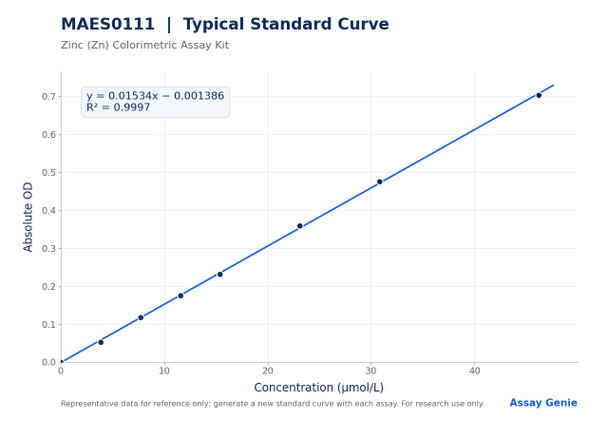
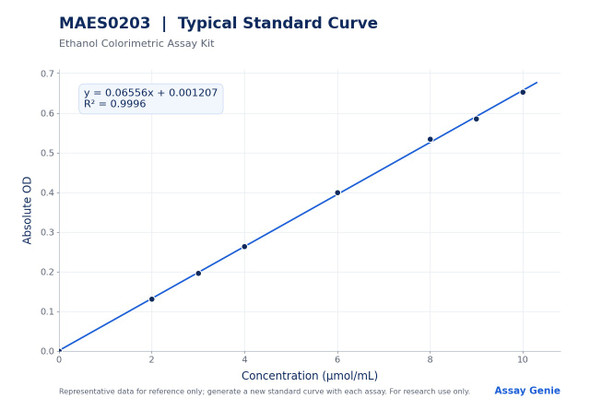
- Plot absolute OD (y) against standard concentration (x) and fit a linear standard curve (y = ax + b).
- Calculate zinc content (µmol/L) = (ΔA − b) ÷ a × 2 × f, where ΔA = OD(sample) − OD(blank), 2 is the pretreatment dilution factor, and f is the pre-assay dilution factor.
Zn content (µmol/L) = (ΔA560 − b) ÷ a × 2* × f
- ΔA560 is the sample OD at 560 nm minus the blank OD (Standard #1, 0 µmol/L), in absorbance units.
- a and b are the slope and intercept of the standard curve y = ax + b, where y is the absolute OD (mean standard OD minus mean blank OD) and x is the standard concentration in µmol/L.
- 2* is the dilution factor of the sample in the pretreatment step (50 µL sample plus 50 µL protein precipitator gives 2).
- f is the dilution factor of the sample applied before the test; use 1 if the sample was not diluted further.
- Result units are µmol/L. Example from the manual: (0.217 − 0.105 − 0.0023) ÷ 0.0152 × 2 = 14.43 µmol/L, using the standard curve y = 0.0152x + 0.0023.
Which sample types can be tested with this kit?
The kit measures zinc in serum, plasma, urine, and milk. The manual lists a recommended dilution factor of 1 for human urine, human serum, human milk, and rat serum.
How should the kit and samples be stored?
Kit reagents are stored at 2-8°C for 12 months, with the Chromogenic Agent and Buffer Solution protected from light. Serum, plasma, urine, and milk that are not tested the same day can be stored at -80°C for one month.
What should I do if my sample is outside the detection range?
The detection range is 0.748 to 46.2 µmol/L. If the concentration is beyond the linear range, dilute the sample with deionized water, measure it again, and multiply the result by the dilution factor.
What can interfere with the assay or affect results?
Do not use EDTA, citrate, or other metal chelators as anticoagulants, and do not use hemolyzed samples. Avoid zinc contamination of vessels and reagents, and prevent bubbles when transferring supernatant to the microplate.
What instrument settings are required?
Use a microplate reader set between 545 and 575 nm, with 560 nm as the optimum wavelength. Mix the plate for 30 seconds, then read absorbance at 560 nm after 5 minutes at room temperature.
How long does the assay take?
The assay time is 20 minutes, according to the product page.
| Storage: | 2–8°C |
| Shelf Life: | 12 months |
| Light Protection: | Chromogenic Agent and Buffer Solution: protect from light |
| Shipping: | Gel pack |
Notes
- For Research Use Only. Not for use in diagnostic procedures.
- Do not use EDTA, citrate, or other metal chelators as anticoagulants.
- Do not use hemolyzed samples.
- Avoid zinc contamination of vessels and reagents, as serum zinc concentrations are very low.
- Clarify supernatants after centrifugation; re-centrifuge turbid supernatants.
- Avoid bubbles when transferring supernatant to the microplate.
- Samples above the linear range should be diluted with deionized water and the result multiplied by the dilution factor.
- Prepare chromogenic working solution and standard dilutions fresh for each assay.
- Do not mix reagents from different kit lots.