Description
ATP5J2 Antibody (CAB17055)
The ATP5J2 Antibody (CAB17055) is a high-quality antibody developed for reliable detection and analysis of target proteins. This antibody, produced in rabbits, exhibits high reactivity with human samples and is validated for use in Western blotting applications. By binding specifically to ATP5J2 protein, this antibody enables precise detection and analysis in a variety of cell types, making it an ideal choice for investigations in molecular biology and bioenergetics.
This antibody is validated for use in WB, ELISA applications and has demonstrated reactivity against Mouse, Rat samples.
| Product Name: | ATP5J2 Antibody |
| SKU: | CAB17055 |
| Size: | 20μL, 100μL |
| Reactivity: | Mouse, Rat |
| Immunogen: | Synthetic peptide. This information is considered to be commercially sensitive. | ||||
| Sequence: | MASV GECP APVP VKDK KLLE VKLG ELPS WILM RDFS PSGI FGAF QRGY YRYY NKYI NVKK GSIS GITM VLAC YVLF SYSF SYKH LKHE RLRK YH | ||||
| Tested Applications: | WB ELISA | ||||
| Recommended Dilution: |
| ||||
| Synonyms: | ATP5J2, ATP5JL |
| Positive Sample: | Mouse brain, Mouse kidney, Rat heart |
| Cellular Localization: | Mitochondrial Inner Membrane, Mitochondrial Proton-Transporting Atp Synthase Complex, Mitochondrion, Nuclear Membrane. |
| Calculated MW: | 11kDa |
| Observed MW: | 11kDa |
Mitochondrial ATP synthase catalyzes ATP synthesis, utilizing an electrochemical gradient of protons across the inner membrane during oxidative phosphorylation. It is composed of two linked multi-subunit complexes: the soluble catalytic core, F1, and the membrane-spanning component, Fo, which comprises the proton channel. The catalytic portion of mitochondrial ATP synthase consists of five different subunits (alpha, beta, gamma, delta, and epsilon) assembled with a stoichiometry of 3 alpha, 3 beta, and single representatives of the gamma, delta, and epsilon subunits. The proton channel likely has nine subunits (a, b, c, d, e, f, g, F6 and 8). This gene encodes the f subunit of the Fo complex. Alternatively spliced transcript variants encoding different isoforms have been identified for this gene. This gene has multiple pseudogenes. Naturally occurring read-through transcription also exists between this gene and the downstream pentatricopeptide repeat domain 1 (PTCD1) gene.
| Purification Method | Affinity purification |
| Gene ID | 9551 |
| RRID | AB_2768507 |
| Buffer Information | Store at -20℃. Avoid freeze / thaw cycles. Buffer: PBS with 0.01% thimerosal,50% glycerol,pH7.3. |
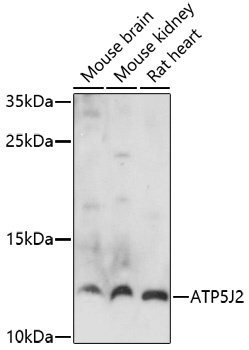 | Western blot analysis of various lysates using ATP5J2 Rabbit pAb (CAB17055) at 1:1000 dilution. Secondary antibody: HRP-conjugated Goat anti-Rabbit IgG (H+L) (CABS014) at 1:10000 dilution. Lysates/proteins: 25μg per lane. Blocking buffer: 3% nonfat dry milk in TBST. Detection: ECL Basic Kit (AbGn00020). Exposure time: 90s. |