Description
BCA Protein Colorimetric Assay Kit
The BCA Protein Colorimetric Assay Kit (MAES0177) measures total protein concentration in serum, plasma, cell culture supernatant, tissue, and cell samples. The assay is based on copper reduction by protein under alkaline conditions and BCA reagent chelation, read as absorbance at 562 nm on a microplate reader. It is supplied as a 96-assay kit for research use only.
Total protein (TP) is the combined protein content of a biological sample, which makes it a general quantitative reference for protein-containing matrices. This BCA Protein Colorimetric Assay Kit (MAES0177) is intended to measure total protein in serum, plasma, cell culture supernatant, tissue, and cell samples. It is listed under the research area Amino Acids And Proteins and is for research use only. The assay does not target a single protein, so the readout reflects the total protein signal in the sample.
Researchers measure total protein to determine the protein concentration of a sample before downstream analysis. The sources cite tissue homogenates from mouse brain, kidney, and heart, rat liver tissue, and human and rat serum as examples of matrices tested with this kit. Because each matrix carries a different protein load, the recommended dilution factors vary by sample type. These sample types support routine physiological and tissue-based protein quantification.
The assay relies on the reduction of Cu2+ to Cu+ by protein under alkaline conditions. Cu+ then combines with BCA reagent to form a purple complex with a maximum absorption peak at 562 nm, and absorbance is proportional to protein concentration. In practice, 20 µL of each standard or sample is added to the bottom of its well, followed by 200 µL of BCA working solution. The plate is oscillated for 20 s, incubated at 37°C for 30 min, and read at 562 nm on a microplate reader operating at 540-590 nm.
Suitable samples include serum, plasma, cell culture supernatant, tissue, and cell samples. Samples must not contain chelating agents such as EGTA or EDTA, or reducing substances such as DTT or mercaptoethanol. Add samples slowly to avoid bubbles, because bubbles can affect results. The BCA working solution is stored at 2-8°C and used within 24 h of preparation, and standard dilutions must be prepared fresh and discarded after use.
Reported sensitivity is 0.0165 mg/mL, and the detection range is 0.0165-1 mg/mL. Precision is 4.5% inter-assay CV and 2.2% intra-assay CV. The standard curve is built from eight points spanning 0 to 1.0 mg/mL. The listed sample volume is 20 µL and the assay time is 40 min.
| Product Name: | BCA Protein Colorimetric Assay Kit |
| SKU: | MAES0177 |
| Size: | 96 Assays |
| Detection Method: | Colorimetric |
| Instrument: | Microplate reader (540-590 nm) |
| Sample Types: | Serum, plasma, cell culture supernatant, tissue, cells |
| Assay Time: | 40 min |
| Research Area: | Amino acids and proteins |
| Use: | Research use only |
| Sensitivity: | 0.0165 mg/mL |
| Detection Range: | 0.0165-1 mg/mL |
| Intra-assay CV: | 2.2% |
| Inter-assay CV: | 4.5% |
| Sample Volume: | 20 µL |
| Absorbance Maximum: | 562 nm |
| Assay Time: | 40 min |
- Colorimetric total protein assay read at 562 nm on a microplate reader (540-590 nm filter range)
- Detection range 0.0165-1 mg/mL with a sensitivity of 0.0165 mg/mL
- Validated sample types: serum, plasma, cell culture supernatant, tissue, and cells
- Intra-assay CV 2.2% and inter-assay CV 4.5%
- Standard curve of eight points (0-1.0 mg/mL) with a 1 mg/mL protein standard
- Assay time of 40 min with 20 µL sample volume
Cu2+ is reduced to Cu+ by protein under alkaline conditions. Cu+ then combines with BCA reagent to form a purple complex with a maximum absorption peak at 562 nm. Absorbance is proportional to protein concentration, so protein concentration is calculated from the OD value against a standard curve.
- Total protein quantification in serum and plasma samples
- Total protein determination in cell culture supernatant and cell lysates
- Protein quantification in tissue homogenates prior to downstream analysis
- Sample normalization for comparing protein-level measurements across experimental groups
| Component | Quantity | Storage |
| BCA Reagent (Reagent 1) | 25 mL × 1 vial (96 Assays) | Room temperature, 12 months, protect from light |
| Copper Salt Solution (Reagent 2) | 0.5 mL × 1 vial (96 Assays) | Room temperature, 12 months, protect from light |
| Standard (Reagent 3), 1 mg/mL after reconstitution | 1 mg × 1 vial (96 Assays) | Room temperature, 12 months, protect from light |
| Standard Diluent (Reagent 4) | 15 mL × 1 vial (96 Assays) | Room temperature, 12 months, protect from light |
| Microplate | 96 wells (96 Assays) | No requirement |
- Microplate reader capable of 540-590 nm (562 nm reading)
- Vortex mixer
- Micropipettor
- Incubator set to 37°C
- Double-distilled water
- Normal saline (0.9% NaCl) or PBS (0.01 mol/L, pH 7.4) for sample dilution
Serum/plasma
- Dilute human serum 100-200-fold before testing.
- Dilute rat serum 100-200-fold before testing.
- Use normal saline (0.9% NaCl) or PBS (0.01 M, pH 7.4) as the diluent.
- For other serum or plasma types, perform a pretest to confirm the dilution factor.
- Confirm the sample does not contain EGTA, EDTA, DTT, or mercaptoethanol.
Tissue
- Prepare a 10% tissue homogenate.
- Dilute 10% mouse brain, mouse kidney, and mouse heart homogenates 8-12-fold using normal saline (0.9% NaCl) or PBS (0.01 M, pH 7.4).
- Dilute 10% rat liver homogenate 15-20-fold using normal saline (0.9% NaCl) or PBS (0.01 M, pH 7.4).
- For other tissue types, perform a pretest to confirm the dilution factor.
Cell culture supernatant and cells
- No dilution factor is provided for these sample types; perform a pretest to determine the appropriate dilution factor.
- Use normal saline (0.9% NaCl) or PBS (0.01 M, pH 7.4) as the diluent.
- Confirm the sample does not contain EGTA, EDTA, DTT, or mercaptoethanol.
Reagent preparation
- Prepare 1 mg/mL standard: dissolve one 1 mg standard vial in 1 mL Standard Diluent and mix thoroughly. Aliquots may be stored at -20°C for 3 months.
- Prepare BCA working solution fresh for each use: per well, mix 4 µL Copper Salt Solution with 196 µL BCA Reagent (200 µL total). Store at 2-8°C for up to 24 h.
- Prepare a fresh standard curve for each run and discard working standard dilutions after use.
Standard curve preparation
- Dilute the 1 mg/mL standard with Standard Diluent to 0, 0.1, 0.2, 0.3, 0.4, 0.6, 0.8, and 1.0 mg/mL. Reference volumes (1 mg/mL standard / Standard Diluent): 0 mg/mL, 0 µL / 200 µL; 0.1 mg/mL, 20 µL / 180 µL; 0.2 mg/mL, 40 µL / 160 µL; 0.3 mg/mL, 60 µL / 140 µL; 0.4 mg/mL, 80 µL / 120 µL; 0.6 mg/mL, 120 µL / 80 µL; 0.8 mg/mL, 160 µL / 40 µL; 1.0 mg/mL, 200 µL / 0 µL.
Assay procedure
- Add 20 µL of each standard to standard wells and 20 µL of each sample to sample wells. Dilute samples in normal saline or PBS as needed; dilution factors are for reference only, and other sample types should be pretested.
- Add 200 µL of BCA working solution to each well, adding it to the bottom of the well.
- Oscillate for 20 s to mix thoroughly, then incubate at 37°C for 30 min.
- Measure OD at 562 nm on a microplate reader. Add samples slowly to avoid bubbles, which affect results.
Calculation
- Average the duplicate readings for each standard.
- Subtract the mean OD of the blank (standard #1, 0 mg/mL) from all standard readings to obtain absolute OD values.
- Plot absolute OD (y-axis) against standard concentration (x-axis) and fit a linear standard curve (y = ax + b).
- Calculate protein content (mg/mL) = (ΔA562 − b) ÷ a × f, where ΔA562 = ODSample − ODBlank and f = sample dilution factor.
Protein content (mg/mL) = (ΔA562 - b) ÷ a × f
- ΔA562 is the absolute OD, calculated as OD sample minus OD blank at 562 nm.
- a is the slope and b is the intercept of the standard curve y = ax + b, generated from the absolute OD of each standard versus its concentration in mg/mL.
- To build the standard curve, average the duplicate reading for each standard and subtract the mean OD of the blank (Standard ①) from all standard readings.
- f is the dilution factor of the sample before testing; multiply the calculated value by f to obtain the undiluted protein concentration.
- The result is expressed in mg/mL.
Which sample types can I test with this kit?
The kit is intended for total protein measurement in serum, plasma, cell culture supernatant, tissue, and cell samples. Samples must not contain EGTA, EDTA, DTT, or mercaptoethanol. For sample types without a listed dilution factor, run a pretest to determine the dilution.
How should I store the kit components and prepared reagents?
The product can be stored at room temperature for 12 months, protected from light. Store all reagents strictly according to the conditions in the kit table, and do not mix components between kits. The BCA working solution is stored at 2-8°C for 24 h, and the 1 mg/mL standard solution can be aliquoted and stored at -20°C for 3 months.
What should I do if my sample is outside the detection range?
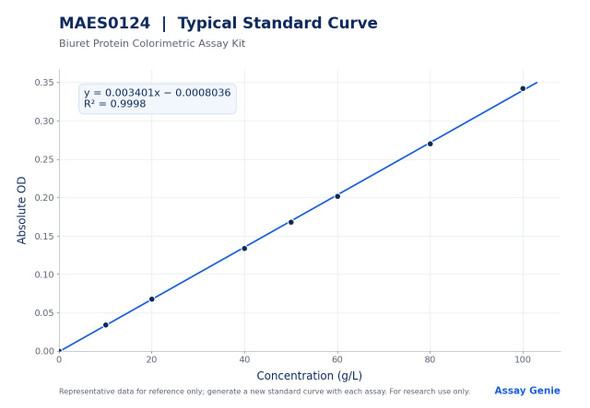
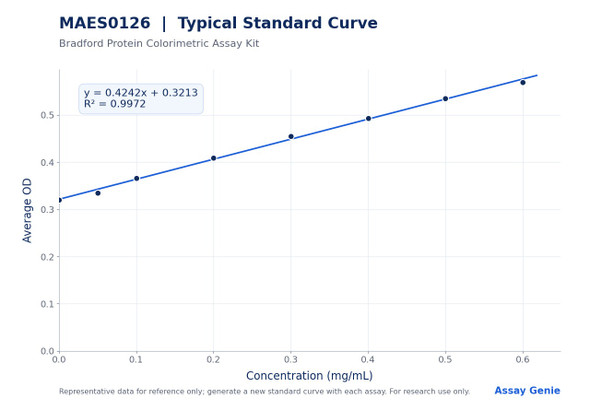
The detection range is 0.0165-1 mg/mL. If protein concentration is high, the sources recommend a biuret-based protein colorimetric kit, and if sample background is high, they recommend a Bradford-based kit. For other sample types, dilute according to a pretest.
What substances can interfere with the assay?
Chelating agents such as EGTA and EDTA, and reducing substances such as DTT and mercaptoethanol, can interfere with results and should not be present in the sample. Bubbles in the wells can also affect results, so add samples slowly.
What instrument settings should I use?
Read absorbance at 562 nm on a microplate reader with a 540-590 nm range. Incubate the reaction at 37°C for 30 min after adding BCA working solution and mixing.
How long does the assay take?
The listed assay time is 40 min. This includes the 30 min incubation at 37°C after the working solution is added and mixed.
| Kit Storage: | Room temperature (RT), 12 months, with shading from light |
| Shelf Life: | 12 months |
| Working BCA Solution: | 2-8°C, up to 24 h |
| Reconstituted 1 mg/mL Standard: | -20°C, up to 3 months (aliquoted) |
| Shipping: | Gel pack |
Notes
- Samples must not contain EGTA, EDTA, DTT, or mercaptoethanol.
- Do not mix reagents from different kits.
- Prepare working solution and standard dilutions fresh; discard unused working standards after use.
- Add reagents to the bottom of the well and add samples slowly to avoid bubbles.
- Dilution factors listed for reference (e.g., human serum 100-200; 10% mouse brain, kidney, or heart homogenate 8-12; 10% rat liver homogenate 15-20; rat serum 100-200) are not validated for all samples; pretest other sample types.
- For Research Use Only. Not for diagnostic or therapeutic use.
BCA Protein Colorimetric Assay Kit (MAES0177) has been used in 1 publication. Newest first.
- 2025Modulation of the Nrf2/HO-1 Pathway- and Apoptosis-Related Genes Following 5-hydroxymethylfurfural Induced Mouse Liver InjuryView publication ↗Kurtel et al. · Journal of Biochemical and Molecular Toxicology