Description
Chloride Assay Kit (Colorimetric) (BA0033) (BA0033)
The Chloride Assay Kit (Colorimetric) (SKU: BA0033) is designed to measure chloride directly in biological samples without any pretreatment. Chloride is the major extracellular anion in body fluids and plays a key role in maintaining water distribution, osmotic pressure and electrolyte balance. Low concentrations may occur with prolonged vomiting, burns and renal disease, while elevated concentrations are associated with dehydration, congestive heart failure and urinary obstruction; sweat chloride is useful in diagnosing cystic fibrosis. This kit uses an improved Fried method in which mercuric 2,4,6-tripyridyl-s-triazine forms a coloured complex specifically with chloride; the intensity measured at 610 nm is directly proportional to the chloride concentration. The optimised formulation substantially reduces interference from substances in raw samples. The single working-reagent, five-minute procedure is readily automated and can be run in 96-well plate or cuvette format.
| Product Name: | Chloride Assay Kit (Colorimetric) (BA0033) |
| SKU: | BA0033 |
| Detection Method: | Colorimetric; improved Fried method using mercuric 2,4,6-tripyridyl-s-triazine measured at 610 nm |
| Detection Range: | 0.7 mg/dL (0.2 mM) to 35 mg/dL (10 mM) Cl- |
| Sample Type: | Serum, plasma, urine, saliva, sweat, food and beverages, water and soil |
| Species Reactivity: | All |
| Assay Time: | 5 min incubation |
| Kit Size: | 250 Assays |
| Equipment Required: | Microplate reader |
| Storage: | Store Reagent and Standard at 4°C. |
| Shelf Life: | 12 months after receipt. |
| Shipping: | Room Temperature |
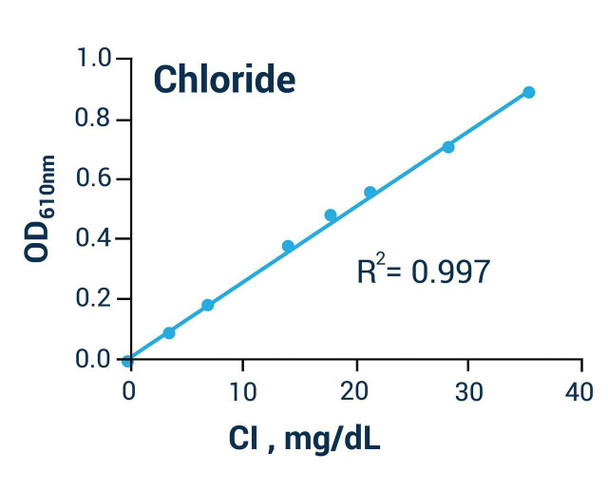
A colorimetric assay for the quantitative determination of chloride directly in biological samples. The improved Fried method uses mercuric 2,4,6-tripyridyl-s-triazine, which forms a coloured complex specifically with chloride; the intensity measured at 610 nm is directly proportional to the chloride concentration. Linear detection range is 0.7 mg/dL (0.2 mM) to 35 mg/dL (10 mM).
- Sensitive and accurate: uses as little as 5 µL of sample; linear detection range 0.7 to 35 mg/dL Cl-.
- Simple and high-throughput: a single working reagent and a 5-minute incubation; readily automated.
- Improved reagent stability and versatility: enhanced reagent and signal stability; cuvette or 96-well plate assay.
- Low interference in biological samples: no pretreatment required, even in the presence of lipid, protein and minerals.
- Cl- in serum, plasma, urine, saliva and sweat.
- Drug discovery and pharmacology: effects of drugs on chloride metabolism.
- Food and beverages: chloride determination.
- Environment: chloride determination in water and soil.
Note: The below protocol is a sample protocol. Protocols are specific to each batch/lot. For the correct instructions please follow the protocol included in your kit.
| Step | Procedure |
| 1 | Bring reagents to room temperature and shake well before use. |
| 2 | Dilute the standards in distilled water as shown in the standards table; dilute serum, plasma, urine and milk samples 20-fold. Transfer 5 µL of diluted standards and samples to wells of a clear-bottom 96-well plate. |
| 3 | Add 200 µL of Reagent and tap lightly to mix. |
| 4 | Incubate 5 min at room temperature and read the optical density at 610 nm (550-650 nm). |
| 5 | Cuvette format: transfer 10 µL diluted standards and samples to tubes, add 1000 µL Reagent, vortex, incubate 5 min and read at 610 nm. |
Subtract the blank OD (water, standard #8) from the standard OD values and plot OD against Cl- concentration to determine the slope. [Chloride] = (ODsample - ODblank) / slope x n (mg/dL), where n is the dilution factor (20 for serum, plasma, milk and urine). Conversions: 1 mg/dL Cl- equals 282 µM, 0.001% or 10 ppm.
| Component | Quantity | Storage |
| Reagent | 50 mL | 4°C |
| Chloride Standard (35 mg/dL Cl-) | 1 mL | 4°C |