Description
DNA library prep kit for Illumina
GenieSeq Universal DNA Library Prep Kit (Illumina) is a ligation-based DNA library preparation kit for Illumina sequencing from pre-fragmented inputs such as cfDNA, FFPE or mechanically sheared DNA, with no enzymatic fragmentation required. It supports PCR and PCR-free workflows over a wide input range (100 pg - 1 μg) and is compatible with target capture.
Optimised end-repair, ligation and amplification modules give a higher conversion rate for low-quality templates and a lower library duplication rate, supporting accurate detection of low-frequency mutations. End repair and dA-tailing run in a single 60 μl reaction, adapter ligation takes 15 min, and the library is ready after bead clean-up and optional amplification. The kit suits genomic DNA, cell-free DNA (cfDNA, ctDNA), FFPE DNA, ChIP DNA and amplicons, with inputs as low as 100 pg for low-complexity samples. Applications include whole-genome, whole-exome and other targeted capture sequencing, amplicon, ChIP, metagenome and methylation sequencing. All reagents undergo rigorous quality control and functional testing. For research use only.
Key Features
| Wide compatibility | Works with low-quality FFPE and cfDNA samples as well as conventional samples. | |
| High efficiency | Higher library conversion rate with a lower duplication rate. | |
| Accurate detection | Supports accurate detection of low-frequency mutations. | |
| Flexible workflow | PCR or PCR-free libraries from 100 pg - 1 μg of input DNA. | |
| Capture-ready | Compatible with common hybrid capture systems for exome and targeted sequencing. |
Specifications
| Method | Ligation-based library preparation from pre-fragmented DNA |
| Platform | Illumina |
| Input DNA | 100 pg - 1 μg |
| Sample types | Genomic DNA, cfDNA/ctDNA, FFPE DNA, ChIP DNA, amplicons |
| Applications | WGS, WES and targeted capture, amplicon, ChIP, metagenome and methylation sequencing |
| Workflow | End preparation, adapter ligation, optional library amplification |
| Shelf life | 2 years |
Components
| Components | 24 rxns (with amplification module) | 96 rxns (with amplification module) | 24 rxns (without amplification module) | 96 rxns (without amplification module) |
| End Prep Buffer 2 | 168 μl | 672 μl | 168 μl | 672 μl |
| End Prep Enzyme 2 | 72 μl | 288 μl | 72 μl | 288 μl |
| Rapid Ligation Buffer 5 | 720 μl | 4 × 720 μl | 720 μl | 4 × 720 μl |
| Rapid DNA Ligase 2 | 240 μl | 4 × 240 μl | 240 μl | 4 × 240 μl |
| GenieSeq HiFi Amplification Mix 2 | 600 μl | 4 × 600 μl | / | / |
| PCR Primer Mix 3 for Illumina | 120 μl | 480 μl | / | / |
| Control DNA (264 bp, 50 ng/μl) | 10 μl | 10 μl | / | / |
Adapters and DNA clean-up beads are not included.
Storage
Store at -30 ~ -15°C.
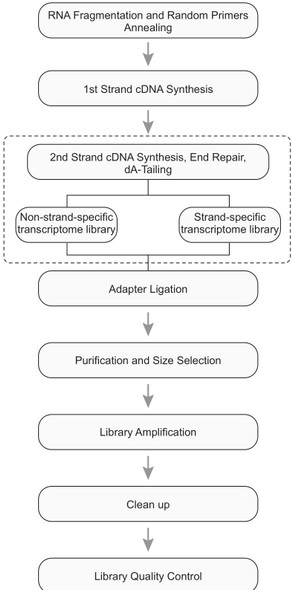
Workflow overview: end preparation (60 μl) → adapter ligation (110 μl) → 0.8× bead clean-up (PCR-free libraries end here) → library amplification (50 μl) → 1× bead clean-up → targeted capture or sequencing. You will also need DNA clean-up beads such as GeniePure DNA Clean-up Beads, indexed Illumina adapters, fresh 80% ethanol, elution buffer (10 mM Tris-HCl, pH 8.0–8.5), 0.1× TE, a magnetic stand and a PCR instrument.
Recommended input DNA
| Application | Sample type | Recommended input DNA |
| Whole-genome sequencing | Complex gDNA | 50 ng - 1 μg |
| Targeted capture sequencing | Complex gDNA | 10 ng - 1 μg |
| Whole-genome/targeted capture sequencing | FFPE DNA | ≥50 ng |
| Whole-genome/targeted capture sequencing | cfDNA/ctDNA | ≥100 pg |
| Whole-genome sequencing | Microbial genome | 1 ng - 1 μg |
| Whole-genome sequencing (PCR-free library) | Complex/small genome | ≥50 ng (no size selection); ≥200 ng (with size selection) |
| ChIP sequencing | ChIP DNA | ≥100 pg |
| Targeted sequencing | Amplicon | ≥100 pg |
These amounts apply to high-quality DNA (A260/A280 = 1.8–2.0); increase them for low-quality samples.
- End preparation
- Thaw End Prep Buffer 2, mix it with End Prep Enzyme 2 by inversion and set up on ice: input DNA x μl, End Prep Buffer 2 7 μl, End Prep Enzyme 2 3 μl, ddH2O to 60 μl.
- Mix by gentle pipetting (do not vortex) and spin down.
- Incubate with the lid at 105°C: 20°C for 30 min, 65°C for 30 min, then hold at 4°C.
- Adapter ligation
- Dilute the adapter in 0.1× TE according to input amount (see table below) so that a fixed 5 μl is used.
- Set up on ice: end preparation product 60 μl, Rapid Ligation Buffer 5 30 μl, Rapid DNA Ligase 2 10 μl, DNA adapter 5 μl, ddH2O 5 μl (total 110 μl). Mix gently and spin down.
- Incubate with the lid at 105°C: 20°C for 15 min, then hold at 4°C. For low inputs, the ligation time can be doubled, although this may increase adapter dimers.
| Input DNA | Adapter : input DNA molar ratio | Adapter working concentration |
| 1 μg | 10:1 | 10 μM |
| 100 ng | 30:1 | 5–10 μM |
| 10 ng | 100:1 | 2 μM |
| 1 ng | 200:1 | 0.5 μM |
| 100 pg | 300:1 | 0.1 μM |
- Post-ligation clean-up (0.8×)
- Add 88 μl of room-temperature, well-mixed beads to the 110 μl ligation product, mix by pipetting 10 times and incubate 5 min at room temperature.
- Separate on a magnetic stand (about 5 min) and discard the supernatant. Wash twice with 200 μl of fresh 80% ethanol (30 sec each), then air-dry 5–10 min.
- Without size selection: elute in 22.5 μl elution buffer and recover 20 μl. With two-round bead size selection: elute in 105 μl and recover 100 μl.
- Products are stable for one week at 4°C, or longer at -20°C. Avoid repeated freeze-thaw cycles.
- Library amplification
- Required for incomplete-length adapters. With complete adapters, it is recommended for inputs below 50 ng and may be skipped above 50 ng or when not needed (PCR-free libraries).
- Set up on ice: purified ligation product 20 μl, PCR Primer Mix 3 for Illumina 5 μl, GenieSeq HiFi Amplification Mix 2 25 μl (total 50 μl). Mix gently and spin down.
| Temperature | Time | Cycles |
| 98°C | 45 sec | 1 |
| 98°C | 15 sec | See table below |
| 60°C | 30 sec | See table below |
| 72°C | 30 sec | See table below |
| 72°C | 1 min | 1 |
| 4°C | Hold |
| Input DNA (into end preparation) | Cycles to generate ~1 μg library |
| 1 μg | 3–5 |
| 100 ng | 6–8 |
| 10 ng | 10–13 |
| 1 ng | 13–15 |
| 100 pg | 17–19 |
Cycle numbers were determined with ~200 bp high-quality input DNA. Increase cycles for poor-quality DNA or longer fragments, and use the higher number if size selection was performed.
- Post-amplification clean-up (1×)
- Add 50 μl of beads to the 50 μl amplification product and purify as in step 3 (or perform two-round bead size selection instead).
- Elute in 22.5 μl elution buffer and recover 20 μl. If targeted capture follows, elute in 22.5 μl ddH2O instead.
- Library quality control
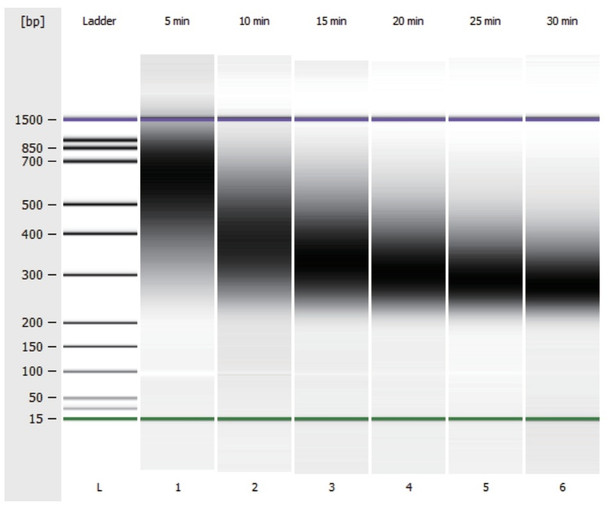
- Check size distribution on an electrophoresis-based instrument (e.g. Agilent 2100 Bioanalyzer) and quantify the library. qPCR-based absolute quantification is recommended and is the only suitable method for PCR-free or over-amplified libraries.
Two-round bead size selection (optional)
Bring the sample to 110 μl with ddH2O. Add X μl beads, mix, incubate 5 min, separate and transfer the supernatant to a new tube (discard the beads). Add Y μl beads to the supernatant, mix, incubate 5 min, separate and discard the supernatant. Wash twice with 80% ethanol, dry and elute as above. Size selection after ligation is recommended for inputs ≥50 ng; after amplification for inputs <50 ng or limited sample copies.
| Time point (sample 110 μl) | Round | 200 bp | 250 bp | 300 bp | 350 bp | 400 bp | 450 bp | 500 bp | 550 bp | 700 bp |
| Before end preparation | 1st X (μl) | 98 | 88 | 77 | 66 | 60 | 57 | 55 | 53 | 47 |
| Before end preparation | 2nd Y (μl) | 22 | 22 | 22 | 22 | 22 | 17 | 17 | 17 | 13 |
| After adapter ligation | 1st X (μl) | 75 | 72 | 65 | 62 | 58 | 56 | 55 | / | / |
| After adapter ligation | 2nd Y (μl) | 22 | 17 | 17 | 13 | 13 | 11 | 11 | / | / |
| After library amplification | 1st X (μl) | 77 | 69 | 61 | 55 | 51 | 50 | 48 | / | / |
| After library amplification | 2nd Y (μl) | 22 | 22 | 22 | 22 | 22 | 22 | 17 | / | / |
Values are expected library insert sizes. For inserts >700 bp, use gel extraction instead.
Q1: How can I reduce residual adapters or adapter dimers?
- Use the recommended adapter : input DNA molar ratio for your input amount (10:1 for 1 μg up to 300:1 for 100 pg) and avoid excess adapter. If the purified ligation product still contains many adapters or dimers, make it up to 50 μl with ddH2O and re-purify with 50 μl (1×) beads; sometimes the adapter amount also needs to be reduced.
Q2: How can I increase library yield from low inputs?
- Increasing the adapter amount (preferably 2–10 fold) can improve yield, especially for inputs ≤25 ng, although it may increase residual adapters. The ligation time can also be doubled for low inputs, and the amplification cycle number adjusted according to the input table.
Q3: Why does my library show a trailing peak at high molecular weight?
- This usually indicates over-amplification, which produces non-complementary cross-annealed products. They sequence normally but are under-estimated by dsDNA dye-based quantification. Reduce the number of amplification cycles rather than removing these peaks by size selection, and use qPCR-based quantification.
Q4: Can I make PCR-free libraries?
- Yes. With complete adapters and sufficient yield, the amplification step can be skipped. Quantify PCR-free libraries by qPCR, because dye-based methods cannot distinguish molecules with adapters at only one end or none.
Q5: When should I perform size selection?
- Size selection can be done before end preparation, after adapter ligation or after amplification. After ligation is recommended for inputs ≥50 ng; after amplification for inputs <50 ng or limited sample copies. Size selection loses about 60%–95% of DNA, so weigh it against library complexity when input is limited.
Q6: Is the kit compatible with hybrid capture?
- Yes. It is compatible with Roche NimbleGen SeqCap EZ, Agilent SureSelect, Illumina TruSeq, IDT xGen Lockdown Probes, the GenieSeq Capture Core Exome Panel and other hybrid capture systems. Elute the amplified library in ddH2O before capture.