Description
RNA-seq library prep kit (plate format)
GenieSeq Universal RNA-seq Library Prep Kit (Illumina & MGI, Plate) is the high-throughput 96-well plate format of the universal RNA-seq library prep kit for Illumina and MGI sequencing platforms. It supports stranded and non-stranded libraries from poly(A)-enriched or rRNA-depleted RNA, and is designed for automation and large sample batches.
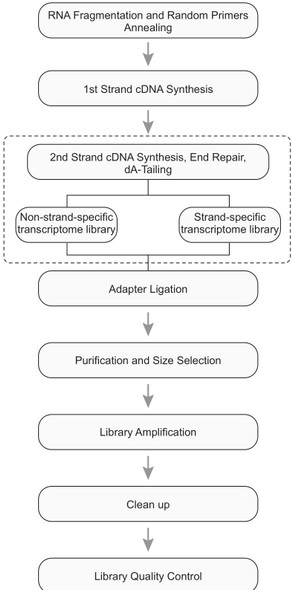
The kit includes two second-strand synthesis mixes, one with dNTPs for non-strand-specific libraries and one with dUTP for strand-specific libraries. Second-strand synthesis, end repair and dA-tailing are combined in one step, and premixed reagents with an optimised reaction system improve library prep efficiency, input compatibility and coverage uniformity across inputs. It accepts total RNA, rRNA-depleted RNA or poly(A)-enriched mRNA from eukaryotes such as animals, plants and fungi, from 0.01–4 μg total RNA or 0.5–100 ng purified RNA. Libraries support gene expression analysis, single-nucleotide variant calling, alternative splicing and gene fusion detection, and targeted transcriptome analysis. All reagents are rigorously quality-controlled and function-tested for stable, reproducible results. For research use only.
Key Features
| Scale effortlessly | High-throughput processing with consistent performance across plate and tube reagents. | |
| Seamless usability | Pre-dispensed, ready-to-use plate reagents enable pipetting-free automation. | |
| Stranded or non-stranded | Choose the dNTP or dUTP second-strand mix to build either library type. | |
| Streamlined workflow | Second-strand synthesis, end repair and dA-tailing run as a single step. | |
| Illumina and MGI | Compatible with both major high-throughput sequencing platforms. |
Specifications
| Format | Prepackaged 96-well reagent plate |
| Platforms | Illumina and MGI |
| Library types | Strand-specific (dUTP) and non-strand-specific (dNTP) |
| Input | 10 ng - 4 μg total RNA (poly(A) capture); 10 ng - 1 μg total RNA (rRNA depletion); 0.5–100 ng purified mRNA or rRNA-depleted RNA |
| Samples | Total RNA, rRNA-depleted RNA or poly(A) mRNA from eukaryotes (animals, plants, fungi); FFPE RNA via rRNA depletion |
| Applications | Gene expression, SNV calling, alternative splicing, gene fusion detection, targeted transcriptome analysis |
| Shelf life | 2 years |
Components
| Components | 48 rxns | 96 rxns |
| Frag/Prime Buffer 2 | 164 μl each | 285 μl each |
| 1st Synthetic Master Mix 2 | 112 μl each | 177 μl each |
| 2nd Synthetic Master Mix 2 (with dNTP) | 164 μl each | 284 μl each |
| 2nd Synthetic Master Mix 2 (with dUTP) | 164 μl each | 284 μl each |
| Ligase Master Mix 2 | 134 μl each | 252 μl each |
| HiFi Amplification Mix 3 | 180 μl each | 360 μl each |
Reagents are supplied prepackaged in a 96-well plate. Columns 10–12 are vacant and can be used to prepare reaction mixes or reagents such as magnetic beads and adapters.
Storage
Store at -30 ~ -15°C.
You will also need: adapters with matching PCR primers (stubby unique dual index sets for Illumina or MGI); GeniePure RNA Clean-up Beads and GeniePure DNA Clean-up Beads; an mRNA enrichment or rRNA depletion kit; RNA QC reagents such as the GenieQuant RNA HS Assay Kit or GenieQuant RNA BR Assay Kit; the GenieQuant 1× dsDNA HS Assay Kit for library QC; freshly prepared 80% ethanol; nuclease-free water, tubes and filter tips; a PCR instrument, magnetic rack, fluorometer and Agilent 2100 Bioanalyzer or equivalent.
- Enrich and fragment RNA
- Option A, poly(A) capture (10 ng - 4 μg intact eukaryotic total RNA in 50 μl): capture mRNA with poly(A) capture beads over two rounds of binding (65°C 5 min, 25°C 5 min, 4°C hold), washing and elution (80°C 2 min). Resuspend the final beads in 18 μl Frag/Prime Buffer 2, fragment at 85°C for 6 min (4°C hold), then transfer 16 μl supernatant to a new tube.
- Option B, rRNA depletion (10 ng - 1 μg total RNA): deplete rRNA following the depletion kit instructions. Purify with 110 μl (2.2×) RNA clean-up beads (15 min on ice), wash twice with 200 μl 80% ethanol and air-dry for 5–10 min. Elute in 18 μl Frag/Prime Buffer 2 (room temperature, 2 min), transfer 16 μl supernatant and fragment at 85°C for 6 min (4°C hold).
- Option C, purified mRNA or total RNA (0.5–100 ng): mix 8 μl RNA with 8 μl 2× fragmentation/priming buffer and fragment at 85°C for 6 min (4°C hold).
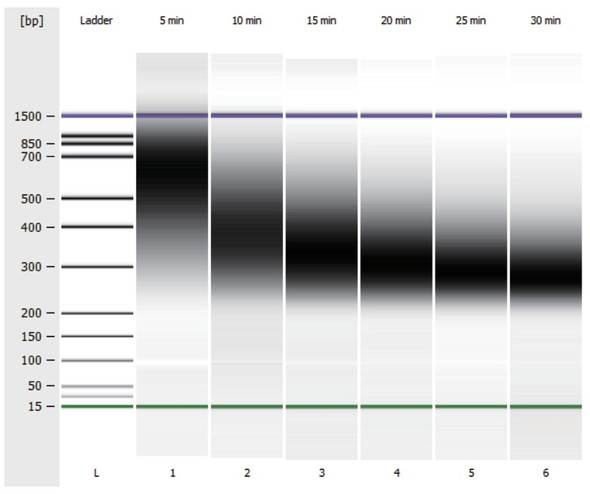
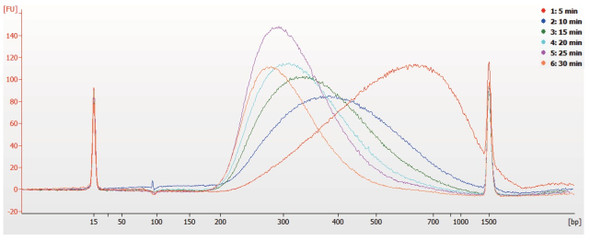
- Do not pause between fragmentation and first-strand synthesis, as mRNA degrades easily. See Table 1 for other fragmentation conditions.
- Synthesise first-strand cDNA
- Mix 16 μl fragmented mRNA with 9 μl 1st Synthetic Master Mix 2 (25 μl total). Protect the master mix from light.
- Run (heated lid 105°C): 25°C 10 min; 42°C 15 min; 70°C 15 min; 4°C hold. Proceed immediately.
- Synthesise second-strand cDNA with end repair and dA-tailing
- Add 40 μl 2nd Synthetic Master Mix 2 to the 25 μl first-strand product (65 μl total). Use the dNTP mix for non-strand-specific libraries or the dUTP mix for strand-specific libraries.
- Run (heated lid 105°C): 16°C 30 min; 65°C 15 min; 4°C hold. Products can be stored at -30 ~ -15°C for 24 h.
- Ligate adapters
- Add 5 μl adapter to the 65 μl ds cDNA and mix, then add 30 μl Ligase Master Mix 2 (100 μl total). Dilute the adapter according to RNA input:
| Total RNA input (Option A/B) | RNA input (Option C) | Adapter concentration |
| ≥1 μg | 100 ng | 5 μM |
| 500 ng | 10 ng | 3 μM |
| 100 ng | 1 ng | 2 μM |
| 10 ng | 0.5 ng | 1.5 μM |
- Run (heated lid 105°C): 20°C 15 min; 4°C hold. Ligation products can be stored at 2 ~ 8°C for 1 h.
- Purify or size-select
- Purification (broad library size, inserts >200 bp): add 60 μl (0.6×) DNA clean-up beads, incubate at room temperature for 10 min, wash twice with 200 μl 80% ethanol, air-dry for 5–10 min, elute in 22 μl nuclease-free water and transfer 20 μl.
- Size selection: purify with 60 μl (0.6×) beads as above but elute in 102 μl and transfer 100 μl. Add 60 μl (0.6×) beads, incubate 10 min and transfer 150 μl supernatant to a new tube. Add 10 μl (0.1×) beads, incubate 10 min, wash twice with 80% ethanol, air-dry, elute in 22 μl and transfer 20 μl. These ratios give a 280–380 bp Illumina insert after fragmentation at 85°C for 6 min; see Table 1 for other sizes.
- Do not carry over beads. Purified products can be stored at -30 ~ -15°C for 24 h.
- Amplify the library
- Mix 20 μl purified ligation product, 5 μl PCR Primer Mix 6 for Illumina/MGI (supplied with the adapter kit) and 25 μl HiFi Amplification Mix 3 (50 μl total).
| Step | Temperature | Time | Cycles |
| Heated lid | 105°C | On | |
| Pre-denaturation | 98°C | 45 sec | 1 |
| Denaturation | 98°C | 15 sec | 9–18 |
| Annealing | 60°C | 30 sec | 9–18 |
| Extension | 72°C | 30 sec | 9–18 |
| Final extension | 72°C | 1 min | 1 |
| Hold | 4°C | Hold |
Recommended PCR cycles:
| Input RNA (Option A/B) | Input RNA (Option C) | Non-strand-specific | Strand-specific |
| >1 μg | - | 9 | 9 |
| 1 μg | 100 ng | 10 | 11 |
| 500 ng | 10 ng | 12 | 13 |
| 100 ng | 1 ng | 14 | 15 |
| 10 ng | 0.1 ng | 17 | 18 |
- Purify the PCR product with 45 μl (0.9×) DNA clean-up beads (10 min at room temperature). Optionally, to remove small fragments, resuspend the beads in 50 μl of a small-fragment removal buffer for 5 min before the ethanol washes. Wash twice with 200 μl 80% ethanol, air-dry for 5–10 min, elute in 25 μl nuclease-free water and transfer 23 μl.
- Check library quality
- Analyse size distribution with an Agilent DNA 1000 kit. A peak at 90–140 bp indicates adapter dimers: dilute the library to 50 μl with nuclease-free water and repeat the 0.9× bead purification.
Table 1. Size selection conditions for ligation products (stubby adapters)
| Platform | Library size (bp) | Fragmentation | Insert size (bp) | 1st round beads | 2nd round beads |
| Illumina | 300–400 | 94°C 5 min | 180–280 | 0.65× | 0.1× |
| Illumina | 400–500 | 85°C 6 min | 280–380 | 0.6× | 0.1× |
| Illumina | 500–600 | 85°C 6 min | 380–480 | 0.5× | 0.1× |
| MGI | 300–400 | 94°C 5 min | 160–260 | 0.5× | 0.2× |
| MGI | 400–500 | 85°C 6 min | 260–360 | 0.5× | 0.15× |
Bead ratios are relative to the initial DNA volume (100 μl). Final library length depends on the bead volumes used.
Q1: How can I improve a low library concentration?
- Library yield depends on RNA integrity and input. If high-quality RNA is not available, increase total RNA input to up to 1 μg, or prepare several replicate libraries and pool them after purification.
Q2: Can the kit be used for small RNA libraries?
- No. Small RNAs of about 22 nt are too short to be captured by the beads used in this workflow.
Q3: Is the kit compatible with FFPE samples?
- Yes. mRNA in FFPE samples may be degraded, so use rRNA depletion rather than poly(A) capture for RNA enrichment.
Q4: How many PCR cycles should I use?
- Follow the recommended cycle table (9–18 cycles depending on input and library type). If unsure, measure 1 μl of unpurified amplification product on a fluorometer and add cycles based on the actual yield.
Q5: Why does my library trace show a double peak?
- Possible causes are RNA degradation leading to nonspecific amplification; uneven fragment distribution after fragmentation of RNA from some species; or assessing the library on a high-sensitivity chip. Use an Agilent DNA 1000 kit, or dilute the library appropriately before running a high-sensitivity DNA kit.
Q6: What does a peak at 90–140 bp mean?
- It indicates adapter-dimer contamination. Dilute the library to 50 μl with nuclease-free water and repeat the 0.9× bead purification.