Description
RNA-seq library prep kit for Illumina and MGI
GenieSeq Universal RNA-seq Library Prep Kit (Illumina & MGI, Tubes) is a versatile RNA-seq library prep kit in tube format for Illumina and MGI platforms. It supports both stranded and non-stranded libraries from poly(A)-enriched or rRNA-depleted RNA. Dual second-strand chemistry and a streamlined, premixed workflow give high-quality libraries across input levels in about 4 hours.
Two second-strand synthesis master mixes are supplied: one with dNTPs for non-strand-specific libraries and one with dUTP for strand-specific libraries. Second-strand synthesis, end repair and dA-tailing run as a single step. The optimised reaction system improves library preparation efficiency, supports lower inputs and gives uniform coverage across input levels, and platform-specific PCR primer mixes are included for Illumina and MGI. The kit works with total RNA, rRNA-depleted RNA or poly(A)-enriched mRNA from eukaryotes such as animals, plants and fungi, including FFPE samples via rRNA depletion. Applications include gene expression analysis, single-nucleotide variant calling, alternative splicing and gene fusion detection, and targeted transcriptome analysis. All reagents undergo rigorous quality control and functional testing for stable, reproducible library preparation. For research use only.
Key Features
| Simplified operation | Premixed reagents complete library preparation in just 4 hours. | |
| Stranded or non-stranded | Choose the dUTP or dNTP second-strand master mix to make strand-specific or non-strand-specific libraries. | |
| Dual-platform compatibility | Supports Illumina and MGI platforms; just select the matching adapter and primer mix. | |
| Species versatility | Works efficiently with RNA from a wide range of eukaryotes, including animals, plants and fungi. | |
| Low input | Works from 0.5 ng of purified mRNA or rRNA-depleted RNA and 10 ng of total RNA. |
Specifications
| Platforms | Illumina and MGI |
| Library types | Non-strand-specific (dNTP) and strand-specific (dUTP) |
| Input: poly(A) mRNA capture | 10 ng - 4 μg total RNA (RIN ≥7) |
| Input: rRNA depletion | 0.01–1 μg total RNA (up to 2 μg for plant samples, depending on depletion kit) |
| Input: purified mRNA or rRNA-depleted RNA | 0.5–100 ng |
| Workflow time | About 4 hours |
| Applications | Gene expression, SNV calling, alternative splicing, gene fusion detection, targeted transcriptome analysis |
| Shelf life | 2 years |
Components
| Components | 24 rxns | 96 rxns |
| Frag/Prime Buffer 2 | 480 μl | 2 × 960 μl |
| 1st Synthetic Master Mix 2 | 216 μl | 864 μl |
| 2nd Synthetic Master Mix 2 (with dNTP) | 960 μl | 4 × 960 μl |
| 2nd Synthetic Master Mix 2 (with dUTP) | 960 μl | 4 × 960 μl |
| Ligase Master Mix 2 | 720 μl | 4 × 720 μl |
| PCR Primer Mix 6 for Illumina | 120 μl | 480 μl |
| PCR Primer Mix 6 for MGI | 120 μl | 480 μl |
| HiFi Amplification Mix 3 | 600 μl | 4 × 600 μl |
PCR primer mixes are supplied for both Illumina and MGI. When using full-length adapters, select the primer mix for your sequencing platform.
Storage
Store at -30 ~ -15°C.
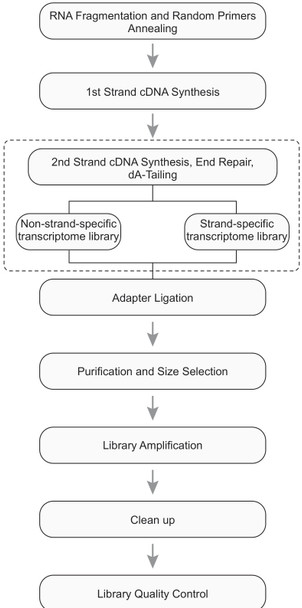
The workflow below is condensed. Thaw all components on ice, mix by inversion, centrifuge briefly and keep on ice.
- Enrich and fragment RNA (choose one option)
Option A: poly(A) mRNA capture (10 ng - 4 μg intact total RNA)
- Using GenieSeq mRNA Capture Beads: dilute total RNA to 50 μl, add 50 μl of beads, then incubate at 65°C for 5 min and 25°C for 5 min. Separate on a magnet and wash with 200 μl of Beads Wash Buffer 2.0.
- Elute in 50 μl of Tris Buffer 2.0 (80°C for 2 min, hold at 25°C), rebind with 50 μl of Beads Binding Buffer 2.0 (room temperature, 5 min) and wash again with 200 μl of Beads Wash Buffer 2.0. Remove as much supernatant as possible.
- Resuspend the beads in 18 μl of Frag/Prime Buffer 2 and fragment at 85°C for 6 min, then hold at 4°C. Transfer 16 μl of supernatant to a new tube.
Option B: rRNA depletion (e.g. 10 ng - 1 μg total RNA)
- Deplete rRNA with an rRNA depletion kit (probe hybridisation, RNase H digestion and DNase I digestion) according to its instructions.
- Purify with 110 μl (2.2×) of GeniePure RNA Clean-up Beads, incubating on ice for 15 min, then wash twice with 200 μl of 80% ethanol and air-dry for 5–10 min.
- Elute in 18 μl of Frag/Prime Buffer 2 (room temperature, 2 min), transfer 16 μl of supernatant and fragment at 85°C for 6 min, then hold at 4°C.
Option C: purified mRNA, rRNA-depleted RNA or total RNA (0.5–100 ng)
- Mix 8 μl of RNA with 8 μl of a separately available 2× Frag/Prime Buffer and fragment at 85°C for 6 min, then hold at 4°C.
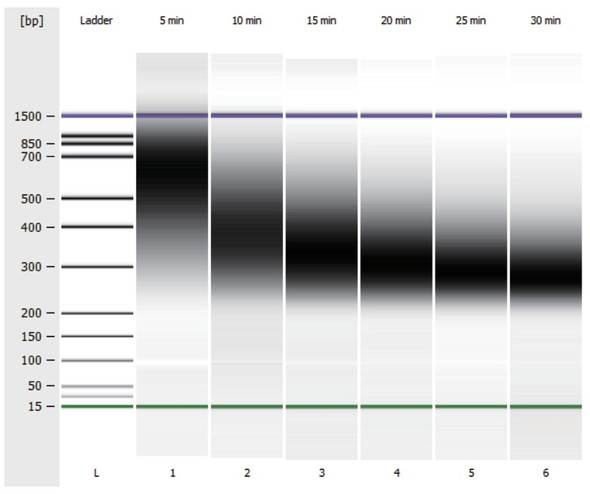
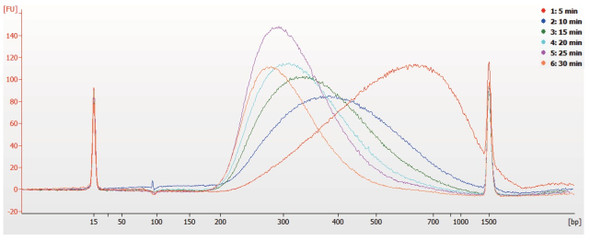
- Fragmentation conditions are for reference; choose them from the size selection table below. Proceed to first-strand synthesis immediately.
- Synthesise first-strand cDNA
- Mix 16 μl of fragmented RNA with 9 μl of 1st Synthetic Master Mix 2 (protect from light) for a 25 μl reaction.
- Run (heated lid 105°C): 25°C for 10 min, 42°C for 15 min, 70°C for 15 min, hold at 4°C. Proceed immediately to second-strand synthesis.
- Synthesise second-strand cDNA with end repair and dA-tailing
- Add 40 μl of 2nd Synthetic Master Mix 2 to the 25 μl of first-strand cDNA (65 μl total). Use the dNTP version for non-strand-specific libraries or the dUTP version for strand-specific libraries.
- Run (heated lid 105°C): 16°C for 30 min, 65°C for 15 min, hold at 4°C. Products can be stored at -30 ~ -15°C for 24 h.
- Ligate adapters
- Add 5 μl of adapter to the 65 μl of ds cDNA and mix, then add 30 μl of Ligase Master Mix 2 (100 μl total).
- Run (heated lid 105°C): 20°C for 15 min, hold at 4°C. Ligation products can be kept at 2–8°C for 1 h.
| Total RNA input (Option A/B) | Input (Option C) | Adapter concentration |
| ≥1 μg | 100 ng | 5 μM |
| 500 ng | 10 ng | 3 μM |
| 100 ng | 1 ng | 2 μM |
| 10 ng | 0.5 ng | 1.5 μM |
- Purify or size-select
- Purification (broad library size, inserts >200 bp): add 60 μl (0.6×) of GeniePure DNA Clean-up Beads, incubate at room temperature for 10 min, wash twice with 200 μl of 80% ethanol, air-dry for 5–10 min and elute in 22 μl of nuclease-free ddH2O, recovering 20 μl.
- Size selection: purify with 60 μl (0.6×) of beads as above but elute in 102 μl and recover 100 μl. Add 60 μl (0.6×) of beads, incubate for 10 min and transfer 150 μl of supernatant to a new tube; add 10 μl (0.1×) of beads, incubate for 10 min, discard the supernatant, wash twice with 80% ethanol, air-dry and elute in 22 μl, recovering 20 μl. (These ratios give a 280–380 bp Illumina insert after fragmentation at 85°C for 6 min; see the table below for other sizes.)
- Purified products can be stored at -30 ~ -15°C for 24 h.
- Amplify the library
- Mix 20 μl of purified ligation product, 25 μl of HiFi Amplification Mix 3 and 5 μl of PCR Primer Mix 6 for Illumina or MGI (50 μl total). Use the included primer mix with full-length adapters; with stubby adapters, use the PCR primers supplied with the adapter kit.
| Step | Temperature | Time | Cycles |
| Heated lid | 105°C | On | |
| Pre-denaturation | 98°C | 45 sec | 1 |
| Denaturation | 98°C | 15 sec | 9–18 |
| Annealing | 60°C | 30 sec | 9–18 |
| Extension | 72°C | 30 sec | 9–18 |
| Final extension | 72°C | 1 min | 1 |
| Hold | 4°C | Hold |
Recommended PCR cycles by input:
| Input (Option A/B) | Input (Option C) | Non-strand-specific | Strand-specific |
| >1 μg | – | 9 | 9 |
| 1 μg | 100 ng | 10 | 11 |
| 500 ng | 10 ng | 12 | 13 |
| 100 ng | 1 ng | 14 | 15 |
| 10 ng | 0.5 ng | 17 | 18 |
- Purify the amplified library
- Add 45 μl (0.9×) of GeniePure DNA Clean-up Beads to the PCR product, incubate at room temperature for 10 min and discard the supernatant. (Optional: to remove small fragments, resuspend in 50 μl of a small-fragment removal buffer, incubate for 5 min and discard the supernatant.)
- Wash twice with 200 μl of 80% ethanol, air-dry for 5–10 min, elute in 25 μl of nuclease-free ddH2O and recover 23 μl.
- Check library quality
- Analyse size distribution with an Agilent DNA 1000 kit. A peak at 90–140 bp indicates adapter dimers: dilute the library to 50 μl with nuclease-free ddH2O and repeat the 0.9× bead purification.
Size selection conditions
| Platform | Library size (bp) | Fragmentation | Full-length adapter insert (bp) | Full-length adapter beads (1st / 2nd round) | Stubby adapter insert (bp) | Stubby adapter beads (1st / 2nd round) |
| Illumina | 300–400 | 94°C, 5 min | 180–280 | 0.65× / 0.1× | 180–280 | 0.65× / 0.1× |
| Illumina | 400–500 | 85°C, 6 min | 280–380 | 0.6× / 0.1× | 280–380 | 0.6× / 0.1× |
| Illumina | 500–600 | 85°C, 6 min | 380–480 | 0.5× / 0.1× | 380–480 | 0.5× / 0.1× |
| MGI | 300–400 | 94°C, 5 min | 220–320 | 0.5× / 0.15× | 160–260 | 0.5× / 0.2× |
| MGI | 400–500 | 85°C, 6 min | 280–380 | 0.45× / 0.15× | 260–360 | 0.5× / 0.15× |
Bead ratios in both rounds are relative to the initial DNA volume (100 μl); the final library length depends on the bead volumes used.
Q1: How can I improve a low library concentration?
- Library concentration depends on total RNA quality, including integrity and input. If high-quality RNA cannot be obtained, increase the total RNA input up to 1 μg, or prepare several duplicate samples and pool them after purification.
Q2: Can the kit be used for small RNA libraries?
- No. Small RNAs are about 22 nt, which is too small to be captured by the beads used in this workflow.
Q3: Is the kit compatible with FFPE samples?
- Yes. Because mRNA in FFPE samples may be degraded, use rRNA depletion rather than poly(A) capture for RNA enrichment.
Q4: How many PCR cycles should I use?
- Follow the recommended cycle table for your input and library type. If unsure, quantify 1 μl of the unpurified amplification product with a fluorometric assay and add cycles according to the actual yield.
Q5: Why does my library show a double peak?
- Possible causes are non-specific amplification from degraded RNA; uneven fragment distribution after fragmentation for RNA from certain species; or analysis on a high-sensitivity chip. Use an Agilent DNA 1000 kit, or dilute the library appropriately before using a high-sensitivity DNA kit.
Q6: Which second-strand master mix should I use?
- Use 2nd Synthetic Master Mix 2 (with dNTP) for non-strand-specific libraries and 2nd Synthetic Master Mix 2 (with dUTP) for strand-specific libraries.