Description
Enzymatic DNA library prep kit for Illumina
GenieSeq Universal Plus DNA Library Prep Kit (Illumina) is an all-enzymatic DNA library prep kit that combines fragmentation, end repair and dA-tailing in a single step, removing the need for mechanical shearing. This upgraded version greatly reduces artificial inverted chimeric reads in FFPE DNA libraries and improves the reliability of SNV calling across a broad input range.
The fragmentation product needs no purification and goes straight into adapter ligation, followed by optional library amplification and size selection. The kit converts 100 pg - 1 μg of DNA into an Illumina-ready library, and insert size is set simply by adjusting the fragmentation time. It is compatible with genomic DNA from animals, plants and microorganisms, as well as FFPE DNA, and is recommended for whole genome sequencing, whole exome sequencing and other targeted capture workflows. With full-length adapters and sufficient input, PCR-free libraries can be prepared. All reagents undergo strict quality control and functional testing for stable, reproducible library preparation. For research use only.
Key Features
| Lower false-positive rate | Greatly reduced false-positive SNV and InDel calls for more accurate variant calling. | |
| One-step fragmentation | Fragmentation, end repair and dA-tailing in one tube, with no purification before ligation. | |
| Wide input range | Converts 100 pg - 1 μg of DNA from diverse sources, including FFPE samples. | |
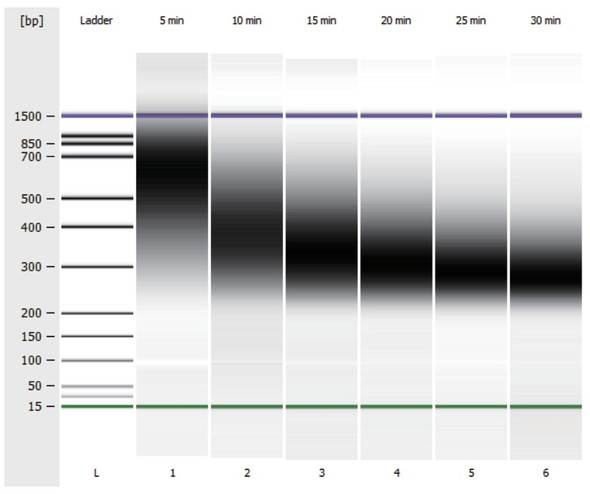
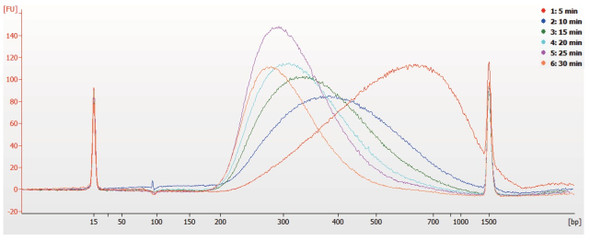
| Tunable insert size | Insert size from about 150 to 550 bp is set by fragmentation time alone. | |
| Excellent performance | Good stability with high library conversion rate and yield. |
Specifications
| Platform | Illumina |
| Method | Enzymatic fragmentation, end repair and dA-tailing (one step), adapter ligation, optional amplification |
| DNA input | 100 pg - 1 μg |
| Sample types | Genomic DNA from animals, plants and microorganisms; FFPE DNA |
| Applications | Whole genome sequencing; whole exome and other targeted capture sequencing |
| Insert size | 150–550 bp, set by fragmentation time |
| Shelf life | 2 years |
Components
| Components | 24 rxns | 96 rxns |
| FEA Buffer V2 | 120 μl | 480 μl |
| FEA Enzyme Mix V2 | 240 μl | 960 μl |
| Rapid Ligation Buffer V2 | 600 μl | 4 × 600 μl |
| Rapid DNA Ligase V2 | 120 μl | 480 μl |
| GenieSeq HiFi Amplification Mix | 600 μl | 4 × 600 μl |
| PCR Primer Mix 3 for Illumina | 120 μl | 480 μl |
| Neutralization Buffer | 120 μl | 480 μl |
| Control DNA (100 ng/μl) | 10 μl | 10 μl |
The Control DNA is derived from salmon genomic DNA and should be re-quantified before use. Not supplied: DNA clean-up beads such as GeniePure DNA Clean-up Beads, Illumina adapters, absolute ethanol, ddH2O, low-binding tubes, PCR tubes, a magnetic rack and a PCR instrument.
Storage
Store at -30 ~ -15°C.
Workflow: fragmentation, end repair and dA-tailing (50 μl) → adapter ligation (100 μl) → 0.6× bead clean-up (PCR-free libraries end here) → library amplification (50 μl) → 0.9× bead clean-up → QC. Optional size selection can be done after ligation or after amplification.
- Fragmentation, end repair and dA-tailing
- Dissolve DNA in ddH2O where possible. The enzyme mix is sensitive to EDTA: if the DNA solvent contains EDTA, either purify the DNA with 2.2× beads and elute in ddH2O, or add Neutralization Buffer according to the final EDTA concentration in the 50 μl reaction (final EDTA = EDTA in DNA solution × DNA volume / 50 μl; e.g. 10 μl DNA in TE with 1 mM EDTA gives 0.2 mM).
| Final EDTA concentration | Neutralization Buffer |
| 1 mM | 5 μl |
| 0.8 mM | 4 μl |
| 0.6 mM | 3 μl |
| 0.5 mM | 2.5 μl |
| 0.4 mM | 2 μl |
| 0.2 mM | 1 μl |
| 0.1 mM | 0.5 μl |
| <0.1 mM | 0 μl |
- Thaw FEA Buffer V2 and FEA Enzyme Mix V2, mix, spin down and keep on ice. Work on ice for all set-up steps.
- In a PCR tube combine Input DNA (x μl), Neutralization Buffer (y μl, only if EDTA is present), 5 μl FEA Buffer V2 and ddH2O to 40 μl.
- Add 10 μl FEA Enzyme Mix V2 last, mix by pipetting or vortexing, spin down and place in the PCR instrument immediately.
- Run: heated lid 105°C; 37°C for the fragmentation time below; 65°C 30 min; 4°C hold.
| Expected insert size | Fragmentation time at 37°C |
| 150 bp | 20–30 min |
| 250 bp | 8–12 min |
| 350 bp | 5–10 min |
| 550 bp | ≤5 min |
Times are based on 100 ng high-quality human gDNA in ddH2O. Within 100 pg - 1 μg input, the same time gives a similar size distribution. For poor-quality DNA or sizes outside the expected range, adjust by 2–5 min. For FFPE DNA, no time adjustment is needed unless insert size is critical.
- Adapter ligation
- Dilute adapters according to input so that a fixed 5 μl is added:
| Input DNA | Adapter concentration | Ready-made 10 μM adapter : ddH2O |
| 1 ng | 0.1 μM | 1:99 |
| 10 ng | 1 μM | 1:9 |
| 50 ng | 5 μM | 1:1 |
| 100 ng - 1 μg | 10 μM | Undiluted |
- Thaw Rapid Ligation Buffer V2 and Rapid DNA Ligase V2, mix, spin down and keep on ice. A white precipitate in the buffer is normal and dissolves on thawing.
- Combine 50 μl fragmentation product, 25 μl Rapid Ligation Buffer V2, 5 μl Rapid DNA Ligase V2, 15 μl ddH2O and 5 μl adapter (100 μl total). Mix and spin down.
- Run: heated lid 105°C; 20°C 15 min; 4°C hold. For very low input, the ligation time can be doubled, though this may increase adapter dimers.
- Clean up with 60 μl beads (0.6×): incubate 5 min at room temperature, separate on a magnet (about 5 min) and discard the supernatant; wash twice with 200 μl fresh 80% ethanol (30 sec each); air-dry until the beads turn from shiny to matte brown.
- Elute in 25 μl eluent (10 mM Tris-HCl, pH 8.0–8.5) or ddH2O and transfer 20 μl. If size selection follows, elute in 105 μl and transfer 100 μl. Store at -20°C.
- Library amplification
- Required for non-full-length (stubby) adapters; recommended for full-length adapters when input is <50 ng. With full-length adapters and ≥50 ng input, this step can be skipped for a PCR-free library.
- Combine 20 μl purified ligation product, 5 μl PCR Primer Mix 3 for Illumina and 25 μl GenieSeq HiFi Amplification Mix (50 μl total). For stubby adapters, use the index primers supplied with the adapter kit instead.
- Run: 95°C 3 min; then cycles of 98°C 20 sec, 60°C 15 sec, 72°C 30 sec (cycle number below); 72°C 5 min; 4°C hold.
| Input DNA | Cycles for 100 ng library | Cycles for 1 μg library |
| 100 pg | 13–15 | 16–18 |
| 1 ng | 9–11 | 13–15 |
| 10 ng | 4–6 | 8–10 |
| 50 ng | 2–4 | 5–7 |
| 100 ng | 0–2 | 4–5 |
| 250 ng | / | 3–4 |
| 500 ng | / | 2–3 |
| 1 μg | / | 0–2 |
Based on high-quality mouse gDNA fragmented for 15 min at 37°C. Use more cycles for poor-quality DNA or if size selection is performed. Stubby adapters need at least 2 extra cycles.
- Clean up with 45 μl beads (0.9×) as above, air-dry 5–10 min, elute in 25 μl eluent or ddH2O (ddH2O if targeted capture follows) and transfer 20 μl. Store at -20°C.
- Library quality control
- Check size distribution on an electrophoresis-based instrument (e.g. Bioanalyzer, TapeStation, LabChip GX or Fragment Analyzer).
- Quantify with a dsDNA fluorescent dye (e.g. GenieQuant 1× dsDNA HS Assay Kit) or by qPCR. qPCR (e.g. GenieQuant Library Quantification Kit for Illumina 2.0) is recommended for PCR-free and over-amplified libraries.
Two-round size selection (optional)
- Perform size selection only once. If input is ≥100 ng, select after adapter ligation; if <100 ng or copy number is limited, select after amplification. Do not omit the post-ligation clean-up before selecting, as the PEG in the ligation buffer interferes.
- Bring the sample to 100 μl with ddH2O. Add X μl beads, incubate 5 min, separate and transfer the supernatant to a new tube (discard beads). Add Y μl beads, incubate 5 min, separate and discard the supernatant. Wash twice with 200 μl 80% ethanol, air-dry 3–5 min, elute in 25 μl and transfer 20 μl.
| Expected insert size (bp) | 150 | 200 | 250 | 300 | 350 | 400 | 450 | 500 |
| After ligation, X (μl) | 78 | 68 | 65 | 59 | 56 | 53 | 51 | 50 |
| After ligation, Y (μl) | 20 | 20 | 15 | 15 | 12 | 12 | 10 | 10 |
| After ligation, stubby adapters, X (μl) | 100 | 90 | 75 | 65 | 60 | 55 | 53 | 50 |
| After ligation, stubby adapters, Y (μl) | 20 | 20 | 20 | 20 | 20 | 20 | 20 | 18 |
| After amplification, X (μl) | 78 | 70 | 63 | 55 | 50 | 46 | 45 | 44 |
| After amplification, Y (μl) | 20 | 20 | 20 | 20 | 20 | 20 | 20 | 15 |
Bead-based selection is ineffective for inserts >700 bp; use gel extraction instead. Conditions may need optimising with other bead brands.
Q1: My DNA is dissolved in TE buffer. Can I still use it?
- Yes, but EDTA inhibits the fragmentation enzyme. If the final EDTA concentration in the 50 μl reaction exceeds 0.1 mM, either purify the DNA with 2.2× beads and elute in ddH2O, or add Neutralization Buffer according to the EDTA table (e.g. 1 μl for 0.2 mM, 5 μl for 1 mM). Do not add excess Neutralization Buffer, as it can cause over-fragmentation.
Q2: How do I control insert size?
- Adjust the 37°C fragmentation time: 20–30 min for 150 bp, 8–12 min for 250 bp, 5–10 min for 350 bp and ≤5 min for 550 bp. If results fall outside the expected range or DNA quality is poor, adjust by 2–5 min. For tighter control, add a two-round bead size selection.
Q3: How can I reduce adapter dimers?
- Dilute the adapter according to DNA input, avoid unnecessarily long ligation times, and use the recommended 0.6× post-ligation clean-up. If dimers remain, bring the purified product to 50 μl with ddH2O and repeat clean-up with 50 μl (1×) beads; reducing adapter amount may also help.
Q4: Why does my library show a high-molecular-weight tail or smear?
- This is usually over-amplification, where primers run out and non-complementary strands cross-anneal. These products are single-stranded libraries of correct length and sequence normally, but dsDNA dye assays underestimate their concentration, so quantify by qPCR. Reduce the cycle number next time; size selection is not recommended to remove the tail.
Q5: Can I make PCR-free libraries?
- Yes. When ligating full-length adapters with ≥50 ng input and sufficient library yield, the amplification step can be omitted. Recommended input for PCR-free WGS is ≥50 ng without size selection or ≥200 ng with size selection. Quantify PCR-free libraries by qPCR.
Q6: When should I perform size selection?
- Perform it only once, as repeated selection reduces complexity and yield. With ≥100 ng input, select after adapter ligation (after the bead clean-up); with <100 ng or limited sample, select after library amplification. With low input, skipping size selection preserves complexity.