Description
Glyoxalase I Activity Assay Kit (Colorimetric) (BA0026) (BA0026)
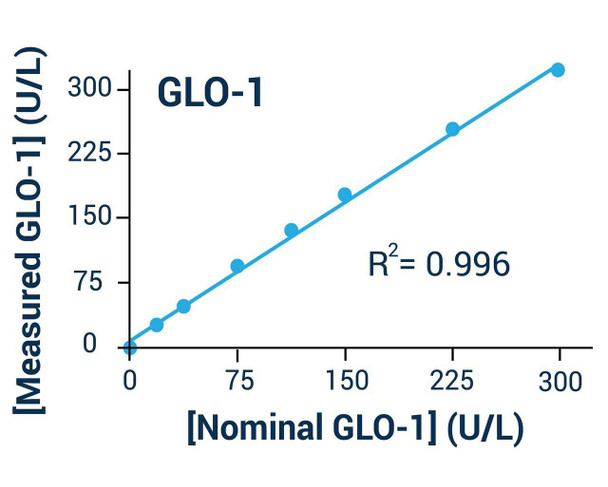
The Glyoxalase I Activity Assay Kit (Colorimetric) (SKU: BA0026) provides a sensitive and convenient method for measuring glyoxalase I (GLO-1) activity in enzyme preparations and biological samples. Glyoxalase I catalyses the isomerisation of hemithioacetal adducts formed between glutathionyl groups and aldehydes, and its principal role is the detoxification of methylglyoxal, a reactive 2-oxoaldehyde that is cytostatic at low concentrations and cytotoxic at higher ones. Because of this role, GLO-1 is a target for pharmaceuticals against bacteria, protozoa and human cancer. The assay monitors the increase in the reaction product, S-lactoylglutathione, by measuring the change in absorbance at 240 nm. It offers a detection limit of 4 U/L, and the simple microplate procedure can be readily automated for high-throughput studies. Separate protocols are provided for pure enzyme preparations and for proteinaceous samples.
| Product Name: | Glyoxalase I Activity Assay Kit (Colorimetric) (BA0026) |
| SKU: | BA0026 |
| Detection Method: | Colorimetric; formation of S-lactoylglutathione measured at 240 nm |
| Detection Range: | Detection limit 4 U/L GLO-1 activity |
| Sample Type: | Enzyme preparations, serum and other biological samples |
| Species Reactivity: | All |
| Assay Time: | 10-20 minutes |
| Kit Size: | 100 Assays |
| Equipment Required: | Microplate reader |
| Storage: | Store the plate at room temperature and other components at -20°C. |
| Shelf Life: | 12 months after receipt. |
| Shipping: | Room Temperature |
A colorimetric assay for the determination of glyoxalase I (GLO-1) activity in enzyme preparations and biological samples. The method monitors the increase in the reaction product S-lactoylglutathione by measuring the change in absorbance at 240 nm. Detection limit is 4 U/L GLO-1 activity.
- Sensitive and accurate: detection limit of 4 U/L GLO-1 activity.
- Simple and high-throughput: incubation of the provided substrate with the sample in a microplate; readily automated for thousands of samples per day.
- GLO-1 activity in enzyme preparations or biological samples.
- Drug discovery and pharmacology: effects of drugs on GLO-1 activity.
Note: The below protocol is a sample protocol. Protocols are specific to each batch/lot. For the correct instructions please follow the protocol included in your kit.
| Step | Procedure |
| 1 | Pure enzyme preparations: bring all reagents to room temperature. Add 40 µL of each sample to separate wells of the UV titer plate, including one blank (sample buffer without GLO-1). |
| 2 | Prepare Working Reagent per well by mixing 160 µL Assay Buffer, 8 µL Substrate and 8 µL Cosubstrate. Add 160 µL Working Reagent to each well. |
| 3 | Read the optical density at 240 nm at t = 0 min and again at t = 10 min (use longer times for low activities). |
| 4 | Proteinaceous samples: add 40 µL of each sample to two Eppendorf tubes (GLO-1 Reaction and Sample Blank). Add 160 µL Working Reagent to the reaction tube and incubate 20 min at room temperature. |
| 5 | Precipitate protein by adding 70 µL 4 M perchloric acid to each reaction tube on ice; chill 15 min, centrifuge 5 min at 14,000 rpm and transfer 200 µL clear supernatant to the UV titer plate. Prepare Sample Blanks in parallel with deproteination before adding Working Reagent. |
| 6 | Read the optical density at 240 nm. |
For pure samples: GLO-1 = (OD10 - OD0) / (ε x l) x (VT / t) x (1 / VS) = 350 x (OD10 - OD0) (U/L). For proteinaceous samples: GLO-1 = 175 x (ODsample - ODblank) x 1.35 x n (U/L). One unit forms 1 µmole of S-lactoylglutathione from methylglyoxal and reduced glutathione per minute at pH 6.6 and 25°C.
| Component | Quantity | Storage |
| Assay Buffer (pH 6.6) | 20 mL | -20°C |
| Substrate | 1 mL | -20°C |
| Cosubstrate | 1 mL | -20°C |
| 96-well UV Titer Plate | 1 Plate | Room temperature |