Description
How the BA0094 creatine kinase assay kit works
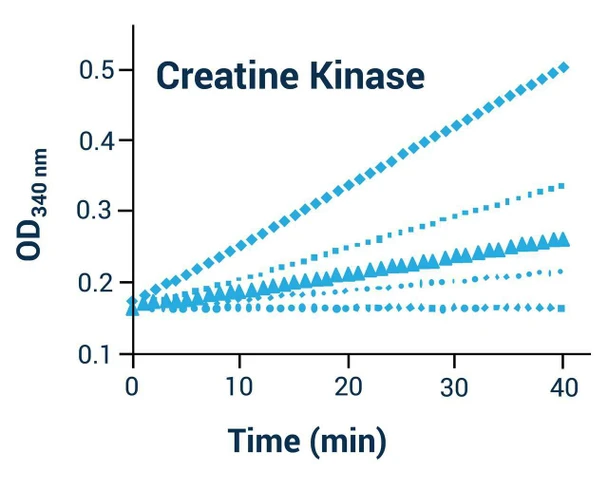
The Creatine Kinase Activity Assay Kit (Colorimetric) (SKU: BA0094) provides a simple, direct and automation-ready procedure for measuring creatine kinase activity. Creatine kinase, also known as creatine phosphokinase, is expressed predominantly in skeletal muscle, smooth muscle and the brain, and its elevation indicates muscle damage associated with injury, rhabdomyolysis, myocardial infarction and related conditions. This kit is based on enzyme-coupled reactions in which creatine phosphate and ADP are converted to creatine and ATP by creatine kinase; the generated ATP phosphorylates glucose via hexokinase to produce glucose-6-phosphate, which is oxidised by NADP in the presence of glucose-6-phosphate dehydrogenase. The produced NADPH, measured at 340 nm, is proportional to the creatine kinase activity in the sample.
Creatine kinase (CK) converts creatine phosphate and ADP into creatine and ATP. In the coupled assay, hexokinase uses that ATP to phosphorylate glucose. Glucose-6-phosphate dehydrogenase then oxidises glucose-6-phosphate and reduces NADP⁺ to NADPH. The rate of NADPH formation, read kinetically at 340 nm, is proportional to CK activity. This is the reaction principle of the IFCC reference procedure for CK.
A CK activity assay reports catalytic activity (U/L) from all CK isoenzymes in the sample (CK-MM, CK-MB, CK-BB) unless one is selectively inhibited. A CK ELISA reports protein mass of a specific isoform, active or not. Use activity to assess muscle damage or enzyme function. Use an isoform-specific ELISA when you need CK-MB or CK-BB mass.
| Product Name: | Creatine Kinase Activity Assay Kit (Colorimetric) (BA0094) |
| SKU: | BA0094 |
| Detection Method: | Colorimetric (kinetic) |
| Detection Range: | 5 to 300 U/L (extendable to 30 to 1,800 U/L) |
| Sample Type: | Serum, plasma and other biological samples |
| Species Reactivity: | All |
| Assay Time: | OD read at 20 and 40 minutes at room temperature or 37C |
| Kit Size: | 100 Assays |
| Equipment Required: | Microplate reader |
| Storage: | -20C |
| Shelf Life: | 6 months after receipt |
| Shipping: | Gel Pack |
Colorimetric determination of creatine kinase activity at 340 nm. Enzyme-coupled reactions convert creatine phosphate and ADP to ATP, which drives NADPH formation; the NADPH absorbance at 340 nm is proportional to creatine kinase activity.
- Sensitive and accurate; detection range 5 to 300 U/L in a 96-well plate assay
- Convenient single-working-reagent procedure read at 20 and 40 minutes
- Assays can be performed at room temperature or 37C
- High-throughput; readily automated for thousands of samples per day
- Direct assays of creatine kinase in serum, plasma and other biological samples
- Pharmacology: effects of drugs on creatine kinase activity
Note: The below protocol is a sample protocol. Protocols are specific to each batch/lot. For the correct instructions please follow the protocol included in your kit.
| Step | Procedure |
| 1 | Sample preparation. Use non-haemolysed samples. Assay within 4 hours of blood collection at room temperature, or within 12 hours if stored at 4C; samples can be stored at -80C and thawed only once. If turbidity is observed, centrifuge and use clear supernatant. |
| 2 | Reagent reconstitution. Bring all components to room temperature. For each reaction well, mix 10 uL Substrate Solution, 100 uL Assay Buffer and 1 uL Enzyme Mix; fresh reconstitution is recommended. For assays at 37C, warm the reconstituted reagent to 37C. |
| 3 | Calibrator. Transfer 110 uL water, and separately 10 uL Calibrator plus 100 uL water, into separate wells of a clear bottom 96-well plate. |
| 4 | Samples. Transfer 10 uL samples into separate wells, add 100 uL reconstituted reagent and tap the plate to mix. |
| 5 | Reaction. Incubate at room temperature or 37C. Creatine kinase is fully activated within 20 minutes by glutathione in the Substrate Solution. Read OD340nm at 20 minutes and again at 40 minutes. |
CK (U/L) = [(OD40min - OD20min) / (OD-Calibrator - OD-H2O)] x 150, where OD40min and OD20min are the sample OD340nm values, OD-Calibrator and OD-H2O are the OD340nm values of the Calibrator and water blank at 40 min, and 150 is the equivalent activity (U/L) of the Calibrator. One unit transfers 1 umole of phosphate from phosphocreatine to ADP per minute at pH 6.0. For activity expected above 300 U/L, read at 20 and 25 minutes, replace (OD40min - OD20min) with (OD25min - OD20min) and replace 150 with 600 (linear range 30 to 1,800 U/L).
| Component | Quantity | Storage |
| Assay Buffer | 12 mL | -20C |
| Enzyme Mix | 120 uL | -20C |
| Substrate Solution | 1.0 mL | -20C |
| Calibrator | 150 uL | -20C |
Is creatine kinase the same as creatine phosphokinase (CPK)?
Yes. Creatine kinase (CK) and creatine phosphokinase (CPK) are two names for the same enzyme, EC 2.7.3.2. It reversibly transfers a phosphate group between creatine phosphate and ADP. BA0094 measures total CK/CPK activity in serum and plasma with a kinetic readout of NADPH absorbance at 340 nm.
How does the creatine kinase activity assay work?
CK in the sample converts creatine phosphate and ADP into creatine and ATP. Hexokinase uses that ATP to phosphorylate glucose, and glucose-6-phosphate dehydrogenase then reduces NADP+ to NADPH. The rate at which absorbance rises at 340 nm, read at 20 and 40 minutes, is proportional to CK activity in the sample.
What is the detection range of the BA0094 kit?
The standard range is 5–300 U/L creatine kinase activity in serum or plasma. For activity expected above 300 U/L, read at 20 and 25 minutes instead of 20 and 40 minutes and use 600 instead of 150 in the calculation, which gives a linear range of 30–1,800 U/L.
Should I run the CK assay at room temperature or 37 °C?
The kit supports both room temperature and 37 °C. Enzyme activity depends on temperature, and readings at 37 °C are higher than at room temperature. Pick one temperature for the whole study, keep it constant across plates and record it with your results, because U/L values from different temperatures are not directly comparable.