

Description
APC Anti-Human CD206 Antibody [15-2]
APC Anti-Human CD206 Antibody [15-2] is a APC-conjugated mouse monoclonal antibody (clone 15-2) against human CD206, for flow cytometry. APC is excited by the 633-640 nm red laser.
CD206, encoded by the MRC1 gene, is a type I membrane receptor that mediates the endocytosis of glycoproteins by macrophages.
Clone 15-2 is also available in 8 other formats: GenieFluor Violet 450, FITC, GenieFluor 488, PerCP/Cyanine5.5, PE, PE/Cyanine5, PE/Cyanine7, GenieFluor 647. Compare every clone and colour on our CD206 antibodies for flow cytometry page.
| Product Title: | APC Anti-Human CD206 Antibody [15-2] |
| SKU: | AGEL1815 |
| Size: | 20 Tests, 100 Tests, 200 Tests |
| Clone No: | 15-2 |
| Synonyms: | CLEC13D;CLEC13DL;MRC1L1;MMR;hMR; |
| Host Species: | Mouse |
| Reactivity: | Human |
| Application: | FCM |
| Isotype: | Mouse IgG1, κ |
| Isotype Control: | APC Mouse IgG1, κ Isotype Control[MOPC-21] |
| Form: | Liquid |
| Conjugation: | APC |
| Recommended Use: | Each lot of this antibody is quality control tested by flow cytometric analysis. The amount of the reagent is suggested to be used 5 µL of antibody per test (million cells in 100 µL staining volume or per 100 µL of whole blood). Please check your vial before the experiment. Since applications vary, the appropriate dilutions must be determined for individual use. |
| Spectrum: | 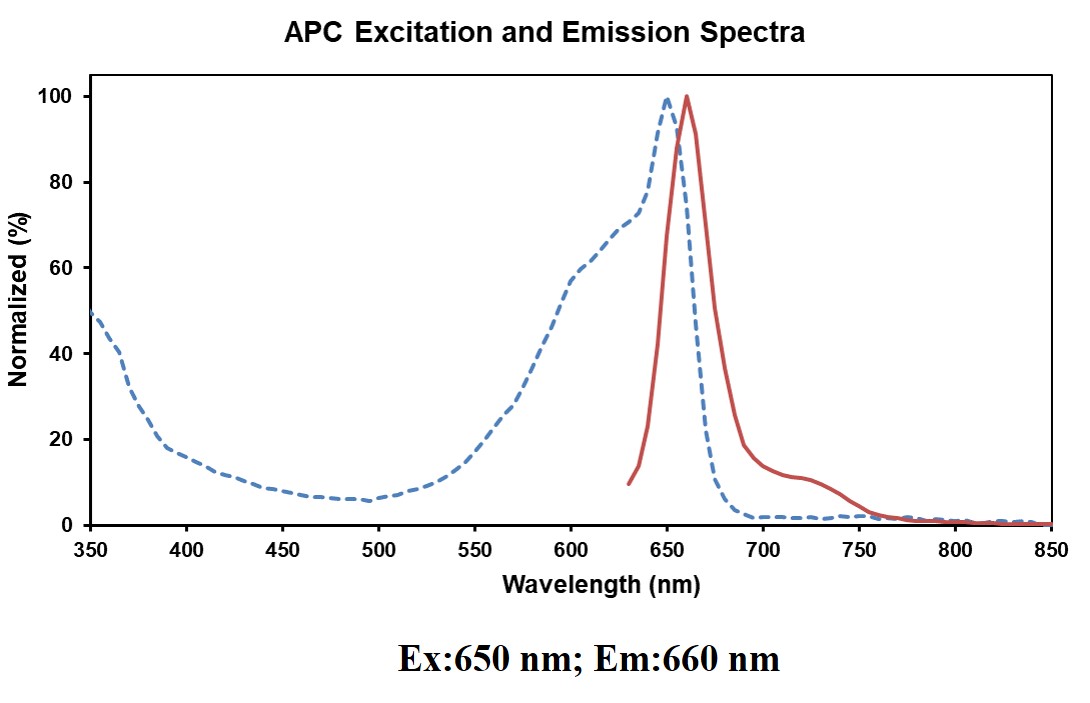 |
| Swissprot: | P22897 |
| Gene ID: | 4360 |
| Storage Buffer: | Phosphate buffered solution, pH 7.2, containing 0.09% stabilizer and 1% protein protectant. |
| Stability & Storage: | Keep as concentrated solution. Store at 2~8°C and protected from prolonged exposure to light. Do not freeze. Centrifuge before opening to ensure complete recovery of vial contents. This product is guaranteed up to one year from purchase. |
| Background: | Macrophage mannose receptor (MMR) is a 162-175 kD type I membrane protein also known as CD206, MRC1, or mannose receptor (MR). It is a pattern recognition receptor (PRR) that belongs to C-type lectin superfamily. MMR is expressed on macrophages, dendritic cells, and hepatic or lymphatic endothelial cells, but not on monocytes. MMR recognizes a range of microbial carbohydrates bearing mannose, fucose, or N-acetyl glucosamine. MMR mediates endocytosis and phagocytosis, induces activation of macrophages and antigen presentation, plays an important role in host defense, and provides a link between innate and adaptive immunity. |


