The Human CD206 Monoclonal Antibody (APC Conjugated) is a vital tool for researchers studying CD206, a cell surface receptor involved in immune responses, particularly related to the immune system's regulation and modulation. This antibody, developed for use with human samples, is specifically designed for flow cytometry applications.CD206, also known as mannose receptor C type 1, is a key molecule in the immune system, playing a role in antigen uptake and presentation, as well as in regulating inflammatory responses. This antibody targets the CD206 protein, enabling precise detection and analysis in various cell types.
Its conjugation with APC facilitates easy visualization and tracking of CD206-expressing cells, making it an excellent choice for immunology and cell biology studies.Researchers interested in immunotherapy, infectious diseases, or inflammatory conditions can benefit from utilizing this antibody to further investigate the functions and roles of CD206 in the immune system. By gaining a deeper understanding of CD206's mechanisms, potential therapeutic strategies targeting this molecule can be explored for the development of novel treatments.
Product Title:
APC Anti-Human CD206 Antibody [15-2]
SKU:
AGEL1815
Size:
20 Tests, 100 Tests, 200 Tests
Clone No:
15-2
Synonyms:
CLEC13D;CLEC13DL;MRC1L1;MMR;hMR;
Host Species:
Mouse
Reactivity:
Human
Application:
FCM
Isotype:
Mouse IgG1, κ
Isotype Control:
APC Mouse IgG1, κ Isotype Control[MOPC-21]
Form:
Liquid
Conjugation:
APC
Recommended Use:
Each lot of this antibody is quality control tested by flow cytometric analysis. The amount of the reagent is suggested to be used 5 µL of antibody per test (million cells in 100 µL staining volume or per 100 µL of whole blood). Please check your vial before the experiment. Since applications vary, the appropriate dilutions must be determined for individual use.
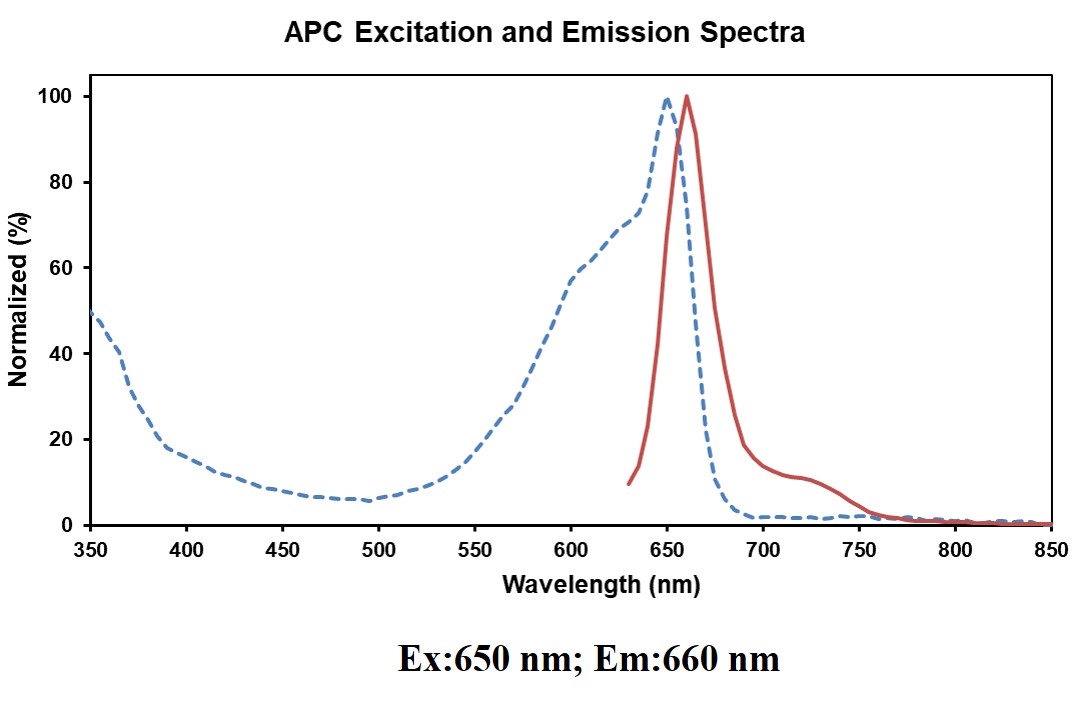
Spectrum:
Swissprot:
P22897
Gene ID:
4360
Storage Buffer:
Phosphate buffered solution, pH 7.2, containing 0.09% stabilizer and 1% protein protectant.
Stability & Storage:
Keep as concentrated solution. Store at 2~8°C and protected from prolonged exposure to light. Do not freeze. Centrifuge before opening to ensure complete recovery of vial contents. This product is guaranteed up to one year from purchase.
Background:
Macrophage mannose receptor (MMR) is a 162-175 kD type I membrane protein also known as CD206, MRC1, or mannose receptor (MR). It is a pattern recognition receptor (PRR) that belongs to C-type lectin superfamily. MMR is expressed on macrophages, dendritic cells, and hepatic or lymphatic endothelial cells, but not on monocytes. MMR recognizes a range of microbial carbohydrates bearing mannose, fucose, or N-acetyl glucosamine. MMR mediates endocytosis and phagocytosis, induces activation of macrophages and antigen presentation, plays an important role in host defense, and provides a link between innate and adaptive immunity.

![APC Anti-Human CD206 Antibody [15-2] (AGEL1815)](https://cdn11.bigcommerce.com/s-h68l9z2lnx/images/stencil/1280x1280/products/22346/606050/apc-anti-human-cd206-antibody-15-2-agel1815__33883.1707496765.jpg?c=2?imbypass=on "APC Anti-Human CD206 Antibody [15-2] (AGEL1815)")
![APC Anti-Human CD206 Antibody [15-2] (AGEL1815)](https://cdn11.bigcommerce.com/s-h68l9z2lnx/images/stencil/608x608/products/22346/606050/apc-anti-human-cd206-antibody-15-2-agel1815__33883.1707496765.jpg?c=2 "APC Anti-Human CD206 Antibody [15-2] (AGEL1815)")
![FITC Anti-Human CD206 Antibody [15-2] (AGEL3349)](https://cdn11.bigcommerce.com/s-h68l9z2lnx/images/stencil/590x590/products/221470/606855/fitc-anti-human-cd206-antibody-15-2-agel3349__22688.1707499370.jpg?c=2 "FITC Anti-Human CD206 Antibody [15-2] (AGEL3349)")
![APC Anti-Mouse CD206 Antibody [C068C2] (AGEL1656)](https://cdn11.bigcommerce.com/s-h68l9z2lnx/images/stencil/590x590/products/22187/606024/apc-anti-mouse-cd206-antibody-c068c2-agel1656__12985.1707496737.jpg?c=2 "APC Anti-Mouse CD206 Antibody [C068C2] (AGEL1656)")
![APC Anti-Mouse CD206 Antibody [C068C2] (AGEL1656)](https://cdn11.bigcommerce.com/s-h68l9z2lnx/images/stencil/590x590/products/22187/768008/apc-anti-mouse-cd206-antibody-c068c2-agel1656__96788.1785533114.jpg?c=2 "APC Anti-Mouse CD206 Antibody [C068C2] (AGEL1656)")
![GenieFluor 700 Anti-Human CD206/MMR Antibody [15-2] (AGEL4933)](https://cdn11.bigcommerce.com/s-h68l9z2lnx/images/stencil/590x590/products/270944/693552/geniefluor-700-anti-human-cd206mmr-antibody-15-2-agel4933__42295.1774509682.jpg?c=2 "GenieFluor 700 Anti-Human CD206/MMR Antibody [15-2] (AGEL4933)")
![APC Anti-Mouse CD206 Antibody [C068C2] (AGEL1653)](https://cdn11.bigcommerce.com/s-h68l9z2lnx/images/stencil/590x590/products/22184/607240/apc-anti-mouse-cd206-antibody-c068c2-agel1653__44987.1707500576.jpg?c=2 "APC Anti-Mouse CD206 Antibody [C068C2] (AGEL1653)")
![APC Anti-Mouse CD206 Antibody [C068C2] (AGEL1653)](https://cdn11.bigcommerce.com/s-h68l9z2lnx/images/stencil/590x590/products/22184/758682/apc-anti-mouse-cd206-antibody-c068c2-agel1653__04641.1785503619.jpg?c=2 "APC Anti-Mouse CD206 Antibody [C068C2] (AGEL1653)")
![APC Anti-Human IgD Antibody [IA6-2] (AGEL1852)](https://cdn11.bigcommerce.com/s-h68l9z2lnx/images/stencil/590x590/products/22383/606008/apc-anti-human-igd-antibody-ia6-2-agel1852__98466.1707496637.jpg?c=2 "APC Anti-Human IgD Antibody [IA6-2] (AGEL1852)")