Description
Ammonia Assay Kit (Colorimetric and Fluorometric) (BA0137) (BA0137)
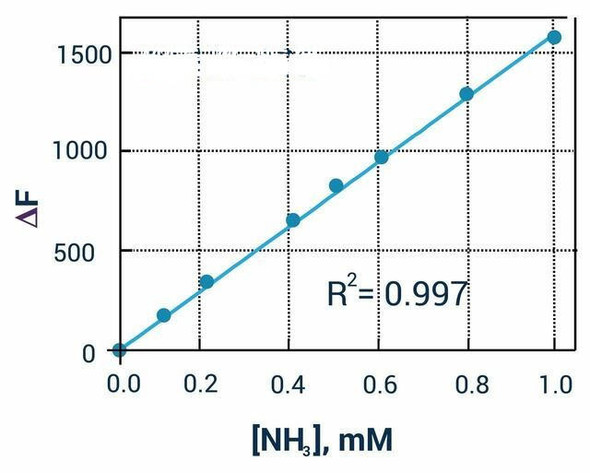
The Ammonia Assay Kit (Colorimetric and Fluorometric) (SKU: BA0137) offers a simple, direct method for measuring ammonia (NH3) and its ion form ammonium (NH4+) in biological samples. Ammonia is an important source of nitrogen for living systems, synthesised through amino acid metabolism and toxic at high concentrations; in the liver it is converted to urea through the urea cycle. Elevated blood ammonia levels (hyperammonaemia) are found in liver dysfunction such as cirrhosis, while hypoammonaemia has been associated with defects in urea cycle enzymes. In this assay, NADH is converted to NAD+ in the presence of NH3, ketoglutarate and glutamate dehydrogenase, and the decrease in optical density at 340 nm or fluorescence at 450/360 nm is directly proportional to the NH3 concentration. This homogeneous mix-and-measure procedure allows reliable quantitation of NH3 within 30 minutes. The linear detection range is 24 to 1000 uM ammonia.
| Product Name: | Ammonia Assay Kit (Colorimetric and Fluorometric) (BA0137) |
| SKU: | BA0137 |
| Detection Method: | Colorimetric and Fluorometric |
| Detection Range: | 24 to 1000 uM ammonia |
| Sample Type: | Serum, plasma, urine, saliva and cell culture |
| Species Reactivity: | All |
| Assay Time: | 30 minutes |
| Kit Size: | 100 Assays |
| Equipment Required: | Microplate reader |
| Storage: | -20 degrees C |
| Shelf Life: | 6 months after receipt (3 weeks after reconstitution of the NADH Reagent) |
| Shipping: | Gel Pack |
This kit is designed to measure NH3 and NH4+ directly. NADH is converted to NAD+ in the presence of NH3, ketoglutarate and glutamate dehydrogenase, and the decrease in optical density at 340 nm or fluorescence intensity at 450/360 nm is directly proportional to the NH3 concentration in the sample.
- High sensitivity and wide linear range using 20 uL sample, with a linear detection range of 24 to 1000 uM ammonia
- Homogeneous and simple mix-and-measure procedure allowing reliable quantitation of NH3 within 30 minutes
- Provides both colorimetric and fluorometric detection formats
- Direct measurement of NH3 in biological samples such as serum, plasma, urine, saliva and cell culture
Note: The below protocol is a sample protocol. Protocols are specific to each batch/lot. For the correct instructions please follow the protocol included in your kit.
| Step | Procedure |
| 1 | Equilibrate all components to room temperature, briefly centrifuge tubes, and reconstitute the NADH Reagent with 1000 uL distilled water (final 10 mM); unused reconstituted NADH Reagent is stable for three weeks when stored frozen at -20 degrees C. |
| 2 | Prepare a 1000 uM NH3 Standard Premix by mixing 15 uL of the 20 mM Standard and 285 uL distilled water, then dilute the standard as described in the dilution table. |
| 3 | Transfer 20 uL standards into separate wells of a clear, flat-bottom 96-well plate, and transfer 20 uL of each sample into two separate wells, one serving as a sample blank and one as a sample well. |
| 4 | For each standard and sample well prepare Working Reagent by mixing 180 uL Assay Buffer, 1 uL Enzyme, 8 uL reconstituted NADH Reagent and 1 uL Ketoglutarate, and add 180 uL to the standards and sample wells; prepare blank control reagent without Enzyme and add 180 uL only to the sample blank wells, then tap the plate to mix and incubate 30 minutes at room temperature. |
| 5 | Read OD340nm, or for the fluorometric procedure use a black flat-bottom 96-well plate and read fluorescence at 350-360 nm excitation and 450 nm emission. |
Subtract the standard values from the blank value and plot the delta OD or delta F against standard concentrations to determine the slope, then calculate [Ammonia] = (RBLANK - RSAMPLE) / [Slope (uM-1)] x n (uM), where n is the sample dilution factor. Conversions: 1000 uM NH3 equals 1.7 mg/dL or 17 ppm.
| Component | Quantity | Storage |
| Assay Buffer | 20 mL | -20 degrees C |
| Ketoglutarate | 120 uL | -20 degrees C |
| NADH Reagent (Dried) | 1 tube | -20 degrees C |
| Enzyme | 120 uL | -20 degrees C |
| Standard | 400 uL | -20 degrees C |