Description
RNA-seq library prep kit for MGI
GenieSeq Universal RNA-seq Library Prep Kit (MGI) is an RNA-seq library preparation kit for the MGI/DNBSEQ platform. It generates stranded or non-stranded libraries from poly(A)-enriched or rRNA-depleted RNA, providing a robust, streamlined workflow for transcriptome sequencing on MGI instruments.
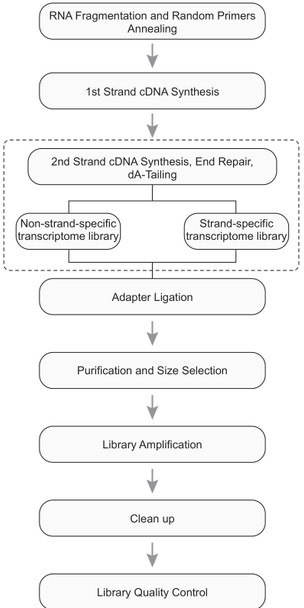
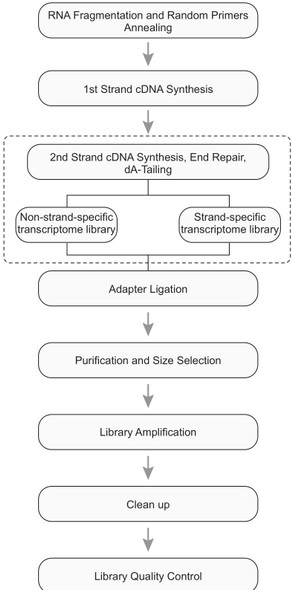
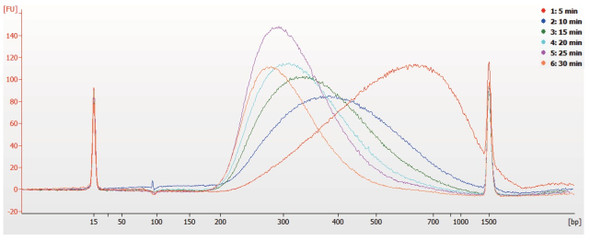
Second-strand cDNA synthesis, end repair and dA-tailing are combined into a single step with no purification, cutting library preparation time to 3 h. Two second-strand buffers are supplied: the dNTP buffer gives non-stranded libraries and the dUTP buffer gives stranded libraries. The optimised reaction system improves library construction efficiency, works with low-input and degraded samples, and gives uniform coverage across input amounts. Insert sizes from 150–200 bp up to 450–550 bp are set by the fragmentation conditions and bead-based size selection. Input ranges from 0.01–4 μg total RNA (poly(A) capture) or 0.5–100 ng purified mRNA or rRNA-depleted RNA. Applications include gene expression analysis, SNV calling, alternative splicing, gene fusion detection and targeted transcriptome analysis. For research use only.
Key Features
| Rapid workflow | A streamlined workflow cuts RNA-seq library preparation time to 3 h. | |
| Stranded or non-stranded | Choose the dUTP or dNTP second-strand buffer to build either library type. | |
| Low-input compatible | Higher library success rates with low input amounts and degraded samples. | |
| Uniform coverage | High-quality sequencing data with more uniform coverage across transcript regions. |
Specifications
| Platform | MGI / DNBSEQ |
| Library type | Stranded (dUTP) or non-stranded (dNTP) transcriptome libraries |
| Input RNA | Total RNA via poly(A) capture: 0.01–4 μg; total RNA via rRNA depletion: 0.01–5 μg depending on depletion kit; purified mRNA or rRNA-depleted RNA: 0.5–100 ng |
| Insert sizes | 150–200 bp to 450–550 bp |
| Library prep time | 3 h |
| Applications | Gene expression, SNV calling, alternative splicing, gene fusion detection, targeted transcriptome analysis |
| Shelf life | 2 years |
Components
| Components | 24 rxns | 96 rxns |
| 2× Frag/Prime Buffer | 240 μl | 960 μl |
| 1st Strand Buffer 3 | 168 μl | 672 μl |
| 1st Strand Enzyme Mix 3 | 48 μl | 192 μl |
| 2nd Strand Buffer 2 (with dNTP) | 600 μl | 4 × 600 μl |
| 2nd Strand Buffer 2 (with dUTP) | 600 μl | 4 × 600 μl |
| 2nd Strand Enzyme Super Mix 2 | 360 μl | 2 × 720 μl |
| Rapid Ligation Buffer 4 | 600 μl | 4 × 600 μl |
| Rapid DNA Ligase 4 | 120 μl | 480 μl |
| PCR Primer Mix 5 for MGI | 120 μl | 480 μl |
| 2× HF Amplification Mix | 600 μl | 4 × 600 μl |
mRNA capture beads or an rRNA depletion kit, RNA adapters for MGI, and DNA/RNA clean-up beads are not included.
Storage
Store at -30 ~ -15°C.
Condensed workflow. Thaw all components on ice, mix by inversion, centrifuge briefly and keep on ice. Mix every step by gently pipetting up and down 10 times.
- Enrich and fragment RNA (choose one)
- Protocol A, poly(A) capture (0.01–4 μg total RNA, RIN ≥7): bring RNA to 50 μl in nuclease-free ddH2O and add 50 μl mRNA capture beads. Bind (65°C 5 min, 25°C 5 min), wash with 200 μl Beads Wash Buffer, release in 50 μl Tris Buffer (80°C 2 min, 25°C hold), rebind with 50 μl Beads Binding Buffer (room temperature, 5 min) and wash again with 200 μl Beads Wash Buffer. Remove all residual wash buffer. Resuspend the beads in 18.5 μl 1× Frag/Prime Buffer (10 μl 2× Frag/Prime Buffer + 10 μl nuclease-free ddH2O), fragment (see table), then transfer 16 μl supernatant to a new tube.
- Protocol B, rRNA depletion (e.g. 0.01–1 μg human/mouse/rat total RNA): deplete rRNA by probe hybridisation, RNase H digestion and DNase I digestion with an rRNA depletion kit. Purify with 110 μl (2.2×) RNA clean-up beads, wash twice with 200 μl fresh 80% ethanol and air-dry for 5–10 min. Elute in 18.5 μl 1× Frag/Prime Buffer for 2 min at room temperature, transfer 16 μl supernatant and fragment (see table). Do not fragment samples with RIN <3.0.
- Protocol C, purified mRNA or rRNA-depleted RNA (0.5–100 ng): mix 8 μl RNA with 8 μl 2× Frag/Prime Buffer (16 μl total) and fragment (see table). Do not fragment already fragmented or short RNA.
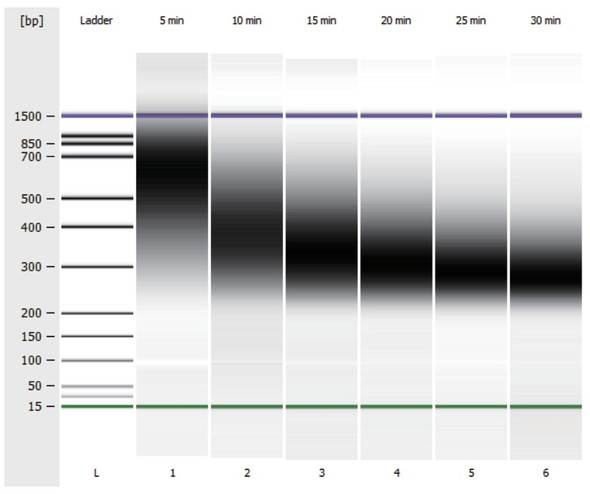
| Insert size (bp) | Temperature | Time |
| 150–200 | 94°C | 8 min, 4°C hold |
| 200–300 | 94°C | 5 min, 4°C hold |
| 250–450 | 85°C | 6 min, 4°C hold |
| 450–550 | 85°C | 5 min, 4°C hold |
Do not pause between fragmentation and first-strand synthesis, as RNA degrades easily in this buffer.
- Synthesise first-strand cDNA
- Combine 16 μl fragmented RNA, 7 μl 1st Strand Buffer 3 and 2 μl 1st Strand Enzyme Mix 3 (25 μl). Keep the buffer/enzyme mix away from light.
- Run (hot lid 105°C): 25°C 10 min, 42°C 15 min, 70°C 15 min, 4°C hold. Proceed immediately to second-strand synthesis.
- Synthesise second-strand cDNA with end repair and dA-tailing
- Add 25 μl 2nd Strand Buffer 2 and 15 μl 2nd Strand Enzyme Super Mix 2 to the 25 μl first-strand product (65 μl). Use the dUTP buffer for stranded libraries or the dNTP buffer for non-stranded libraries.
- Run (hot lid 105°C): 16°C 30 min, 65°C 15 min, 4°C hold.
- Ligate adapters
- Add the RNA adapter to the 65 μl ds cDNA and mix, then add 25 μl Rapid Ligation Buffer 4 and 5 μl Rapid DNA Ligase 4 and make up to 100 μl with nuclease-free ddH2O.
- Adapter volume: 5 μl for 1–4 μg (Protocol A/B) or 100 ng (Protocol C); 3 μl for 100–999 ng (A/B) or 10–99 ng (C); 1 μl for 10–99 ng (A/B) or 0.5–9.9 ng (C).
- Run (hot lid 105°C): 20°C 15 min, 4°C hold. Ligation products can be stored at 2 ~ 8°C for 1 h or at -85 ~ -65°C for 12 h.
- Purify and size-select
- Option A (150–200 bp inserts, 94°C 8 min fragmentation, or input <100 ng): purify with 45 μl (0.45×) DNA clean-up beads, wash twice with 200 μl fresh 80% ethanol, air-dry 5–10 min, elute in 22.5 μl nuclease-free ddH2O and recover 20 μl.
- Option B (>200 bp inserts, input ≥100 ng): purify with 45 μl (0.45×) beads as above but elute in 102.5 μl and recover 100 μl. Then perform two rounds of size selection (table below). For 350–450 bp inserts: add 50 μl (0.5×) beads, incubate 10 min at room temperature, transfer 145 μl supernatant to a new tube; add 15 μl (0.15×) beads, incubate 10 min, discard supernatant, wash twice with 80% ethanol, air-dry, elute in 22.5 μl and recover 20 μl.
- Purified products can be stored at -30 ~ -15°C for 24 h.
| Insert size (bp) | 200–300 | 250–350 | 350–450 | 450–550 |
| Library size (bp) | 280–380 | 330–430 | 430–530 | 530–630 |
| Fragmentation | 94°C 5 min | 85°C 6 min | 85°C 6 min | 85°C 5 min |
| Beads, 1st round | 60 μl (0.6×) | 55 μl (0.55×) | 50 μl (0.5×) | 45 μl (0.45×) |
| Beads, 2nd round | 20 μl (0.2×) | 20 μl (0.2×) | 15 μl (0.15×) | 15 μl (0.15×) |
Bead ratios are relative to the 100 μl input DNA (e.g. 20 μl in the second round is 0.2× of 100 μl, not of the supernatant).
- Amplify the library
- Combine 20 μl purified ligation product, 5 μl PCR Primer Mix 5 for MGI and 25 μl 2× HF Amplification Mix (50 μl).
| Step | Temperature | Time | Cycles |
| Hot lid | 105°C | On | |
| Pre-denaturation | 98°C | 45 sec | 1 |
| Denaturation | 98°C | 15 sec | 9–19 |
| Annealing | 60°C | 30 sec | 9–19 |
| Extension | 72°C | 30 sec | 9–19 |
| Final extension | 72°C | 1 min | 1 |
| Hold | 4°C | Hold |
| Input RNA (Protocol A/B) | Input RNA (Protocol C) | Cycles |
| 2–4 μg | 9–10 | |
| 1–2 μg | 100 ng | 10–12 |
| 100–999 ng | 10–99 ng | 13–15 |
| 10–99 ng | 0.5–9.9 ng | 16–19 |
- Purify the PCR product
- Add 45 μl (0.9×) DNA clean-up beads, incubate 10 min at room temperature, wash twice with 200 μl fresh 80% ethanol and air-dry 5–10 min.
- Elute in 25 μl nuclease-free ddH2O and recover 22.5 μl. With 10 ng input, an extra 0.85× bead purification can remove primer dimers.
- Check library quality
- Analyse 1 μl on an Agilent 2100 Bioanalyzer DNA 1000 chip. A good library shows a narrow peak at the expected size. A peak at 120 bp indicates adapter dimers: dilute the library to 50 μl with nuclease-free ddH2O and repeat the 0.9× purification.
Q1: How can I improve a low library concentration?
- Use high-quality RNA where possible. Otherwise increase the RNA input; prepare several replicate samples and pool them after fragmentation or before PCR; or build libraries without size selection, since RNA fragmented at 94°C for 8 min is short but tightly distributed and uniform.
Q2: What should I do about high rRNA residue?
- Keep the input within the range for your enrichment method: poly(A) capture 0.01–4 μg; rRNA depletion for human/mouse/rat 0.01–1 μg, bacteria 0.01–5 μg, globin and rRNA depletion 0.01–1 μg, plants 1–5 μg. For some samples, an extra Beads Wash Buffer wash during poly(A) capture improves rRNA removal.
Q3: Can I use this kit for small RNA or FFPE samples?
- It is not suitable for small RNA: these are about 22 nt, whereas the beads capture fragments of at least 100 bp. FFPE RNA is usually degraded, so use an rRNA depletion workflow rather than poly(A) capture.
Q4: Why are my size-selected inserts larger than expected?
- Too few beads were added. This happens when beads are not equilibrated to room temperature or mixed thoroughly, when the pipette is inaccurate, or when beads stick to the pipette tip.
Q5: What is the maximum number of PCR cycles?
- Adjust cycles to the input amount. You can test 1 μl by Qubit and add 1–2 cycles if needed, but do not exceed 19 cycles.
Q6: Why does the Bioanalyzer trace show double peaks?
- Residual impurities or degraded RNA reduce effective template and cause nonspecific amplification (test RNA by heating at 65°C for 15 min and re-extract if it fails); some species give discontinuous fragments with two size ranges; or a high-sensitivity chip was overloaded (use a DNA 1000 kit or dilute the library for the high-sensitivity kit).
Q7: Why does a high-yield library show a tail after the upper marker?
- This is over-amplification. Late in PCR the primers are exhausted and fragments anneal imperfectly, forming larger partly single-stranded hybrids. It is normal and does not affect sequencing or data analysis.
Q8: What if I make a mistake during poly(A) capture or fragmentation?
- If 80% ethanol was added instead of Beads Wash Buffer, discard it, dry the beads, resuspend in 200 μl Beads Wash Buffer and continue. If less than 16 μl supernatant is recovered after fragmentation, make it up to 16 μl with 1× Frag/Prime Buffer. If a different fragmentation condition was used than planned, choose the size-selection conditions for the condition actually used; otherwise library construction fails or the insert size changes.