Description
L-Lactic Acid/Lactate (LA) Colorimetric Assay Kit
The L-Lactic Acid/Lactate (LA) Colorimetric Assay Kit (MAES0056) quantifies lactic acid in serum, plasma, cell culture supernatant, tissue homogenates, and cell lysates. The lactate dehydrogenase (LDH)-coupled reaction reduces NBT to a purple product that is read at 530 nm. The kit is used in glycolysis and energy metabolism studies that require a plate-based, 30-minute lactate measurement.
Lactic acid (lactate) is a metabolite whose concentration is measured in serum, plasma, tissue, cells, and cell culture supernatant. In the enzymatic reaction underlying this kit, lactate dehydrogenase (LDH) catalyzes the conversion of lactate to pyruvate, which reduces NAD+ to NADH. The reaction therefore links lactate content to the NAD+/NADH redox state of the sample, and the kit is built around measuring this LDH-dependent step.
Researchers use this kit to quantify lactic acid in the research areas of glycolysis and lipid metabolism and energy metabolism. Measurements are made in serum, plasma, tissue homogenates, and cell cultures, including rat kidney and rat brain tissue and HepG2 cells and their culture supernatant. The kit is intended for research use only and must not be used for clinical diagnosis.
The assay is a colorimetric method. Standards or samples (5 µL) are mixed with enzyme working solution, which is prepared from buffer solution and enzyme stock solution, followed by chromogenic agent. PMS acts as a hydrogen carrier, facilitating the reduction of NBT to a purple product. After 10 min at 37°C, stop solution is added, the plate is mixed, and the OD is read at 530 nm on a microplate reader (520-540 nm). Lactic acid content is then calculated from the standard curve.
Serum and plasma are assayed directly, while cell culture supernatant, tissue homogenates, and cell lysates are clarified by centrifugation and kept on ice before testing. Human serum, rat kidney and rat brain homogenates, and HepG2 samples have recommended dilution factors, and other sample types require a pretest to confirm dilution. The analytical sensitivity is 0.12 mmol/L and the detection range is 0.12-7.0 mmol/L. Intra-assay CV is 1.2-1.8%, inter-assay CV is 3.1-4.0%, and the average recovery is 105% (range 103-106%).
| Product name: | L-Lactic Acid/Lactate (LA) Colorimetric Assay Kit |
| SKU: | MAES0056 |
| Size: | 96 Assays |
| Detection method: | Colorimetric |
| Sample types: | Serum, plasma, cell culture supernatant, tissue, cells |
| Instrument: | Microplate reader (520-540 nm; 530 nm measurement) |
| Assay time: | 30 min |
| Sensitivity: | 0.12 mmol/L |
| Detection range: | 0.12-7.0 mmol/L |
| Recovery rate: | 105% |
| Intra-assay CV: | 1.4% |
| Inter-assay CV: | 3.5% |
| Research area: | Glycolysis and carbohydrate metabolism |
| Sample volume: | 5 µL |
| Assay time: | 30 min |
| Analytical sensitivity: | 0.12 mmol/L |
| Detection range: | 0.12-7.0 mmol/L |
| Recovery rate: | 105% |
| Intra-assay CV: | 1.4% |
| Inter-assay CV: | 3.5% |
| Measurement wavelength: | 530 nm |
- Colorimetric, microplate-based lactic acid measurement read at 530 nm
- Detection range 0.12-7.0 mmol/L with analytical sensitivity of 0.12 mmol/L
- Accepts serum, plasma, cell culture supernatant, tissue, and cell samples
- Recovery of 105% and intra-assay CV of 1.4% and inter-assay CV of 3.5%
- Approximately 30 min assay time after sample preparation
- Research Use Only
Lactate dehydrogenase (LDH) catalyzes the conversion of lactate to pyruvate, which reduces NAD+ to NADH. PMS acts as a hydrogen carrier, facilitating the reduction of NBT to a purple product. The OD value is measured at 530 nm, and the lactic acid concentration is calculated from a standard curve.
- Quantifying lactate in serum and plasma for glycolysis and energy metabolism studies
- Measuring lactate released into cell culture supernatant over time
- Determining lactate content in tissue homogenates normalized to protein concentration
- Measuring lactate in cell lysates from cultured cells
- Investigating LDH-linked lactate and pyruvate interconversion in metabolic research
| Component | Quantity | Storage |
| Reagent 1: Buffer Solution | 6 mL x 2 vials | 2-8°C, 12 months |
| Reagent 2: Enzyme Stock Solution | 1.2 mL x 1 vial | 2-8°C, 12 months |
| Reagent 3: Chromogenic Agent | 1.2 mL x 2 vials | 2-8°C, 12 months; protect from light |
| Reagent 4: Stop Solution | 12 mL x 2 vials | 2-8°C, 12 months |
| Reagent 5: Lactic Acid Standard (10 mmol/L) | 1 mL x 2 vials | 2-8°C, 12 months |
| Microplate | 96 wells x 1 | Room temperature |
- Microplate reader capable of 520-540 nm reading (530 nm)
- Micropipettor
- Centrifuge (10000×g capability for sample clarification)
- Incubator set to 37°C
- Vortex mixer
- Double-distilled water
- Normal saline (0.9% NaCl) or PBS (0.01 mol/L, pH 7.4) for sample dilution
- Dounce homogenizer or ultrasonic cell disruptor for tissue and cell samples
Serum/plasma
- Detect directly without pretreatment.
- If not detected on the same day, store serum or plasma at -80°C for up to one month.
- Dilute human serum 2-5 fold with normal saline (0.9% NaCl) or PBS (0.01 M, pH 7.4) before testing (recommended dilution factor 2-5).
- Use 5 µL of diluted sample per well.
Cell culture supernatant
- Collect fresh cell culture supernatant.
- Centrifuge at 10000×g for 10 min at 4°C.
- Collect the supernatant and keep it on ice for detection.
- For HepG2 cell culture supernatant, the recommended dilution factor is 1 (no dilution).
Tissue
- Harvest the amount of tissue needed for each assay (initial recommendation 20 mg).
- Wash tissue in cold PBS (0.01 M, pH 7.4).
- Homogenize 20 mg tissue in 180 µL PBS (0.01 M, pH 7.4) with a dounce homogenizer at 4°C.
- Centrifuge at 10000×g for 10 min at 4°C to remove insoluble material.
- Collect the supernatant and keep it on ice for detection.
- Determine the protein concentration of the supernatant with a separate protein assay; this value is required for the calculation.
- Dilute 10% rat kidney tissue homogenate 1-3 fold with normal saline (0.9% NaCl) or PBS (0.01 M, pH 7.4). For 10% rat brain tissue homogenate, the recommended dilution factor is 1.
Cells
- Harvest the number of cells needed for each assay (initial recommendation 3×10^6-5×10^6 cells).
- Wash cells with PBS (0.01 M, pH 7.4).
- Homogenize 3×10^6-5×10^6 cells in 200 µL PBS (0.01 M, pH 7.4) with an ultrasonic cell disruptor at 4°C.
- Centrifuge at 10000×g for 10 min at 4°C to remove insoluble material.
- Collect the supernatant and keep it on ice for detection.
- Determine the protein concentration of the supernatant with a separate protein assay; this value is required for the calculation.
- For HepG2 cells, the recommended dilution factor is 1 (no dilution).
Reagent preparation
- Keep Enzyme Stock Solution on ice during use. Equilibrate other reagents to room temperature before use.
- Prepare enzyme working solution fresh before the assay: mix 100 µL of Buffer Solution with 10 µL of Enzyme Stock Solution per 110 µL prepared.
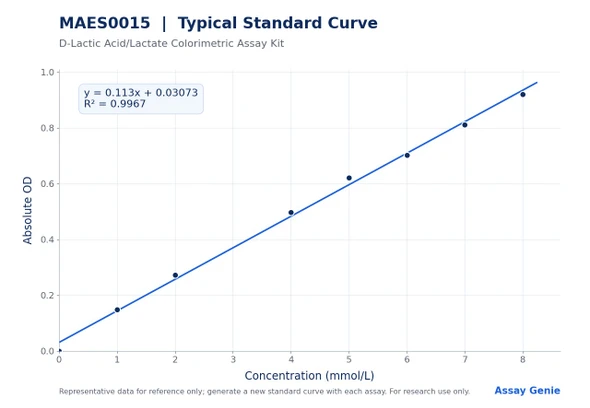
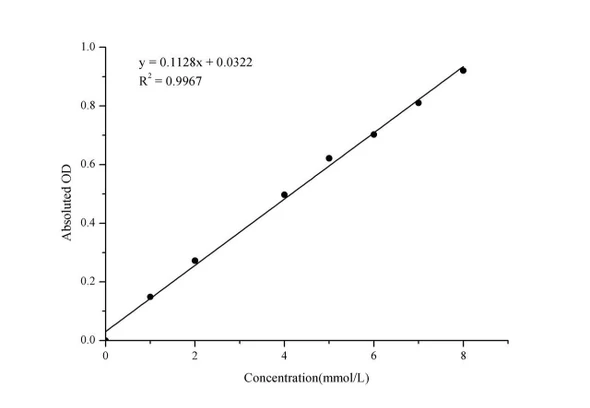
- Prepare a fresh standard curve each time. Dilute the 10 mmol/L Lactic Acid Standard with deionized water to 0, 1, 2, 3, 4, 5, 6, and 7 mmol/L (for example, 0-140 µL of standard and 200-60 µL of deionized water per 200 µL total). Discard working standards after use.
Sample preparation
- Serum and plasma: assay directly. If not assayed the same day, store at -80°C for up to one month.
- Cell culture supernatant: centrifuge fresh supernatant at 10000×g for 10 min at 4°C, then keep the supernatant on ice.
- Tissue: wash tissue in cold PBS, homogenize 20 mg tissue in 180 µL PBS (0.01 mol/L, pH 7.4) at 4°C, centrifuge at 10000×g for 10 min at 4°C, and keep the supernatant on ice.
- Cells: wash 3×10^6-5×10^6 cells with PBS, homogenize in 200 µL PBS (0.01 mol/L, pH 7.4) at 4°C, centrifuge at 10000×g for 10 min at 4°C, and keep the supernatant on ice.
- Dilute samples as needed with normal saline or PBS (0.01 mol/L, pH 7.4). Recommended dilutions for reference: human serum 2-5-fold; 10% rat kidney tissue homogenate 1-3-fold; 10% rat brain tissue homogenate 1-fold; HepG2 cell culture supernatant 1-fold; HepG2 cells 1-fold. Pretest other sample types.
Assay
- Add 5 µL of each standard to standard wells and 5 µL of each sample to sample wells.
- Add 100 µL of enzyme working solution to each well.
- Add 20 µL of Chromogenic Agent to each well.
- Incubate at 37°C for 10 min.
- Add 180 µL of Stop Solution to each well.
- Mix for 5 s and measure OD at 530 nm on a microplate reader.
Calculation
- Average duplicate readings for each standard and subtract the blank (standard 0 mmol/L) mean OD to obtain absolute OD.
- Plot absolute OD (y) against lactic acid concentration (x) and fit a linear standard curve (y = ax + b).
- Serum, plasma, and liquid samples: LA (mmol/L) = (ΔA - b) ÷ a × f, where ΔA is sample absolute OD (OD sample minus OD blank) and f is the dilution factor.
- Tissue and cell samples: LA (mmol/g protein) = (ΔA - b) ÷ a ÷ Cpr × f, where Cpr is protein concentration in g protein/L.
Serum, plasma, culture supernatant, and other liquid samples: LA content (mmol/L) = (ΔA − b) ÷ a × f Tissue and cell samples: LA content (mmol/gprot) = (ΔA − b) ÷ a ÷ C_pr × f
- Standard curve: average the duplicate OD readings for each standard, subtract the mean OD of the blank (standard #1, 0 mmol/L) from all standard readings to obtain the absolute OD, and plot absolute OD (y-axis) against concentration in mmol/L (x-axis). Fit y = ax + b; a is the slope and b is the intercept.
- ΔA is the absolute OD at 530 nm, calculated as OD(sample) − OD(blank).
- f is the dilution factor of the sample before testing. The calculated value is multiplied by f to give the content in the undiluted sample. For example, human serum diluted 5-fold yields a result multiplied by 5.
- C_pr is the protein concentration of the sample in gprot/L, so tissue and cell results are expressed in mmol/gprot.
- Results are reported in mmol/L for liquid samples and mmol/gprot for tissue and cell samples.
What sample types can be tested with this kit?
The kit measures lactic acid in serum, plasma, tissue, cells, and cell culture supernatant. Serum and plasma are assayed directly, and other sample types are prepared as described in the sample preparation section.
How should the kit and samples be stored?
Kit components should be stored at 2-8°C for 12 months, and the chromogenic agent should be protected from light. Serum or plasma not tested on the same day can be stored at -80°C for a month, and cell culture supernatant should be kept on ice during testing.
What is the detection range, and what should be done if a sample is out of range?
The detection range is 0.12-7.0 mmol/L. If the concentration of a sample is not within the detection range, an extra dilution or concentration should be taken for the sample.
What key points should be followed during the assay?
Prepare enzyme working solution fresh on the spot, and keep the enzyme stock solution on ice during use. Prepare standards fresh and discard working standard dilutions after use. Add samples by touching the bottom of the well, and aliquot buffer solution before use to avoid contamination.
What instrument settings are required, and how long does the assay take?
Read the OD at 530 nm on a microplate reader (520-540 nm). The assay time is 30 min.
| Storage: | 2-8°C |
| Shelf life: | 12 months |
| Light sensitivity: | Keep Chromogenic Agent protected from light |
| Shipping: | Gel pack |
Notes
- For Research Use Only. Not for clinical diagnosis or other diagnostic or therapeutic use.
- Keep Enzyme Stock Solution on ice; prepare enzyme working solution fresh for each assay.
- Prepare standards fresh and discard working dilutions after use.
- Do not mix reagents from different kits.
- Centrifuge small reagent volumes before use to recover full volume.
- Add samples by touching the bottom of the well.
- Dilute samples that fall outside the 0.12-7.0 mmol/L range and include the dilution factor in the calculation.
- Wear a lab coat and gloves; follow standard laboratory safety practices.
- Run a pretest for sample types not listed in the protocol.
L-Lactic Acid/Lactate (LA) Colorimetric Assay Kit (MAES0056) has been used in 1 publication. Newest first.