The PD-1 Monoclonal Antibody (EH12.2H7) is a cutting-edge research tool developed by Assay Genie for studying the PD-1 protein, a key immune checkpoint receptor involved in regulating immune responses. This monoclonal antibody, rigorously tested and validated for its specificity to human samples, is designed to detect and analyze the PD-1 protein in various cell types. Ideal for Western blot applications, the EH12.2H7 antibody provides researchers with a reliable tool for investigating the role of PD-1 in immunology and cancer research.PD-1, also known as programmed cell death protein 1, is a crucial immune checkpoint receptor that plays a pivotal role in maintaining immune tolerance and preventing excessive immune activation.
Dysregulation of PD-1 signaling has been implicated in various diseases, including cancer and autoimmune disorders, making it a target of significant interest in research and therapeutic development. By understanding the mechanisms underlying PD-1 function, researchers can pave the way for the development of innovative immunotherapies aimed at enhancing or modulating immune responses for improved treatment outcomes.
Product Title:
PE Anti-Human CD279/PD-1 Antibody [EH12.2H7]
SKU:
AGEL2723
Size:
20 Tests, 100 Tests, 200 Tests
Clone No:
EH12.2H7
Synonyms:
PDCD1;PD1;Protein PD-1;hPD-1;
Host Species:
Mouse
Reactivity:
Human
Application:
FCM
Isotype:
Mouse IgG1, κ
Isotype Control:
PE Mouse IgG1, κ Isotype Control[MOPC-21]
Form:
Liquid
Conjugation:
PE
Recommended Use:
Each lot of this antibody is quality control tested by flow cytometric analysis. The amount of the reagent is suggested to be used 5 µL of antibody per test (million cells in 100 µL staining volume or per 100 µL of whole blood). Please check your vial before the experiment. Since applications vary, the appropriate dilutions must be determined for individual use.
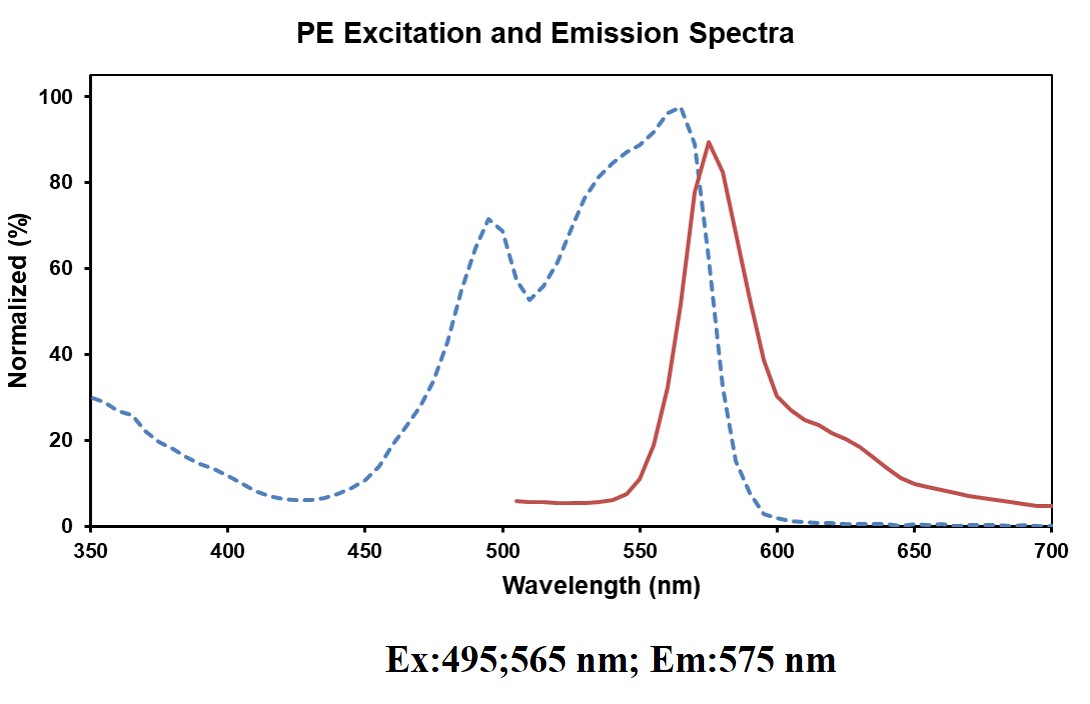
Spectrum:
Swissprot:
Q15116
Gene ID:
5133
Storage Buffer:
Phosphate buffered solution, pH 7.2, containing 0.09% stabilizer and 1% protein protectant.
Stability & Storage:
Keep as concentrated solution. Store at 2~8°C and protected from prolonged exposure to light. Do not freeze. Centrifuge before opening to ensure complete recovery of vial contents. This product is guaranteed up to one year from purchase.
Background:
Programmed cell death 1 (PD-1), also known as CD279, is a 55 kD member of the immunoglobulin superfamily. CD279 contains the immunoreceptor tyrosine-based inhibitory motif (ITIM) in the cytoplasmic region and plays a key role in peripheral tolerance and autoimmune disease. CD279 is expressed predominantly on activated T cells, B cells, and myeloid cells. PD-L1 and PD-L2 are ligands of CD279 (PD-1) and are members of the B7 gene family. Evidence suggests overlapping functions for these two PD-1 ligands and their constitutive expression on some normal tissues and upregulation on activated antigen-presenting cells. Interaction of CD279 ligands results in inhibition of T cell proliferation and cytokine secretion.

![PE Anti-Human CD279/PD-1 Antibody [EH12.2H7] (AGEL2723)](https://cdn11.bigcommerce.com/s-h68l9z2lnx/images/stencil/1280x1280/products/229873/599065/pe-anti-human-cd279pd-1-antibody-eh12.2h7__58101.1703614571.jpg?c=2?imbypass=on "PE Anti-Human CD279/PD-1 Antibody [EH12.2H7] (AGEL2723)")
![PE Anti-Human CD279/PD-1 Antibody [EH12.2H7] (AGEL2723)](https://cdn11.bigcommerce.com/s-h68l9z2lnx/images/stencil/608x608/products/229873/599065/pe-anti-human-cd279pd-1-antibody-eh12.2h7__58101.1703614571.jpg?c=2 "PE Anti-Human CD279/PD-1 Antibody [EH12.2H7] (AGEL2723)")
![FITC Anti-Human CD279/PD-1 Antibody [EH12.2H7] (AGEL3070)](https://cdn11.bigcommerce.com/s-h68l9z2lnx/images/stencil/590x590/products/229995/605042/fitc-anti-human-cd279pd-1-antibody-eh12.2h7-agel3070__10736.1706889168.jpg?c=2 "FITC Anti-Human CD279/PD-1 Antibody [EH12.2H7] (AGEL3070)")
![APC Anti-Human CD279/PD-1 Antibody [EH12.2H7] (AGEL2724)](https://cdn11.bigcommerce.com/s-h68l9z2lnx/images/stencil/590x590/products/229874/605353/apc-anti-human-cd279pd-1-antibody-eh12.2h7__18494.1706890138.jpg?c=2 "APC Anti-Human CD279/PD-1 Antibody [EH12.2H7] (AGEL2724)")
![PerCP/Cyanine5.5 Anti-Human CD279/PD-1 Antibody [EH12.2H7] (AGEL3158)](https://cdn11.bigcommerce.com/s-h68l9z2lnx/images/stencil/590x590/products/230032/605237/percpcyanine5.5-anti-human-cd279pd-1-antibody-eh12.2h7-agel3158__91098.1706889770.jpg?c=2 "PerCP/Cyanine5.5 Anti-Human CD279/PD-1 Antibody [EH12.2H7] (AGEL3158)")
![GenieFluor 700 Anti-Human CD279/PD-1 Antibody [EH12.2H7] (AGEL4567)](https://cdn11.bigcommerce.com/s-h68l9z2lnx/images/stencil/590x590/products/270673/693591/geniefluor-700-anti-human-cd279pd-1-antibody-eh12.2h7-agel4567__67596.1774509802.jpg?c=2 "GenieFluor 700 Anti-Human CD279/PD-1 Antibody [EH12.2H7] (AGEL4567)")
![Purified Anti-Human CD279 Antibody [EH12.2H7] (AGEL5100)](https://cdn11.bigcommerce.com/s-h68l9z2lnx/images/stencil/590x590/products/271104/693674/purified-anti-human-cd279-antibody-eh12.2h7-agel5100__06015.1774510049.jpg?c=2 "Purified Anti-Human CD279 Antibody [EH12.2H7] (AGEL5100)")