
Luciferase Assays
Luciferase Assays
Designed for Gene Expression Analysis
Explore our specialized bioluminescence tools used to measure gene expression, promoter activity, and cell viability with high sensitivity. They utilize luciferase enzymes (commonly firefly or Renilla) that emit light when oxidizing luciferin, allowing researchers to quantify biological processes in real time.

Explore Our Luciferase Assay Range
Nine systems in two categories. Choose what you are measuring: what a gene is doing, or how many cells are alive.
Quantify promoter activity and gene expression — from single-reagent HTS screening to dual-reporter normalisation.
Mono-Lux Luciferase Assay System
One reagent, direct lysis, no wash steps — the everyday choice for routine reporter screening and HTS.
Brite-Lux Luciferase Assay System
The fastest read in the range: a bright, direct-lysis signal ready two minutes after reagent addition.
Bio-Lux Luciferase Assay System
Tuned for cell-based potency and ADCC bioassays, with a glow window wide enough for full plate batches.
Stable-Lux Luciferase Assay System
Maximum signal stability for long, unattended runs and ultra-high-sensitivity reporter work.
Duo-Lux Luciferase Assay System
Firefly and Renilla from the same well in a simple 2-step protocol, with no sample processing.
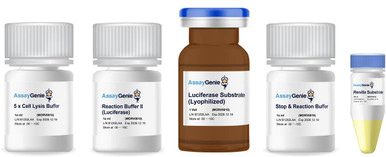
Dual Luciferase Reporter Assay Kit
Normalised firefly/Renilla results with 99.90% quenching efficiency — read immediately after substrate addition.
Measure viable cells by ATP in 2D and 3D culture, or image luciferase-expressing cells in living animals.
CellQuant-Lux 2.0 Luciferase Assay System
Count viable cells in 2D monolayer culture by measuring ATP as a luminescent signal.
CellQuant-Lux 3D Luciferase Assay System
Built for spheroids and organoids, so complex 3D models still give an accurate viable-cell count.
VivoGenie-Lux D-Luciferin In Vivo Salt
High-purity D-luciferin substrate for bioluminescence imaging (BLI) in live organisms.
Read our technical note
We ran our Dual Luciferase Reporter Assay Kit head-to-head against the market-standard system. Here is what came back.
Comparable performance, without the premium
Both kits quenched firefly luminescence almost completely before Renilla detection — 99.90% for MORV0010 against 99.95% for E1910 — and background luminescence was effectively matched at 680 RLU versus 639 RLU. MORV0010 gave slightly higher initial firefly signal, so gene-expression changes stay easy to resolve.
If you are running dual-luciferase assays as routine work, the technical note is worth reading before your next standing order.
Trusted by researchers worldwide
Serving academic and industry labs in more than 80 countries.
Assay Genie provided a critical ELISA kit that is very difficult to find on the market. Not only did this kit work dependably well, but it also provided me with the measurement sensitivity that I needed to evaluate my samples.
Erika, on Trustpilot
The support staff are very easy to deal with. The delivery is quick and efficient and the ELISA kits are great quality.
Amy O’Rahilly, on Trustpilot
Fast delivery
7–10 business day lead time on the Lux range.
Highly cited
Thousands of citations across leading scientific journals.
PhD-level support
Our team is trained to PhD level, so you talk to a scientist.
Why choose the Lux systems?
Bioluminescence chemistry tuned to the way plates actually get run.
High sensitivity
Wide dynamic range and low background luminescence, so small changes in expression are still real changes in signal.
Stable glow signal
A 30–55 minute glow half-life means a full plate — or a batch of plates — reads consistently from the first well to the last.
Reporter to in vivo
One supplier for single and dual reporters, ATP viability in 2D and 3D, and the D-luciferin substrate for live imaging.
Simple protocols
Direct lysis, homogeneous 1- and 2-step formats — add reagent, read plate, no sample processing.
How luciferase assays work
One light-producing reaction behind every system in the range.
Luciferase reporter enzymes (commonly firefly or Renilla) emit light when they oxidise a luciferin substrate. The light output is proportional to enzyme amount, so luciferase acts as a quantitative reporter of promoter activity, gene expression or, via ATP-dependent reactions, the number of viable cells.
Dual-luciferase formats express a second control luciferase to normalise for transfection efficiency, while D-luciferin salts enable bioluminescence imaging in living animals.
FAQs
What is a luciferase reporter assay used for?
It quantifies promoter or gene-expression activity by linking a gene of interest to a luciferase reporter; light output reflects expression levels.
Why use a dual-luciferase assay?
A dual-luciferase assay expresses a second control luciferase (e.g. Renilla alongside firefly) to normalise for transfection efficiency and sample variation, improving accuracy.
How does luciferase measure cell viability?
ATP-dependent luciferase reactions emit light in proportion to ATP, which reflects the number of metabolically active, viable cells — the basis of the CellQuant-Lux assays.
Which Lux system should I choose?
Start from the read-out. For routine reporter screening and HTS, Mono-Lux is the single-reagent workhorse; Brite-Lux is the fastest read and Stable-Lux the most signal-stable. For normalised firefly/Renilla data choose Duo-Lux or the Dual Luciferase Reporter Assay Kit. For cell-based potency and ADCC bioassays use Bio-Lux, for ATP viability CellQuant-Lux 2.0 (2D) or 3D (spheroids and organoids), and for imaging in live animals the VivoGenie-Lux D-luciferin salt.
What is the glow half-life and why does it matter?
The glow half-life is how long the luminescent signal stays stable after the detection reagent is added. Glow-type reagents like the Lux systems give a long-lived, slowly decaying signal rather than a brief flash — typically a 30 to 55 minute half-life across the range — so a full plate, or a batch of plates, can be read without the signal shifting appreciably between the first and last well. See each system's datasheet for its stated signal window.
How does the Assay Genie Dual Luciferase Reporter Assay Kit compare with Promega E1910?
In a head-to-head evaluation, MORV0010 quenched firefly luminescence at 99.90% against 99.95% for E1910, with comparable background luminescence (680 RLU vs 639 RLU) and slightly higher initial firefly signal — comparable dual-luciferase performance at a lower cost per kit. The full technical note is available to read on our site.
Choosing a luciferase workflow?
Tell our technical team about your reporter or viability application and we'll recommend the right Lux system.
Additional resources
Everything else you need alongside the assays — free to download.