
Luciferase Assays
Bright, flexible luciferase assays
Luciferase enzymes emit light as they oxidise luciferin, giving a fast, sensitive read-out of gene expression, promoter activity and cell viability. Our Lux systems span single-reagent reporters, dual-luciferase normalisation, ATP-based viability and in vivo imaging.
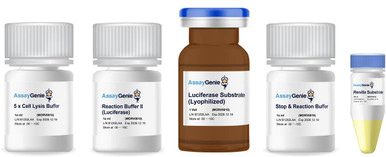


Which luciferase system is right for you?
From reporter-gene studies to ATP viability and in vivo imaging — the Lux range covers four application types. Use the filters below to browse the systems for each.
The Lux luciferase range
Filter by application or search by system name.
Why choose the Lux systems?
Sensitive bioluminescence tuned to your workflow.
High sensitivity
Bioluminescence gives a wide dynamic range and low background for confident quantitation.
Stable glow signal
Long-lived, slowly decaying luminescence supports batch processing and high-throughput plate reads.
Reporter to in vivo
Single and dual reporter assays, ATP viability and in vivo D-luciferin substrate.
Simple protocols
Direct-lysis, homogeneous 1- and 2-step formats with minimal sample handling.
How luciferase assays work
One light-producing reaction behind every system in the range.
Luciferase reporter enzymes (commonly firefly or Renilla) emit light when they oxidise a luciferin substrate. The light output is proportional to enzyme amount, so luciferase acts as a quantitative reporter of promoter activity, gene expression or, via ATP-dependent reactions, the number of viable cells.
Dual-luciferase formats express a second control luciferase to normalise for transfection efficiency, while D-luciferin salts enable bioluminescence imaging in living animals.
FAQs
What is a luciferase reporter assay used for?
It quantifies promoter or gene-expression activity by linking a gene of interest to a luciferase reporter; light output reflects expression levels.
Why use a dual-luciferase assay?
A dual-luciferase assay expresses a second control luciferase (e.g. Renilla alongside firefly) to normalise for transfection efficiency and sample variation, improving accuracy.
How does luciferase measure cell viability?
ATP-dependent luciferase reactions emit light in proportion to ATP, which reflects the number of metabolically active, viable cells — the basis of the CellQuant-Lux assays.
What is the glow half-life and why does it matter?
The glow half-life is how long the luminescent signal stays stable after the detection reagent is added. Glow-type reagents like the Lux systems give a long-lived, slowly decaying signal rather than a brief flash, so a full plate — or a batch of plates — can be read without the signal shifting appreciably between the first and last well. See each system's datasheet for its stated signal window.
Choosing a luciferase workflow?
Tell our technical team about your reporter or viability application and we'll recommend the right Lux system.