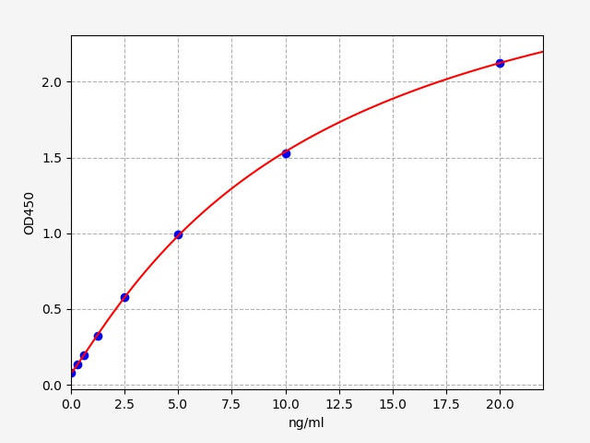
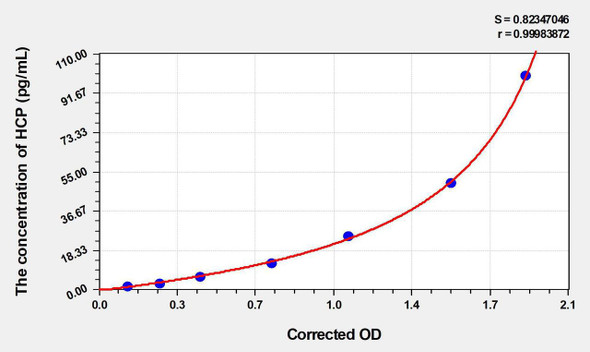
The CHO (Chinese hamster ovary) HCP (Host Cell Protein) ELISA Kit is a cutting-edge assay designed for the precise quantification of host cell proteins in CHO cell-derived biologics. This advanced kit allows for the accurate measurement of residual host cell proteins in bioprocessing samples, ensuring the purity and safety of biopharmaceutical products.CHO cells are commonly used in the production of recombinant proteins, monoclonal antibodies, and other biologics. However, residual host cell proteins in the final product can pose a risk to patients, potentially triggering immune responses or affecting the efficacy of the therapeutic protein. The CHO HCP ELISA Kit enables researchers and bioprocess developers to monitor and control host cell protein levels throughout the production process, ensuring the quality and regulatory compliance of biopharmaceutical products.
With its high sensitivity and specificity, the CHO HCP ELISA Kit offers reliable and reproducible results, making it an essential tool for bioprocess optimization, product characterization, and quality control. Whether in academic research, biopharmaceutical development, or bioprocess validation, this innovative kit provides a valuable solution for ensuring the safety and efficacy of CHO cell-derived biologic products.
Product Name:
CHO Host Cell Protein (HCP) ELISA Kit
Product Code:
AEFI01040
Size:
96T
Alias:
CHO HCPs, Chinese Hamster Ovary host cell proteins
Detection method:
Sandwich ELISA, Double Antibody
Application:
CHO HCPs ELISA Kit allows for the in vitro quantitative determination of residual CHO host cell protein concentrations in cell culture supernatant, bioreactor harvest material, downstream process intermediates (e.g. chromatography pools) and final drug substance.
Sensitivity:
< 0.188ng/ml
Range:
0.313-20ng/ml
Storage:
2-8°C for 6 months
Note:
For Research Use Only
Recovery:
Matrices listed below were spiked with certain level of CHO HCPs and the recovery rates were calculated by comparing the measured value to the expected amount of CHO HCPs in samples.
Matrix
Recovery range(%)
Average(%)
serum(n=5)
86-100
92
EDTA plasma(n=5)
86-103
95
heparin plasma(n=5)
85-97
93
Linearity:
The linearity of the kit was assayed by testing samples spiked with appropriate concentration of CHO HCPs and their serial dilutions. The results were demonstrated by the percentage of calculated concentration to the expected.
Sample
1:2
1:4
1:8
serum(n=5)
87-105%
87-99%
86-104%
EDTA plasma(n=5)
82-99%
92-96%
96-101%
heparin plasma(n=5)
82-99%
83-96%
84-95%
CV(%):
Intra-Assay: CV<8% Inter-Assay: CV<10%
To achieve the best possible results, samples should be clarified and appropriately diluted before assaying. Below are recommended procedures for the preparation of common bioprocess sample types.
Sample Type
Protocol
Cell culture supernatant / harvest material
Collect the cell culture media by pipette, followed by centrifugation at 4°C for 20 mins at 1500 rpm (or 0.22 µm filtration) to remove cells and debris. Collect the clear supernatant and dilute in sample diluent to fall within the assay range. Assay immediately or aliquot and store at -80°C. Avoid multiple freeze-thaw cycles.
Cell lysates
Solubilize cells in lysis buffer and allow to sit on ice for 30 minutes. Centrifuge tubes at 14,000 x g for 5 minutes to remove insoluble material. Aliquot the supernatant into a new tube and discard the remaining whole cell extract. Quantify total protein concentration using a total protein assay. Assay immediately or aliquot and store at ≤ -20 °C.
Downstream process intermediates
Dilute chromatography pools and other in-process samples (e.g. Protein A eluate, polishing step pools, UF/DF retentate) in sample diluent to fall within the assay range. Verify buffer compatibility: samples with extreme pH or high salt concentrations should be neutralized or buffer-exchanged prior to assaying. Assay immediately or aliquot and store at -80°C.
Drug substance / purified protein
Dilute purified protein samples in sample diluent to fall within the assay range. Assay at a minimum of two dilutions to confirm dilutional linearity in the sample matrix. Assay immediately or aliquot and store at -80°C. Avoid multiple freeze-thaw cycles.