Description
WASP Antibody (CAB0978)
The WASP Antibody (CAB0978) is a high-quality antibody developed for reliable detection and analysis of target proteins. This antibody, generated in rabbits, demonstrates high specificity and sensitivity for detecting WAS protein in human samples, making it an excellent choice for Western blot applications.WAS is a critical player in immune cell function and signaling, with mutations in the gene leading to the development of Wiskott-Aldrich Syndrome, a primary immunodeficiency disorder. By targeting the WAS protein, researchers can investigate its role in immune cell development, activation, and immune responses, providing insights into the pathogenesis of Wiskott-Aldrich Syndrome and other related disorders.
This antibody is validated for use in WB, ELISA applications and has demonstrated reactivity against Human samples.
| Product Name: | WASP Antibody |
| SKU: | CAB0978 |
| Size: | 20μL, 100μL |
| Reactivity: | Human |
| Conjugate: | Unconjugated |
| Immunogen: | Recombinant protein (or fragment).This information is considered to be commercially sensitive. | ||||
| Sequence: | GAEH WTKE HCGA VCFV KDNP QKSY FIRL YGLQ AGRL LWEQ ELYS QLVY STPT PFFH TFAG DDCQ AGLN FADE DEAQ AFRA LVQE KIQK RNQR QSGD RRQL PPPP TPAN EERR GGLP PLPL HPGG DQGG PPVG PLSL GLAT VDIQ NPDI TSSR YRGL PAPG PSPA DKKR SGKK KISK ADIG APSG FKHV SHV | ||||
| Tested Applications: | WB ELISA | ||||
| Recommended Dilution: |
| ||||
| Synonyms: | THC, IMD2, SCNX, THC1, WASP, WASPA |
| Positive Sample: | HL-60, THP-1, Ramos |
| Cellular Localization: | Cytoplasm, Cytoskeleton. |
| Calculated MW: | 53kDa |
| Observed MW: | 62kDa |
The Wiskott-Aldrich syndrome (WAS) family of proteins share similar domain structure, and are involved in transduction of signals from receptors on the cell surface to the actin cytoskeleton. The presence of a number of different motifs suggests that they are regulated by a number of different stimuli, and interact with multiple proteins. Recent studies have demonstrated that these proteins, directly or indirectly, associate with the small GTPase, Cdc42, known to regulate formation of actin filaments, and the cytoskeletal organizing complex, Arp2/3. Wiskott-Aldrich syndrome is a rare, inherited, X-linked, recessive disease characterized by immune dysregulation and microthrombocytopenia, and is caused by mutations in the WAS gene. The WAS gene product is a cytoplasmic protein, expressed exclusively in hematopoietic cells, which show signalling and cytoskeletal abnormalities in WAS patients. A transcript variant arising as a result of alternative promoter usage, and containing a different 5' UTR sequence, has been described, however, its full-length nature is not known.
| Purification Method | Affinity purification |
| Gene ID | 7454 |
| RRID | AB_2757497 |
| Buffer Information | Store at -20℃. Avoid freeze / thaw cycles. Buffer: PBS containing 50% glycerol, preserved with proclin300 or sodium azide, pH 7.3. |
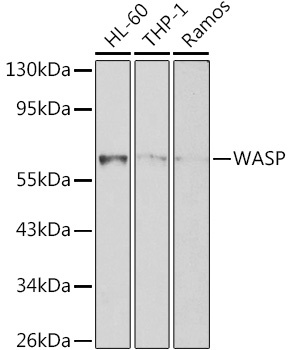 | Western blot analysis of various lysates using WASP Rabbit pAb (CAB0978) at 1:1000 dilution. Secondary antibody: HRP-conjugated Goat anti-Rabbit IgG (H+L) (CABS014) at 1:10000 dilution. Lysates/proteins: 25μg per lane. Blocking buffer: 3% nonfat dry milk in TBST. Detection: ECL Basic Kit (AbGn00020). |