The Coenzyme NAD Monoclonal Antibody (CAB21047) is a high-quality antibody developed for reliable detection and analysis of target proteins. This antibody, produced in rabbits, is highly specific and reactive with human samples, making it suitable for a wide range of applications in the study of NAD+ biology.Coenzyme NAD+ is a key player in cellular redox reactions, DNA repair, and cell signaling pathways, making it a crucial molecule in physiological and pathological processes. The Anti-Coenzyme NAD+ Antibody binds specifically to NAD+, enabling precise detection and analysis in various cell types and tissues.
This antibody is validated for use in ELISA, DB applications and has demonstrated reactivity against Species independent samples.
Product Name:
Coenzyme NAD Monoclonal Antibody
SKU:
CAB21047
Size:
20μL, 100μL
Reactivity:
Species independent
Clone Number:
ARC51050
Conjugate:
Unconjugated
Immunogen:
Chemical compounds corresponding to Coenzyme.
Tested Applications:
ELISADB
Recommended Dilution:
DB
1:500 - 1:1000
ELISA
Recommended starting concentration is 1 μg/mL. Please optimize the concentration based on your specific assay requirements.
Observed MW:
Refertofigures
The coenzyme NAD is involved in oxidation–reduction reactions critical for glycolysis, fatty acid oxidation, the TCA cycle, and complex I of the mitochondrial respiratory chain and also is a key regulator of autophagy. At least two different mechanisms are involved. First, the NAD+-dependent deacetylase SIRT1 activates autophagy by directly deacetylating ATG proteins. Under starvation conditions, the increased NAD+/NADH ratio activates SIRT1, which results in stimulation of mitophagy. Second, the hydrogen of NADH can be transferred to NADP+ to form NADPH via the energy-linked transhydrogenase. In the fed state, when the NAD+/NADH ratio falls, NADPH inhibits autophagy by scavenging of ROS via the glutathione peroxidase-glutathione reductase system and by preventing the production of ROS at complex 1 of the respiratory chain.
Purification Method
Affinity purification
Gene ID
CAS:53-84-9
Buffer Information
Store at -20℃. Avoid freeze / thaw cycles. Buffer: PBS containing 50% glycerol and 0.05% BSA, preserved with proclin300 or sodium azide, pH 7.3.
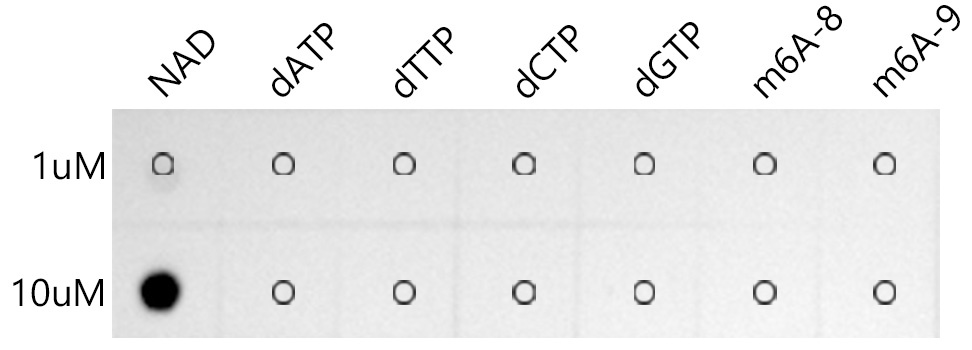
The Coenzyme NAD Rabbit mAb (CAB21047) are tested in Dot Blot against NAD and deoxynucleotide,adenosine. m6A 8 - ATAACTGG-m6A-CCGAATGG m6A 9 - ATAACTGGACCGAATGG



![Anti-Acetyl Coenzyme A Carboxylase [R08-8F4] Monoclonal Antibody (AGMB00892)](https://cdn11.bigcommerce.com/s-h68l9z2lnx/images/stencil/590x590/products/272181/690925/anti-acetyl-coenzyme-a-carboxylase-r08-8f4-monoclonal-antibody-agmb00892__96097.1774501395.jpg?c=2 "Anti-Acetyl Coenzyme A Carboxylase [R08-8F4] Monoclonal Antibody (AGMB00892)")
![Anti-Methylmalonyl Coenzyme A mutase [R01-2J-5] Monoclonal Antibody (AGMB03847)](https://cdn11.bigcommerce.com/s-h68l9z2lnx/images/stencil/590x590/products/275136/676417/anti-methylmalonyl-coenzyme-a-mutase-r01-2j-5-monoclonal-antibody-agmb03847__35537.1773029411.jpg?c=2 "Anti-Methylmalonyl Coenzyme A mutase [R01-2J-5] Monoclonal Antibody (AGMB03847)")
![Anti-Acetyl Coenzyme A Carboxylase [R07-2G8] Monoclonal Antibody (AGMB01979)](https://cdn11.bigcommerce.com/s-h68l9z2lnx/images/stencil/590x590/products/273268/680203/anti-acetyl-coenzyme-a-carboxylase-r07-2g8-monoclonal-antibody-agmb01979__77547.1773041313.jpg?c=2 "Anti-Acetyl Coenzyme A Carboxylase [R07-2G8] Monoclonal Antibody (AGMB01979)")
![Anti-Methylmalonyl Coenzyme A mutase [R05-3G4] Monoclonal Antibody (AGMB02224)](https://cdn11.bigcommerce.com/s-h68l9z2lnx/images/stencil/590x590/products/273513/676569/anti-methylmalonyl-coenzyme-a-mutase-r05-3g4-monoclonal-antibody-agmb02224__39375.1773029891.jpg?c=2 "Anti-Methylmalonyl Coenzyme A mutase [R05-3G4] Monoclonal Antibody (AGMB02224)")

