The NRCAM Antibody (CAB20160) is a high-quality antibody developed for reliable detection and analysis of target proteins. This antibody, produced in rabbits, exhibits high specificity and reactivity towards human samples, making it a reliable tool for various research applications such as immunohistochemistry and Western blotting.NRCAM is known for its involvement in cell adhesion, axon guidance, and synaptic plasticity in the nervous system. Its dysregulation has been linked to neurological disorders such as schizophrenia, autism, and Alzheimer's disease.
This antibody is validated for use in WB, ELISA applications and has demonstrated reactivity against Human, Mouse samples.
Product Name:
NRCAM Antibody
SKU:
CAB20160
Size:
20μL, 100μL
Reactivity:
Human, Mouse
Conjugate:
Unconjugated
Immunogen:
Recombinant protein (or fragment).This information is considered to be commercially sensitive.
Recommended starting concentration is 1 μg/mL. Please optimize the concentration based on your specific assay requirements.
Synonyms:
NEDNMS, NRCAM
Positive Sample:
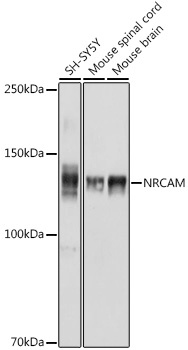
SH-SY5Y, Mouse spinal cord, Mouse brain
Cellular Localization:
Axon, External Side Of Plasma Membrane, Extracellular Region, Glutamatergic Synapse, Neuron Projection, Plasma Membrane, Postsynaptic Density Membrane.
Calculated MW:
144kDa
Observed MW:
140kDa
Cell adhesion molecules (CAMs) are members of the immunoglobulin superfamily. This gene encodes a neuronal cell adhesion molecule with multiple immunoglobulin-like C2-type domains and fibronectin type-III domains. This ankyrin-binding protein is involved in neuron-neuron adhesion and promotes directional signaling during axonal cone growth. This gene is also expressed in non-neural tissues and may play a general role in cell-cell communication via signaling from its intracellular domain to the actin cytoskeleton during directional cell migration. Allelic variants of this gene have been associated with autism and addiction vulnerability. Alternative splicing results in multiple transcript variants encoding different isoforms.
Purification Method
Affinity purification
Gene ID
4897
RRID
AB_2862947
Buffer Information
Store at -20℃. Avoid freeze / thaw cycles. Buffer: PBS with 0.01% thimerosal,50% glycerol,pH7.3.
Western blot analysis of various lysates using NRCAM Rabbit pAb (CAB20160) at 1:1000 dilution. Secondary antibody: HRP-conjugated Goat anti-Rabbit IgG (H+L) (CABS014) at 1:10000 dilution. Lysates/proteins: 25μg per lane. Blocking buffer: 3% nonfat dry milk in TBST. Detection: ECL Basic Kit (AbGn00020). Exposure time: 1s.