
mRNA-1010 and Beyond: How Moderna's mRNA Platform is Revolutionizing Hantavirus Vaccine Development
Hantavirus, a silent threat lurking in rodent populations, has long posed a significant public health challenge with its severe and often fatal outcomes. For decades, the quest for effective vaccines has been a scientific priority. Now, a new era of vaccine development is dawning, spearheaded by revolutionary mRNA technology, promising unprecedented speed and efficacy in our fight against this elusive pathogen.
Introduction
Orthohantaviruses, commonly known as hantaviruses, are a group of zoonotic viruses responsible for two severe human diseases: Hemorrhagic Fever with Renal Syndrome (HFRS) in Eurasia and Hantavirus Pulmonary Syndrome (HPS) in the Americas. These illnesses carry high fatality rates, ranging from 1% to a staggering 50%, underscoring the urgent need for robust preventive measures. The absence of specific antiviral treatments post-exposure makes vaccine development critically important. Historically, efforts have focused on inactivated vaccines, but their limitations in inducing strong, long-lasting immunity have paved the way for more advanced approaches. Nucleic acid vaccines, including both DNA and mRNA platforms, are now at the forefront of this research, offering rapid design, potent immune responses, and adaptable production capabilities, positioning them as the future of orthohantavirus prevention Nucleic acid vaccines show greatest future potential.
Supporting Research: Hantavirus Detection & Serology
As vaccine development advances, accurate diagnostic tools become essential for monitoring vaccine effectiveness and tracking hantavirus epidemiology. Our comprehensive ELISA kits support clinical trials and epidemiological surveillance with reliable hantavirus antibody detection.
Human Serology Solutions: The Human Hanta Virus Antibody ELISA Kit enables qualitative screening of HV-specific antibodies in patient sera, critical for clinical vaccine trials and epidemiological monitoring.
Human HV Antibody Kit →The mRNA Advantage: A New Paradigm for Vaccine Speed and Efficacy
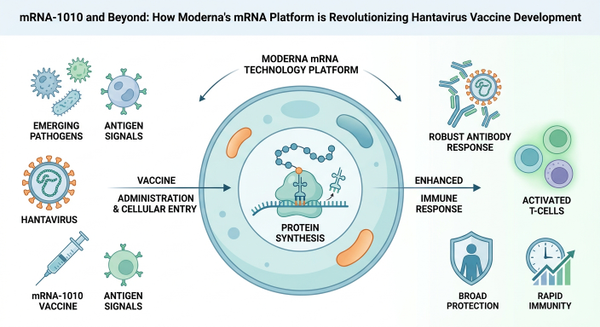
The advent of messenger RNA (mRNA) technology has revolutionized vaccinology, most notably demonstrated during recent global health crises. This platform offers unparalleled speed in design and manufacturing, crucial for responding to emerging viral threats like hantavirus. Unlike traditional vaccines, mRNA vaccines instruct the body's cells to produce viral proteins, triggering a robust immune response without introducing the live virus. This approach not only enhances safety but also allows for rapid adaptation to viral mutations. Researchers are now leveraging these inherent advantages to develop next-generation hantavirus vaccines. The potential for mRNA to elicit strong T-helper 1 cell immune responses is particularly promising, as this type of cellular immunity is vital for clearing viral infections and providing long-term protection mRNA vaccines induce strong T-helper 1 responses. This shift towards mRNA platforms represents a significant leap forward, moving beyond the limitations of older vaccine technologies.
Targeting the Andes Virus: Pioneering mRNA-Based Protection
Among the various hantaviruses, the Andes virus (ANDV) is particularly concerning due to its association with HPS and documented human-to-human transmission. Developing an effective vaccine against ANDV is therefore a high priority. Recent studies have explored different mRNA platforms for an ANDV vaccine, focusing on the M segment of the viral genome. Researchers compared vaccines utilizing regular uridine (U-mRNA) and N1-methylpseudouridine (m1Ψ-mRNA). While m1Ψ-mRNA initially showed slightly greater germinal center responses, both platforms demonstrated remarkable efficacy. Importantly, both U-mRNA and m1Ψ-mRNA constructs provided robust protection against lethal ANDV challenge in animal models, with vaccinated subjects surviving without evidence of viral replication. This groundbreaking work highlights the potential of mRNA technology to provide effective immunity against ANDV, paving the way for clinical translation mRNA platforms provide robust protection against Andes virus.
Pre-Clinical Vaccine Evaluation: Animal Model Screening
ANDV vaccine development relies heavily on animal models to assess immune responses before human trials. Our species-specific ELISA kits provide precise antibody detection in both mouse and rat models, essential for comprehensive immune profiling.
Animal Model Solutions:
Mouse HV Antibody ELISA
Ideal for initial screening of vaccine candidates and ANDV challenge studies
View Kit →Hantaan Virus Glycoproteins: The Key to Potent Antibody Responses
For Old World orthohantaviruses like the Hantaan virus (HTNV), which causes HFRS, the focus has been on glycoprotein-based nucleic acid vaccines. Glycoproteins on the viral surface are critical targets for neutralizing antibodies, which can block viral entry into host cells. A significant advancement involves the use of prefusion-stabilized HTNV glycoproteins in nucleic acid vaccines. Both DNA and mRNA-LNP (lipid nanoparticle) versions of these vaccines have been shown to elicit potent neutralizing antibody responses by vigorously activating germinal centers, the sites where B cells mature and produce high-affinity antibodies. This strong antibody induction protected mice from high-dose HTNV challenge Prefusion-stabilized glycoproteins elicit potent neutralizing antibodies. Furthermore, these prefusion-stabilized glycoprotein mRNA-LNP vaccines proved superior in boosting memory B cell responses, even when used as boosters after initial immunization with less effective inactivated vaccines, showcasing their potential to enhance existing vaccine strategies.
Detailed Immune Analysis: IgG & IgM Specific Detection
Understanding vaccine-induced immunity requires distinguishing between different antibody classes. IgM antibodies indicate recent immune activation, while IgG reflects durable long-term protection. Our isotype-specific ELISA kits enable comprehensive assessment of vaccine quality and duration of protection.
Human Isotype-Specific Kits:
Comprehensive Animal Model Profiling: For detailed immune characterization in mouse and rat studies:
Beyond mRNA: A Multi-pronged Approach to Hantavirus Prevention
While mRNA technology is rapidly advancing, other nucleic acid vaccine approaches, such as DNA vaccines, also contribute significantly to the hantavirus prevention landscape. Clinical trials have demonstrated that Andes virus DNA vaccines delivered by electroporation are safe and induce robust, durable immune responses in humans DNA vaccines demonstrate safety and robust immunogenicity. These findings underscore the versatility of nucleic acid platforms in general. Moreover, research into specific and versatile monoclonal antibodies offers another promising avenue for both prevention and treatment of Hantavirus Pulmonary Syndrome. These antibodies can directly neutralize the virus, providing immediate protection or therapeutic intervention Novel monoclonal antibodies target hantavirus pulmonary syndrome. The combination of these diverse strategies, from cutting-edge mRNA vaccines to targeted monoclonal antibodies, creates a comprehensive arsenal against hantavirus infections.
A Future Revolutionized by mRNA in Hantavirus Defense
The landscape of hantavirus vaccine development is undergoing a profound transformation, largely driven by the innovative power of Moderna's mRNA platform and similar nucleic acid technologies. From the rapid design capabilities to the induction of potent and broad immune responses, mRNA vaccines are proving to be a game-changer. The successful development of protective mRNA vaccines against both Andes and Hantaan viruses, alongside promising DNA vaccine trials and novel monoclonal antibody therapies, paints a hopeful picture for the future. As research continues to advance, particularly with the integration of computational biology and artificial intelligence, we are moving closer to a future where hantavirus infections can be effectively prevented and treated, safeguarding global public health against this persistent threat.
References
- Ye W, Dang Y, Wang Y, et al. (2026). Prefusion-stabilized Hantaan virus glycoprotein nucleic acid vaccine elicits potent neutralizing antibody responses via germinal center activation. Nature Communications. 17(1):3972. PMID: 41832144
- Kuzmin IV, Acosta RS, Pruitt L, et al. (2024). Comparison of uridine and N1-methylpseudouridine mRNA platforms in development of an Andes virus vaccine. Nature Communications. 15(1):6421. PMID: 39080316
- Zhang J, Zhang J, Wang Y, et al. (2024). A comprehensive investigation of Glycoprotein-based nucleic acid vaccines for Hantaan Virus. NPJ Vaccines. 9(1):196. PMID: 39443512
- Chai S, Wang L, Du H, et al. (2025). Achievement and Challenges in Orthohantavirus Vaccines. Vaccines (Basel). 13(2):198. PMID: 40006744
- Paulsen GC, et al. (2024). Safety and Immunogenicity of an Andes Virus DNA Vaccine by Electroporation: A Phase 1 Clinical Trial. The Journal of Infectious Diseases. 229(4):1047-1055. PMID: 37380156
- LaPointe A, et al. (2025). Specific and versatile monoclonal antibodies for hantavirus pulmonary syndrome. Science Translational Medicine. 17(784):eadj9123. PMID: 41288105
Recent Posts
-

Combien coûte réellement un anticorps de recherche ?
Combien coûte réellement un anticorps de recherche ? Prévoyez un budget de 130 à 2 500 dollars par …20th Sep 2026 -

Problemas ELISA: guía práctica para diagnosticar y corregir fallos
Problemas ELISA: guía práctica para diagnosticar y corregir fallos Ante un resultado inesperado, lo …20th Sep 2026 -

Cytokine-Storm-Panel: Analyten, Auswahl und Interpretation
Cytokine-Storm-Panel: Analyten, Auswahl und Interpretation Ein Cytokine-Storm-Panel ist ein vorvali …20th Sep 2026