
Questions About Dilutions? A Real Example of How to Prepare Your ELISA Solutions
A researcher preparing a Human IL-18 ELISA wasn't sure whether the protocol's “300-fold” HRP-Streptavidin step meant adding 40 µL of concentrate to 12 mL of diluent, or to a total of 12 mL. A fold dilution always describes the final total volume, not the diluent alone. For a 300-fold dilution you combine 1 part concentrate (40 µL) with 299 parts diluent (11,960 µL) to reach 12 mL total — so 40 µL HRP-Streptavidin + 11,960 µL Assay Diluent = 12 mL. The worked example's rounded “12 mL diluent” wording was the source of the confusion.
The problem
A researcher had just received a Human IL-18 ELISA kit and was working through reagent preparation when two parts of the manual seemed to disagree. The protocol described its dilutions as “5-fold”, “80-fold” and “300-fold”, but the worked HRP-Streptavidin example read as though the fold value multiplied onto the diluent volume — “add 40 µL of concentrate to 12 mL of Assay Diluent.” With only one kit on hand, they wanted to be certain they prepared the working detection reagent exactly as intended before committing samples.
Snapshot of the data
Here are the two ways the 300-fold HRP-Streptavidin step can be read. Only one matches the definition of a fold dilution.
| Interpretation | Concentrate | Diluent | Total volume | Correct? |
| “Fold” multiplies the diluent | 40 µL | 12,000 µL | 12,040 µL | No |
| “Fold” is the total volume | 40 µL | 11,960 µL | 12,000 µL (12 mL) | Yes |
And the same logic applied consistently across the protocol's dilution steps:
| Dilution | 1 part concentrate | + parts diluent | = total |
| 5-fold (Assay Diluent B) | 15 mL | 60 mL water | 75 mL 1X diluent |
| 80-fold | 1 part | 79 parts | 80 parts |
| 300-fold (HRP-Streptavidin) | 40 µL | 11,960 µL | 12,000 µL (12 mL) |
Values are illustrative and rounded to show the method; follow the concentrations and volumes in your kit's current lot-specific manual.
Why it happens
“Fold” is a ratio that describes the finished solution, not an instruction to add that multiple of diluent. A 300-fold dilution means the concentrate ends up at one three-hundredth of the final volume — 1 part in 300 parts total. The trouble starts when a worked example rounds “11,960 µL of diluent to a 12 mL total” down to “12 mL of diluent.” At these volumes the 40 µL of concentrate is almost negligible, so the numbers look close — but read literally, the shorthand flips the meaning of the fold and invites a small, avoidable prep error.
Our analysis
We confirmed the researcher's reading of a fold dilution was correct. For the detection reagent: 40 µL × 300 = 12,000 µL total, and because the concentrate is part of that total, the diluent is 12,000 − 40 = 11,960 µL. We then worked through the other follow-ups in the same case:
Running samples neat. Undiluted samples can be run, but we recommend a small preliminary test on one or two samples first to confirm they read on-curve. The serum/plasma diluent (Assay Diluent A) is ready-to-use and contains no component the assay needs beyond providing the correct matrix and dilution.
Sensitivity. The kit's minimum detectable dose is established empirically by the lab from known concentrations and serial dilutions; treat any figure below that as a reference floor and validate your own LOD/LLOQ for your samples. As a general QC rule, replicate wells should agree within a 20% CV.
Root cause
This was not a kit fault — it was a units ambiguity in the reagent-prep example. The line “12 mL diluent” should read “11,960 µL diluent to a 12 mL total.” Once every dilution is read as total volume, the fold language and the worked numbers agree perfectly.
What we recommended
Read every “X-fold” as 1 part concentrate + (X−1) parts diluent = X parts total.
Prepare HRP-Streptavidin as 40 µL concentrate + 11,960 µL Assay Diluent = 12 mL total.
If running samples neat, pilot 1–2 samples first to confirm they read on-curve before committing the plate.
Establish your own LOD/LLOQ empirically; treat the manual's minimum detectable dose as a reference floor, not a guarantee.
Key takeaway
When a protocol says “X-fold”, that number is the final total volume ratio — the diluent is the total minus the concentrate. Check any worked example against that rule before you pipette. For step-by-step reagent-prep and data-analysis guidance, see the ELISA Support Hub →
FAQ
Does a “300-fold dilution” mean 300× the diluent?
No. It means the concentrate is 1 part in 300 parts total. For 40 µL of concentrate that's 12,000 µL total — made up of 40 µL concentrate + 11,960 µL diluent.
How much diluent do I add for the HRP-Streptavidin working solution?
11,960 µL of Assay Diluent, plus the 40 µL of HRP-Streptavidin concentrate, for 12 mL (12,000 µL) total.
Can I run my samples undiluted?
Yes, but run a quick pilot on one or two samples first to confirm they fall on the standard curve. If signals are off-scale, dilute and repeat.
How is the kit's minimum detectable dose determined?
Empirically, in the lab, from known concentrations and serial dilutions. Treat it as a reference floor and validate your own LOD/LLOQ for your specific sample type.
Calculating & Analyzing ELISA Data →
Sandwich ELISA: Step-by-Step Protocol & Troubleshooting →
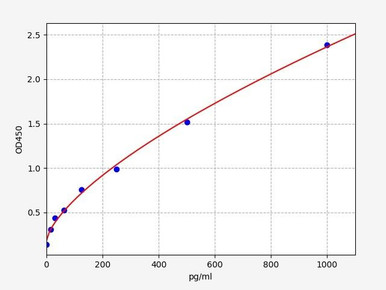
SKU: HUFI00011
| Detection range | 15.625–1000 pg/mL |
| Sensitivity (MDD) | 9.375 pg/mL |
| Sample types | Serum, plasma, cell culture supernatant, lysates |
| Price | $857 USD |
Stuck on a reagent-prep or dilution step?
Our scientific support team is happy to check your calculations before you run the plate.
This post is based on an anonymized technical-support case and is provided for general guidance only. Sample data shown is illustrative. Always follow the concentrations, volumes and acceptance criteria in the lot-specific manual supplied with your kit, and validate assay performance for your own samples.
Recent Posts
-
8-OHdG/Creatinine Ratio Too High? Urine ELISA Troubleshooting
Quick answer A researcher running an 8-OHdG ELISA and a creatinine ELISA on human ur …23rd Sep 2026 -
Do Not Eat Me Is Not a Switch
Phagocytosis is a subtraction, not a switch. A macrophage engulfs when its activating signals excee …23rd Sep 2026 -
One Cytokine, Two Opposite Clinical Effects
Low-dose IL-2 expands regulatory T cells. High-dose IL-2 expands the cells they exist to restrain. …23rd Sep 2026