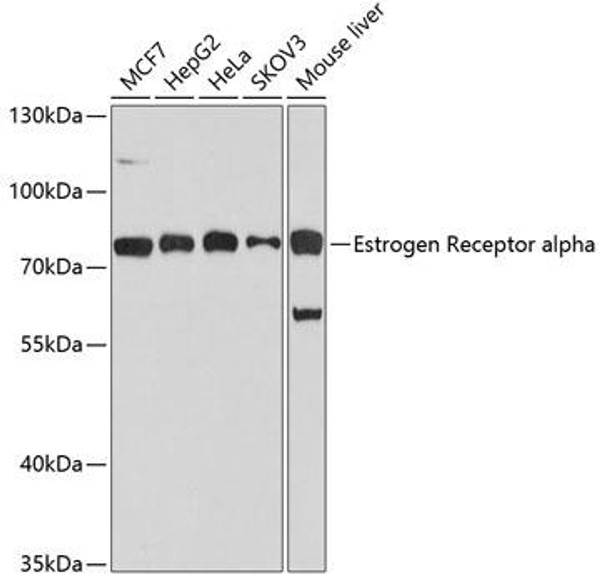
The ESRalpha Antibody (CAB0296) is a high-quality antibody developed for reliable detection and analysis of target proteins. This antibody, produced in rabbits, is highly specific for detecting estrogen receptor in human samples and is validated for use in Western blot applications. By binding to the estrogen receptor protein, this antibody allows for precise detection and analysis in a variety of cell types, making it ideal for studies in endocrinology, cancer research, and reproductive biology.The estrogen receptor plays a crucial role in mediating the effects of estrogen on target tissues, influencing a wide range of physiological processes such as cell proliferation, differentiation, and survival.
This antibody is validated for use in WB, ELISA applications and has demonstrated reactivity against Human, Mouse samples.
Product Name:
ESRalpha Antibody
SKU:
CAB0296
Size:
20μL, 100μL
Reactivity:
Human, Mouse
Conjugate:
Unconjugated
Immunogen:
Recombinant protein (or fragment).This information is considered to be commercially sensitive.
Recommended starting concentration is 1 μg/mL. Please optimize the concentration based on your specific assay requirements.
Synonyms:
ER, ESR, Era, ESRA, ESTRR, NR3A1, ESRα
Positive Sample:
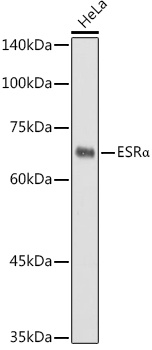
HeLa
Cellular Localization:
Cell Membrane, Cytoplasm, Cytoplasmic Side, Cytoplasmic Side, Golgi Apparatus, Nucleus, Peripheral Membrane Protein, Single-Pass Type I Membrane Protein.
Calculated MW:
66kDa
Observed MW:
66kDa
This gene encodes an estrogen receptor and ligand-activated transcription factor. The canonical protein contains an N-terminal ligand-independent transactivation domain, a central DNA binding domain, a hinge domain, and a C-terminal ligand-dependent transactivation domain. The protein localizes to the nucleus where it may form either a homodimer or a heterodimer with estrogen receptor 2. The protein encoded by this gene regulates the transcription of many estrogen-inducible genes that play a role in growth, metabolism, sexual development, gestation, and other reproductive functions and is expressed in many non-reproductive tissues. The receptor encoded by this gene plays a key role in breast cancer, endometrial cancer, and osteoporosis. This gene is reported to have dozens of transcript variants due to the use of alternate promoters and alternative splicing, however, the full-length nature of many of these variants remain uncertain.
Purification Method
Affinity purification
Gene ID
2099
RRID
AB_2757108
Buffer Information
Store at -20℃. Avoid freeze / thaw cycles. Buffer: PBS containing 50% glycerol, preserved with proclin300 or sodium azide, pH 7.3.
Western blot analysis of lysates from HeLa cells, using ESRα Rabbit pAb (CAB0296) at 1:500 dilution. Secondary antibody: HRP-conjugated Goat anti-Rabbit IgG (H+L) (CABS014) at 1:10000 dilution. Lysates/proteins: 25μg per lane. Blocking buffer: 3% nonfat dry milk in TBST. Detection: ECL Basic Kit (AbGn00020). Exposure time: 180s.